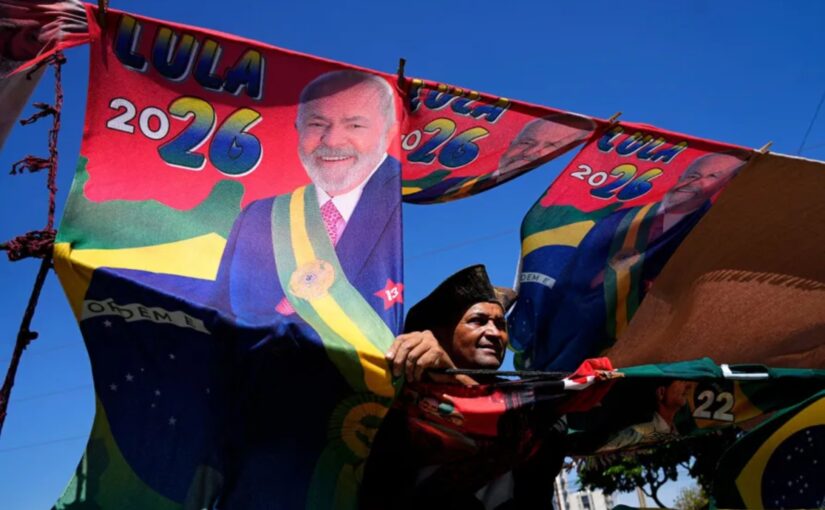
With just a few days to go before Brazil’s presidential runoff on 25 October, Invent the Future reporter Sara Vivacqua speaks to Isabel dos Anjos Leandro – Brazilian political scientist, long-standing Workers’ Party (PT) activist and political educator from Minas Gerais – about what’s at stake.
They discuss the open campaign of US pressure on Brazil’s election and its links to the Bolsonaro family; the surprise first-round result, in which Flávio Bolsonaro edged ahead of Lula; where Lula can find the votes to win, from the undecided to the millions who abstained; the grassroots campaign spreading beyond the party and onto social media; what is really driving the Bolsonaro vote; and why a Flávio Bolsonaro victory, alongside a far-right Congress, would threaten the 1988 Constitution and the independence of the Supreme Court.
The interview is in Portuguese with English subtitles; an English translation of the transcript is below.
Sara Vivacqua: Today I’m here with Isabel dos Anjos Leandro, a Brazilian political scientist with a doctorate and post-doctorate, and a long-standing activist in the Workers’ Party, with a background in political education, party strategy and programme development.
Isabel is currently coordinator of Lula’s presidential campaign in Minas Gerais, and also works as a parliamentary adviser in Minas Gerais.
Isabel, thank you for joining us today here on Invent the Future.
Brazil goes to the polls on 25 October in a presidential runoff between Luiz Inácio Lula da Silva and Flávio Bolsonaro, son of the jailed former president Jair Bolsonaro. In this contribution to an International Manifesto Group webinar on the Brazilian elections, Carlos Martinez argues that the outcome matters far beyond Brazil’s borders: the election is a front line in the struggle between a declining US-led imperialist system and a rising multipolar world.
The talk sets out the “Trump Corollary” to the Monroe Doctrine and Washington’s campaign of tariffs, sanctions, terrorist designations and alleged foreign financing against Lula’s Brazil; contrasts it with China’s partnership in trade, investment and industrial development; and looks at what a Bolsonaro government would mean for BRICS, for Palestine and Iran, and for the Global South.
Other speakers know far more than I do about Brazil’s domestic dynamics, so I’ll focus on what this election means for the wider Latin American region, for China, for BRICS, and for this overall, historic struggle between a declining US-led imperialist system and a rising multipolar world.
It’s my view that, of all the elections in the Americas this year, this is the one whose outcome matters most to the Trump regime, which is why it has been so flagrantly interfering, as we’ve been hearing. And the election is of critical importance to the Global South as well, essentially for the same reasons: Brazil is currently on the front line in this war between imperialism and multipolarity.
The Donroe Doctrine
The US National Security Strategy, published last December, promises to “assert and enforce a ‘Trump Corollary’ to the Monroe Doctrine”, and to “reward and encourage the region’s governments, political parties, and movements broadly aligned with our principles and strategy”.
A few analysts interpreted this document as a sort of retreat into the US’s traditional backyard. But the criminal war on Iran, launched a couple of months later, in February this year, shows that the US is not retreating from anywhere. The document is about consolidating the Americas as a secure rear base for a long campaign against China, against Russia, against Iran, and against the peoples of the Global South more generally.
We’ve already seen what this ‘Trump Corollary’ looks like in reality. Venezuelan President Nicolás Maduro has been kidnapped, along with First Combatant Cilia Flores. The US is attempting to impose control over Venezuela’s abundant oil resources.
A talk given by Carlos Martinez to the Young Communist League’s Harry Pollitt School, on China’s international strategy on climate and the environment.
Carlos looks at what’s actually happening on the ground: China’s solar capacity has overtaken coal for the first time, its carbon emissions have been flat or falling for nearly two years, and it’s now exporting that green transition to the Global South – financing solar and wind projects across Africa, helping Cuba keep the lights on through a brutal US blockade, and making clean energy cheap enough for the rest of the world to actually use. The talk sets this against the record of the imperialist powers, and makes the case that China’s record isn’t an accident, but the product of a planned, socialist economy.
Transcript
Comrades, thank you very much for inviting me, and thanks to the Young Communist League for organising this year’s Harry Pollitt School – and for supporting the Socialist China Conference last weekend.
I’ve been asked to talk about China’s international strategy in relation to the environment.
Starts at home
China’s international role rests on what it has done at home, so let me start there briefly.
For years we were told that China was the world’s greatest climate villain – the biggest emitter of greenhouse gases; building coal plants left, right and centre.
It’s true, China is overall the world’s biggest emitter of greenhouse gases – albeit it’s a very large country with a population of 1.4 billion people, and a manufacturing powerhouse that engages in a great deal of industry, and its per capita emissions are half those of the United States or Canada.
It’s also true that China still burns more than half the world’s coal.
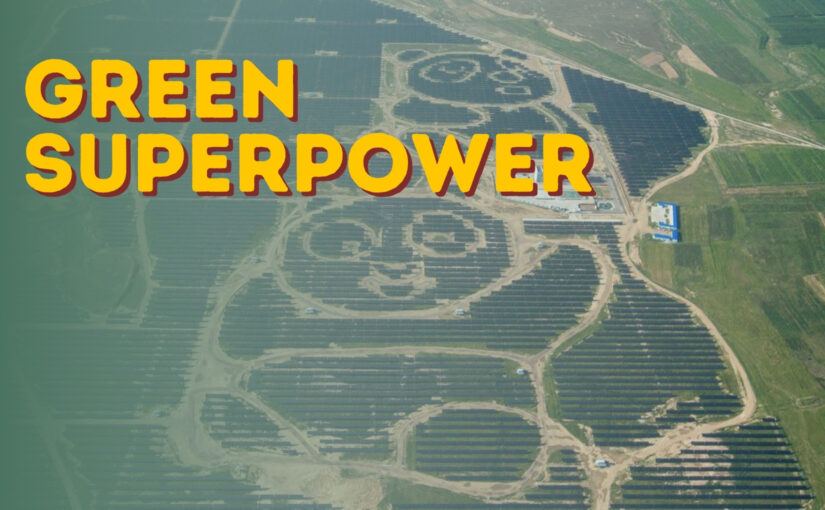
But there is an unmistakeable direction of travel. In July, China’s installed solar capacity overtook coal for the first time, reaching 1,286 gigawatts – around ten times Britain’s entire generating capacity from all sources. Coal has gone from around 80 percent of China’s energy mix a few decades ago to under 50 percent today, and this number continues to fall. Where new coal stations are built, these are typically to provide backup capacity for intermittent renewable sources, which means they’re playing an important role in the energy transition. In 2025, China added more solar than the rest of the world combined.
China’s carbon emissions have now been flat or falling for nearly two years. And last year, for the first time, China committed to an absolute cut in emissions: 7 to 10 percent below peak by 2035.
As is well known, China is by far the world leader in electric vehicles, electric buses, high-speed rail, batteries, solar panels, wind turbines and other clean energy technologies.
None of this happened by accident. Carbon Brief recently went through the 72 thematic five-year plans published by Chinese ministries this year, and found that 54 of them – three quarters – include policies or targets related to climate change and energy. Decarbonisation in China runs through the whole system of economic planning.
That’s possible because the commanding heights of the economy are in public hands, because the major banks are state-owned, because even the private economy is regulated and incorporated into the planning system, and because economic priorities are connected to the long-term needs of society rather than the pursuit of short-term profit.
Affordable and renewable
The single biggest contribution China has made to the global fight against climate breakdown is something fairly prosaic: it has made clean energy cheap.
Over the last 15 years, the global cost of solar power has fallen by more than 80 percent, and wind by around 60 percent, almost exclusively the result of Chinese investment, innovation and scale. As Kevin Tu of Columbia University put it, “if the Chinese manufacturers had not brought down the cost of panels by more than 95 percent, we could not see so many installations across the world.”
This is a game changer for the Global South. Africa has 60 percent of the world’s best solar resources – meaning that it’s exposed to a hell of a lot of solar radiation – but until recently it was too expensive to leverage that. Now it isn’t.
Africa’s solar installations rose by 54 percent last year. And when the criminal US–Israeli war on Iran sent oil and gas prices through the roof this spring, countries across Asia and Africa responded by buying Chinese solar.
In March, according to Ember Energy, Chinese solar exports hit an all-time record of 68 gigawatts, equivalent to Spain’s entire solar capacity. Exports to Africa nearly tripled in a single month, and Nigeria, Ethiopia and Kenya each imported more than a gigawatt for the first time.
So every target in China’s five-year plan is also manifested in the green transition in the Global South.
Global cooperation
In 2021, Xi Jinping announced at the UN General Assembly that China would build no new coal-fired power plants abroad. Today, 59 percent of China’s energy projects in Africa are solar and wind.
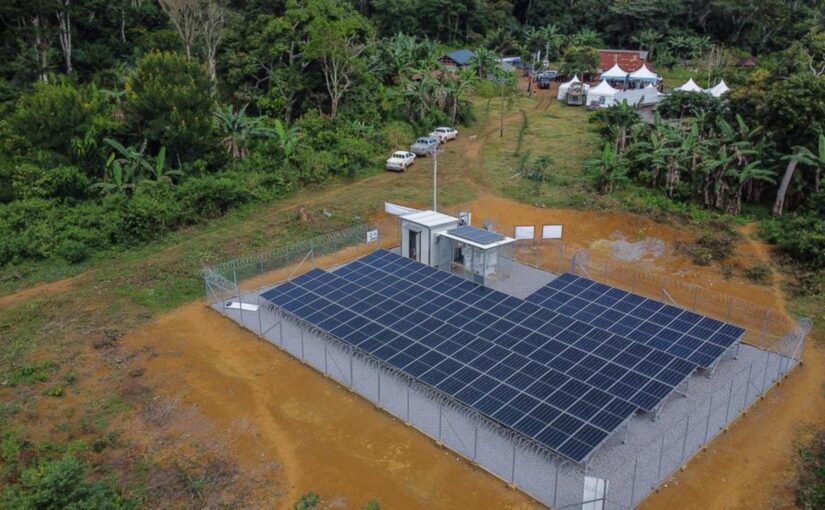
Chinese companies have built the Benban solar park in Egypt, wind farms in Ethiopia and South Africa, hydroelectric stations in Zambia, and a battery-backed solar plant is going into every one of Zambia’s 156 constituencies.
And this is not about creating a relationship of dependency. China is helping countries in the Global South to build their own renewable energy industries. For example, when Zimbabwe decided to stop exporting raw lithium, a Chinese company committed 400 million dollars to building a processing plant there.
The most moving and most poignant example is Cuba. Facing a barbaric – let’s say it, genocidal – energy siege imposed by the Trump regime, with the national grid collapsing again and again, and tens of thousands of patients waiting for operations, China has helped Cuba install around 900 megawatts of solar power. At the Socialist China conference last Saturday, First Secretary at the Cuban Embassy Pablo Ginarte told us this had taken the renewable share of Cuba’s electricity from around 3 percent to 21 percent in a single year. As he put it: “The United States cannot blockade the sun”.
Bizarrely, there are some in the West, and in the Western left, who see all this progress and call it “green imperialism”. These modern-day Lenins have come up with a new definition of imperialism that doesn’t include domination or coercion; where a country can become an imperialist power without wars, coups, military bases, destabilisation campaigns, unilateral sanctions, economic coercion, unequal exchange or structural adjustment. Apparently China has become imperialist through building solar farms in Zambia. Either this is a stunning and important theoretical development, or it’s utter nonsense; I’ll leave it to you to decide.
Defending multilateralism
China has also been the most consistent defender of the international framework for tackling climate change. It insists on the Paris Agreement, and on the principle of common but differentiated responsibilities – the idea that the rich countries, which caused the problem, should take the lead in cutting emissions and should provide technology and financial resources for sustainable development in the Global South.
Although, as an aside, in reality it’s China that’s doing the lion’s share of this work!
Meanwhile, Trump has pulled out of the Paris Agreement for a second time, called climate change “the greatest con job ever perpetrated on the world”, and made “drill, baby, drill” the official energy policy of the most powerful country on Earth.
Not to mention waging war on Iran and supporting a genocide in Gaza, both of which are having devastating environmental consequences.
Meanwhile, Washington and Brussels slap tariffs on Chinese solar panels, batteries and electric vehicles – the very things the world needs most – and accuse China of “overcapacity” for making too many of them.
Why this matters
What does all this mean for us in Britain?
First, it means that the New Cold War is not only a threat to peace; it’s a threat to the planet. Every tariff on Chinese solar panels and every attempt to cut China out of supply chains makes the green transition slower and more expensive, in Britain as much as anywhere. A Britain that cooperated with China on renewable energy, on electric transport, on grid technology, would be doing far better on its climate commitments, and furthermore would bring down energy bills.
Second, it’s a reminder that socialism works. The West has had more than 30 years of climate summits, and we’ve been told the whole time that the market will sort it out, or that we can save the planet if only we take shorter showers and make sure we put our packaging in the right bin. China has shown that a green transition happens when a socialist state plans for it, invests in it and puts the long-term needs of humanity ahead of short-term profit.
And third, many people who care about the environment are starting to look at China with fresh eyes, and to ask why it is succeeding where our own rulers are failing. As young communists, you are well placed to help them find the answer.
Xi Jinping said last year that “however the world may change, China will not slow down its climate actions, will not reduce its support for international cooperation, and will not cease its efforts to build a community with a shared future for mankind.”
Let’s do what we can to support that, and to build a world where cooperation, not coercion, is the guiding principle of international relations.
In a result that defied the pre-election polls, Flávio Bolsonaro took first place in the first round of Brazil’s presidential election on 4 October, edging out President Luiz Inácio Lula da Silva ahead of a runoff on 25 October. In the following article, Carlos Martinez and Sara Vivacqua examine why the far right did so well – a ruling class in crisis, the politics of fear and faith – and what is at stake in the second round.
They argue that a Bolsonaro victory would threaten the 1988 Constitution itself, hand Washington its biggest prize yet under the so-called Donroe Doctrine, and do enormous damage to the multipolar project and to the Amazon. Yet they also show why the material basis of China–Latin America cooperation is too strong to be disrupted on purely ideological grounds.
This article was first published in the Morning Star.
In a surprise result that defied pre-election polls, the far right had a very good night in Brazil last Sunday. Flávio Bolsonaro – son of the former president Jair Bolsonaro, who is currently serving a 27-year sentence for plotting a coup – took first place in the presidential election with 47 percent of the vote, against 45.2 percent for the incumbent Luiz Inácio Lula da Silva. With neither candidate passing the 50 percent threshold, the two will meet again in a runoff on 25 October.
The bad news does not end with the presidential elections. Of the 54 Senate seats contested, 34 went to the right or far right, among them Michelle Bolsonaro and Carlos Bolsonaro, the former president’s wife and second son. Jair Bolsonaro’s Liberal Party (PL) is now the largest party in the Chamber of Deputies, with 121 seats to the Workers’ Party’s (PT) 70. The PT held on to its traditional strongholds in the north-east (the poorest region, with the highest proportion of Afro-Brazilians), but the overall picture is of a significant shift to the right.
A ruling class in crisis
Capital quickly delivered a favourable verdict: the Financial Times reports that the Brazilian real rose 4.2 percent against the dollar and the São Paulo stock exchange jumped almost 8 percent to a record high, as investors bet on a Bolsonaro government that would “mount rapid spending cuts” and dismantle environmental regulations. That should surprise nobody: always hostile to Lula and the PT, Brazil’s ruling class and its media stenographers have led a frenzied demonisation campaign against the left, portraying the PT as corrupt and incompetent.
The country is running a budget deficit of close to a tenth of GDP, with some of the highest interest rates in the world, and Lula has governed since 2023 alongside an obstructive, conservative-dominated Congress. In spite of these severe economic and political constraints, the PT government has taken Brazil off the UN Hunger Map, restored and expanded Bolsa Família, made bold commitments on environmental protection, and refused to subordinate the country’s foreign policy to Washington.
In the following article, Carlos Martinez draws on a recent visit to Hangzhou, the capital of Zhejiang Province, to examine how the city has become at once a centre of frontier technology – home to DeepSeek, Unitree Robotics and Alibaba – and a testing ground for ecological civilisation.
Carlos traces both transformations back to Zhejiang’s “Eight-Eight Strategy”, launched in 2003 when Xi Jinping was provincial Party secretary, and shows how public institutions have created the conditions for innovation while directing it towards wider developmental goals. He sets out the material record of the green transition – distributed solar overtaking coal, clean rivers and a restored West Lake, a metro network that has grown fivefold in seven years – while also confronting the contradiction at its heart: the AI and cloud-computing industries that make Hangzhou a technology leader are among its fastest-growing sources of electricity demand.
The direction of technological change, he concludes, is a political choice, requiring “long-term planning, public investment and institutions capable of subordinating private profit to the common good”. The article complements Gary Wilson’s recent analysis of the US chip blockade and the discussion on AI and the new quality productive forces at the recent Socialist China Conference.
A version of this article first appeared in Beijing Review.
Visiting Hangzhou in April, the signs of change were everywhere: electric vehicles crowding the roads, an extensive metro system, e-bikes as a default mode of transport for millions, and well-maintained residential communities built around shared green space and public amenities.
Hangzhou has emerged simultaneously as a centre of frontier technology and a testing ground for ecological civilisation. It is home to DeepSeek, Unitree Robotics and Alibaba; it is also a city of restored waterways, expanding wetlands, distributed solar power and extensive low-carbon transport.
Both of these development threads have common roots in a strategy laid down more than two decades ago.
A twenty-year harvest
Hangzhou is now a megacity of 12.7 million people. Its economy reached 2.3 trillion yuan ($330 billion) in 2025, while the core industries of its digital economy account for 29.5 percent of GDP. This is not a small technology enclave surrounded by an otherwise traditional economy. Digital development has become one of the city’s principal productive forces.
The Western media discovered Hangzhou’s technology sector in early 2025, after the success of DeepSeek and the emergence of the so-called “six little dragons”: DeepSeek, Unitree, Game Science, Deep Robotics, BrainCo and Manycore Tech. The label is journalistic rather than official; what matters is the ecosystem beneath it.
Three of the six have founders who studied at Zhejiang University, which has established itself as one of the world’s leading research institutions. Those companies have also benefited from dense manufacturing supply chains, a large pool of engineers, competitive domestic markets and a local government willing to build institutions around emerging industries.
This is a story of public institutions creating the conditions in which innovation can occur, then attempting to direct that innovation towards wider developmental goals.
The origins lie in Zhejiang’s “Eight-Eight Strategy”, launched in 2003 when Xi Jinping was provincial Party secretary. The strategy combined advanced manufacturing, regional integration and scientific development with the construction of an “ecological province”.
Unitree tells a related story. The launch price of its humanoid robots fell from around $90,000 in 2023 to $5,900 in 2025, reflecting the depth of China’s component suppliers and manufacturing infrastructure.
Ecological civilisation in material form
Hangzhou’s green transformation has followed the same pattern: targets, infrastructure, experimentation and adjustment.
The city of Hangzhou itself reached 7.55 gigawatts of solar capacity by June 2026, already exceeding its 2030 target of 6.5 gigawatts. The provincial energy big-data centre monitors energy systems in real time, while virtual power plants coordinate batteries, electric vehicles and commercial buildings to help balance supply and demand. The energy transition is therefore not simply a matter of installing panels; it involves constructing a more flexible and intelligent electricity system around them.
By 2025, 99.7 percent of the province’s nationally and provincially monitored water sections were at Grade III or better. All eight major river systems, together with the Grand Canal, reached that level for the first time. In Hangzhou, monitored surface-water sections and drinking-water sources have achieved full compliance for five consecutive years.
The municipal response has been to impose a power-usage-effectiveness ceiling of 1.2 on new large data centres, while expanding solar power, storage and smart-grid management. This is the real content of a green transition: not the absence of contradictions, but the capacity to identify and manage them.
The city’s experience suggests that future technology and ecological development cannot be separated. Artificial intelligence can help integrate renewable energy, manage transport, monitor pollution and use resources more efficiently; but it also consumes electricity and materials on an enormous scale. The task is not to choose between becoming “smart” and becoming green. It is to ensure that technological development remains subject to social and ecological goals.
Hangzhou does not offer a finished model, still less a future without contradictions. What it does show is that the direction of technological change is a political choice. Markets can generate new products, but they cannot by themselves coordinate energy systems, restore waterways, build public transport or ensure that the costs and benefits of innovation are shared. Bringing future technology into line with ecological civilisation requires long-term planning, public investment and institutions capable of subordinating private profit to the common good.
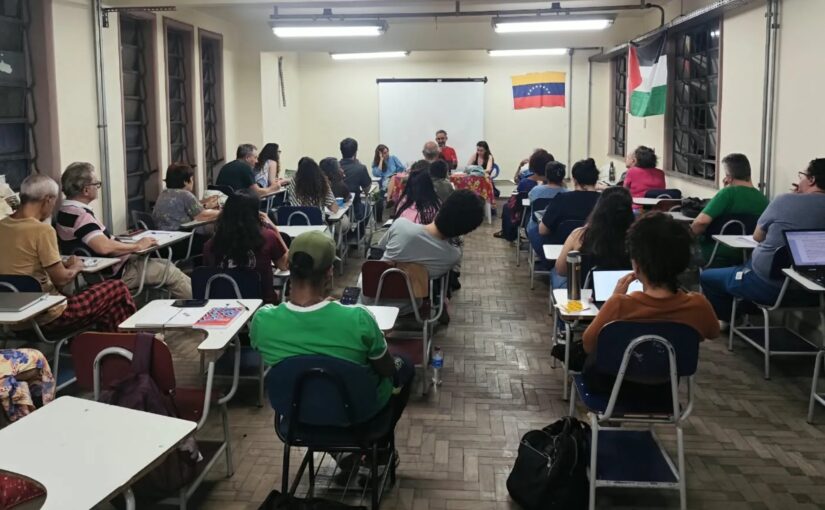
During a recent visit to Brazil, Carlos Martinez was interviewed by Flora Villela of Brasil de Fato in Belo Horizonte, where he was taking part in the debate “China and Socialism in the Global Geopolitical Dispute”, organised by the Landless Workers’ Movement (MST).
In the interview, Carlos makes the case for the socialist character of contemporary China; discusses Western media stereotypes and what democracy actually means in Britain and in China; sets out the transition from a US-led imperialist system towards a multipolar world; and addresses what China can and cannot do in defence of countries under attack by the US, as well as the wars in Iran and Ukraine.
An English translation of the interview is reproduced below. It first appeared in Portuguese in Brasil de Fato.
China and the construction of socialism in the 21st century: expert discusses conflicts and prospects
Author, researcher and activist Carlos Martinez defends the socialist character of contemporary China
By Flora Villela
We are living through one of the most tense moments in global geopolitics: not since the Second World War has the planet seen a period with so many simultaneous armed conflicts and wars.
At the centre of these challenges are military arbitrariness and economic policies imposed on various countries by the world’s greatest power – the United States; new technologies represent civilisational challenges for every nation; authoritarianism is regaining ground and eroding democracies; and the conflicts threaten to produce economic crises that would generate widespread poverty.
Despite this scenario, China continues to emerge as the world’s new economic power, following, by all indications, a path centred on peace. And the defence of multilateralism as a solution to the crisis is gaining strength, particularly in the so-called Global South. Nonetheless, “there is a whole campaign of defamation, a propaganda war in an attempt to win public support for increasingly hostile policies towards China, which at the moment take the form of a Cold War with tariffs, semiconductor restrictions, sanctions and unilateral, coercive economic measures”, argues Carlos Martinez.
A co-editor of the Friends of Socialist China website, an author, researcher and activist, Martinez has written the books The East Is Still Red: Chinese Socialism in the 21st Century and The End of the Beginning: Lessons from the Soviet Collapse. His work focuses on dispelling what he considers an “enormous misunderstanding in relation to China”.
“Even on the left, there is an assumption that China is just another capitalist country and that the conflict between the US and China is an example of imperialist rivalry or the so-called ‘Thucydides Trap’. So in my work I try to explain the true nature of China and of Chinese socialism, and at the same time to counter anti-China propaganda”, he explains.
During a visit to Belo Horizonte to take part in the debate “China and Socialism in the Global Geopolitical Dispute”, the author spoke to Brasil de Fato MG. In the interview, we discussed the conflicts under way around the world, the role of Brazil and of this year’s elections, the dispute over global hegemony, and the path of multilateralism and peace.
“It will be a long and painful process towards our post-imperialist world, but I believe that in the end humanity will get there”, says Martinez.
Brazilians go to the polls on 4 October in an election pitting President Luiz Inácio Lula da Silva against the far-right Flávio Bolsonaro, with the polls showing a technical tie. In the following article, Carlos Martinez and Sara Vivacqua set out why this is the election in the Americas that matters most to Washington – and the one it has worked hardest to influence.
They document the extent of US interference – from tariffs, sanctions and terrorist designations to suspicions of foreign money reaching the Bolsonaro campaign – and situate it within the ‘Trump Corollary’ to the Monroe Doctrine, which seeks to consolidate the Americas as a secure rear base for a longer confrontation with China. Against this backdrop, they argue, a Lula victory would show the whole of the Global South that such pressure can be faced down.
This article was first published in the Morning Star.
Brazilians go to the polls this weekend in what will be a crucial election for the country and the wider region. The contest pits the incumbent president Luiz Inácio Lula da Silva against the far-right Flávio Bolsonaro – son of the former president Jair Bolsonaro, who is currently serving a 27-year sentence, convicted of plotting a coup to overturn the result of the 2022 election.
Of all the elections in the Americas this year, this is the one whose outcome matters most to Washington – and the one it has worked hardest to influence. Brazil – a top-ten economy, a founder of BRICS and a driver of the multipolar order – is the last large country in South America that, under Lula, refuses to fall in line with Washington. It is one of the final pieces, and also a potential turning point, in Washington’s strategy for the capture of the Americas.
“Brazilian democracy belongs to Brazilians. Brazil will remain a sovereign country.”
In his speech at the opening of the 81st United Nations General Assembly on 22 September, Lula denounced foreign interference in the region’s elections and brought it under international scrutiny, in an attempt to prevent an institutional rupture before it could materialise.
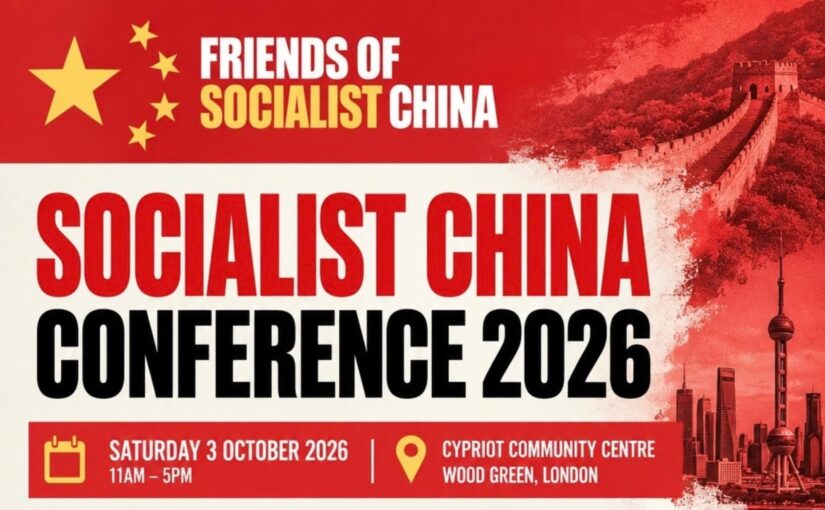
In the following article, Friends of Socialist China co-editor Carlos Martinez sets out the agenda for the third annual Socialist China Conference, taking place in London on Saturday 3 October.
Carlos notes that the British ruling class – the security state and its media representatives above all – talks about China constantly, from Chinese “kill switches” in wind turbines to Beijing supposedly funding the Palestine marches. The conference is a chance for the left to get a word in: on the drive to war in the Asia-Pacific, on what China’s achievements in poverty eradication, infrastructure and renewable energy mean for workers in Britain, on the shifting of global opinion in China’s favour, and on turning the “Chinamaxxing” mood among young people into political understanding.
If the right-wing press is to be believed, Britain is under systematic attack by the cunning Chinese communists.
Over the past couple of months, we have been warned that Beijing is funding the Palestine marches; that these perennial evil-doers are hacking our tractors; that Chinese-made wind turbines may be fitted with kill switches; and that a Chinese-owned hotel in Cyprus has a suspiciously good view of RAF Akrotiri.
Former MI6 chief Sir Richard Dearlove has claimed that China “could switch off our power grid at any second.”
The British ruling class – and particularly the security state and its media representatives – talks about China constantly, so it is probably a good idea for us to get a word in. That is what the third annual Socialist China Conference, in London this Saturday, is for.
War and peace
China’s unprecedented rise took the West by surprise. Washington’s strategists expected the country to remain at or near the bottom of the global economic hierarchy for decades or centuries, but today’s China is the world’s second-largest economy and is growing at more than twice the rate of the US economy; it is also the world’s largest trading nation and manufacturer.
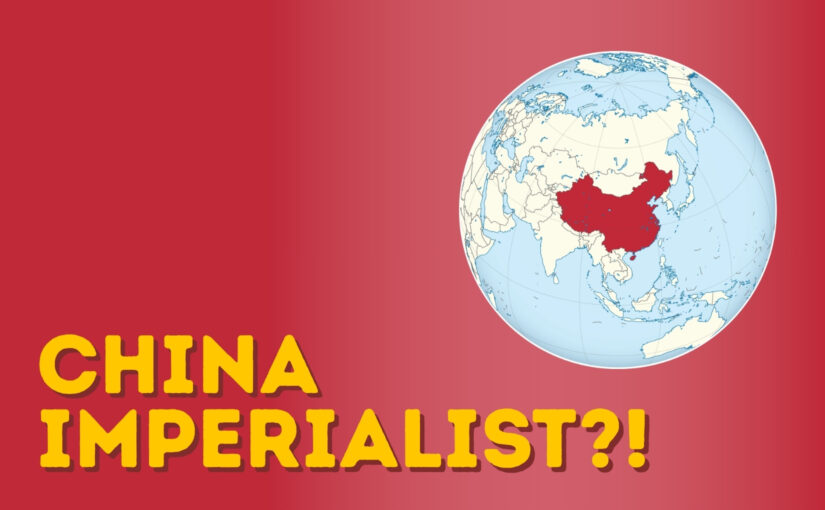
Is China simply another imperialist power, differing from the US only in degree? It’s a claim heard increasingly often on the left, from the Communist Party of Greece to Jacobin. This video sets out why that claim doesn’t survive scrutiny.
Working from Lenin’s classical definition of imperialism, Carlos Martinez examines whether China exhibits the super-exploitation of foreign labour that has always been imperialism’s economic core – and finds the opposite: China has been on the receiving end of value extraction by Western capital, not a source of it. The video looks at the real record of the Belt and Road Initiative against the “debt trap” accusation, at China’s strikingly peaceful military record since 1949, and at whether the underlying class dynamics of Chinese society could ever produce an imperialist foreign policy. And it closes by asking what China’s promotion of a multipolar world order means for the long-term prospects of overcoming imperialism altogether.
Hello and welcome. This video is based on a chapter I’ve written for a newly-released book, co-edited with Keith Bennett: China’s Foreign Policy and the Making of a Multipolar World, out now from Praxis Press – link in the description.
In this video I want to work through the core of that chapter, which addresses a question that comes up again and again on the left: is China imperialist?
That China is an imperialist power is a fairly widespread claim, at least in the West. China is after all a major player on the world stage, with a large economy, a powerful military and expanding global influence, and it routinely faces accusations of “debt trap diplomacy” and other forms of economic coercion.
Some go even further: China has been described as “a rising imperialist power… that increasingly exploits Third World countries in pursuit of raw materials and outlets for its exports.” The Communist Party of Greece says China is “an integral part of the international imperialist system”, with its disputes with the US amounting to nothing more than a quarrel over “the division of the loot”.
In this framing, China is just another imperialist power, differing from the US and Western Europe only in degree, and all the talk of multipolarity is a veneer over the ambitions of a rising hegemon.
The strategic implication of that for the left is clear: if China is an imperialist power, it must be opposed and exposed like any other imperialist power. That’s the line of Neither Washington nor Beijing, which picks up where the old – and unlamented – Neither Washington nor Moscow left off.
I want to show why that’s wrong – that China has never been engaged in the type of economic, political and military domination that the word ‘imperialism’ implies; that its internal class dynamics and the actual geopolitical reality militate against it becoming imperialist, and that the multipolar world order it’s working to build provides a way out of imperialism for everyone.
What is imperialism?
Let’s start with a definition. In his classic pamphlet Imperialism: The Highest Stage of Capitalism, Lenin put forward what he called the “briefest possible definition” – that imperialism is “the monopoly stage of capitalism” – and then set out five basic features: the concentration of capital into monopolies; the rise of a financial oligarchy, essentially the banks, as the driving force of the economy; the export of capital as a key engine of growth; international combines that carve up the world between them – the modern multinational; and the complete territorial division of the world among the major capitalist powers.
That still holds up pretty well. But there’s one important development Lenin couldn’t account for at the time: a few months after he published that book, the Russian working class overthrew the tsarist system and founded the world’s first socialist state, which went on to back national liberation struggles and socialist movements around the world.
That set in train a new phase of human development: the phase of the transition to socialism.
Today’s world still has imperialist powers and it still has oppressed countries, but it also has socialist countries and countries – for example India, Brazil, South Africa, Mexico – that are fairly deeply integrated into the global economy, that export capital like the vast majority of the world’s states, and yet they don’t dominate other countries. That’s a crucial difference from Lenin’s time: since the start of this transitional phase, it’s possible to actively engage in the global economy – to trade and invest on your own terms – without being an imperialist power.
So I’d argue that the most useful working definition of imperialism today is this: a system of economic, political and military domination of some countries over others, driven by the dominant countries’ pursuit of raw materials, land, markets and cheap labour, in which value flows continuously from the periphery (the oppressed countries) to the core (the imperialist countries) through structures that have been put in place and are held in place by means of coercion. That’s a bit of a mouthful, admittedly. More pithy perhaps is the definition by economists Li Zhongjin and David Kotz: “Imperialism is… the economic and political domination of one country by the ruling class of another aimed at extracting economic benefits for that ruling class.”
Super-exploitation is the core of it
The core concept for understanding the reality of imperialism is the super-exploitation of labour in the oppressed countries.
Marx wrote that capital goes abroad “because it can be employed at a higher rate of profit in a foreign country.” The Russian Marxist Nikolai Bukharin identified exactly this dynamic – capital is exported in search of a higher rate of profit, drawn above all from the higher rate of exploitation in poorer countries – as the defining feature of imperialism.
The economist John Smith has done a detailed and useful investigation of what this looks like in the 21st century. He notes that the major imperialist powers have spent decades outsourcing production to low-wage economies, reinforcing a hierarchy in which the US, Western Europe and Japan – what Samir Amin called the “imperialist triad” – remain the core of the global economy, while the Global South is relegated to the periphery.
Eighty-three percent of the world’s manufacturing workforce now lives in the Global South, often exposed to forced labour, illegal overtime and relentless downward pressure on wages and safety. This reflects a process starting in the 1970s where, facing a chronic crisis of overproduction at home, Western capital turned to what Smith calls “global labour arbitrage” as a survival tactic. Paying starvation wages in the Global South is how Western capitalism has propped up its own declining profitability for decades.
Is China a super-exploiter, or the super-exploited?
Where does China fit into all this? Clearly, not on the side of the exploiters. Like South Asia, Africa and Latin America, China has been on the receiving end of huge capital inflows from the imperialist triad, as multinationals leveraged its vast, highly-educated and relatively low-wage workforce.
Certainly throughout the 80s, 90s and early 2000s, value was created in China and captured by the West. John Smith’s 2008 study of Apple’s iPod found that the 12,250 Chinese workers making it earned just six percent of the average US retail wage – and while a similar number of workers were employed on each side, the total US wage bill was 719 million dollars against a Chinese wage bill of 19 million.
The economists Guglielmo Carchedi and Michael Roberts, analysing this kind of unequal exchange, conclude that “there is a clear transfer of surplus value from China to the bloc of imperialist countries, averaging five to ten percent of China’s GDP since the 1990s… China is not an imperialist country by our definition; on the contrary, it clearly fits into the dominated bloc.”
Now, Chinese wages have been rising fast and clearly things have changed since 2008. Chinese companies do invest abroad. But there’s no evidence of systematic super-exploitation of foreign labour by Chinese capital – actually the biggest recipients of Chinese investment are the US, Britain and Australia, and it’s hard to see how those flows could be described as exploiting Western labour.
As for China’s lending to the Global South, this is typically composed of mutually beneficial deals, rather than deals designed to extract superprofits. China is offering developing countries an alternative to the predatory lending of the IMF and World Bank – and that’s a challenge to the imperialist system, not a reinforcement of it.
No imperialism without domination
The word ‘imperialism’ comes from the Latin for command, to rule; obviously it’s very closely connected to the word ‘empire’.
It isn’t just about concentration of capital or foreign investment – fundamentally, it’s about domination. So: does China assert economic, political or military domination over other countries? Has it joined Lenin’s “handful of exceptionally rich and powerful states which plunder the whole world simply by clipping coupons”?! Quite obviously not.
And yet the Belt and Road Initiative is routinely condemned as neocolonialism – China luring developing countries into debt traps to dominate them. This doesn’t stand up, and I’ve got another video on this topic that I’ll link in the description. But even the reliably reactionary Economist admits debt-trap accusations are “largely unfair”, noting that China “has financed roads, ports, railways and other needed infrastructure, when private lenders and other countries were often unwilling to do so.”
Chinese interest rates typically run at about half those of Western banks, without the austerity conditions the IMF attaches. Tim Jones of the charity Debt Justice calls the whole debt trap narrative a distraction by Western countries, and asserts that “their own banks, asset managers and oil traders are far more responsible”.
Of Chinese loans to Africa, 40 percent has gone to power generation and 30 percent to transport – addressing Africa’s infrastructure gap.
The people actually living with these loans agree. Cambodia’s Deputy Prime Minister, responding to debt-trap accusations last year, said: “The Belt and Road Initiative is not a debt trap… it is a lifeline for our social and economic development.” Angola’s Minister of Energy and Water says that “China has never imposed any projects on us; each project was selected by us… Nobody offered us support except China.”
And China is actively sharing technology the West has always hoarded – payment systems, satellite networks, telecoms, renewable energy – opening up a pathway out of Western dependence.
Is there such a thing as peaceful imperialism?
Another thing is that China is remarkably peaceful for an imperialist power.
As Hugo Chávez put it: “China is large but it’s not an empire. China doesn’t trample on anyone, it hasn’t invaded anyone, it doesn’t go around dropping bombs on anyone.”
This directly connects to the political theory. Bukharin observed that the struggle to invest capital abroad “is always reinforced by military pressure”, and Rudolf Hilferding argued that finance capital needs a state strong enough to “intervene in every corner of the globe”.
The entire imperialist system was built through military force – Britain’s empire on naval supremacy over sea lanes on which, famously, the sun never set and the blood never dried; Japanese, French, German, Dutch, Spanish, Portuguese and Italian imperialism were all built on brutal conquest; the US itself was built through war against Indigenous nations, against Mexico, and then across Latin America and the Pacific. And even after formal colonialism ended, the imperialist powers carried on using force to maintain their dominance – the wars on Korea, Vietnam, Yugoslavia, Iraq, Libya, Afghanistan and today Iran; the proxy wars on Syria and Yemen; the sanctions strangling Cuba, Zimbabwe, Nicaragua and other countries.
As Thomas Friedman famously put it in the New York Times, with remarkable candour: “the hidden hand of the market will never work without a hidden fist – McDonald’s cannot flourish without McDonnell Douglas”.
China’s record simply looks nothing like this. China participated in the Korean and Vietnam wars on the side of the victims of imperialism. Then it had a brief border war with Vietnam in 1979. In the nearly half-century since, China hasn’t dropped a single bomb on foreign territory. Its per-capita military spending is around one-twentieth of the US’s; it holds roughly five hundred nuclear warheads to the US’s five thousand, and it’s maintained a no-first-use policy since its first nuclear test in 1964.
So if we’re saying that China has become an imperialist power without recourse to military force – without coercion, without war – then we are throwing Lenin’s theory of imperialism out the window.
Could China become imperialist?
So China isn’t imperialist today. But could it become imperialist in future? For a country to go down that road, three things have to be true: 1) it has to be capitalist, in the sense that profit maximisation is the core motive of its economy; 2) its capitalist class has to exercise control of the country’s foreign policy; and 3) the objective conditions have to exist for it to actually dominate other countries.
Let’s take these in turn.
In China, the profit motive is certainly important, but it isn’t the principal factor driving economic strategy – after all, a huge share of the economy is directed by the state, the major banks are state-owned and answerable to the Chinese people, and infrastructure and technology projects go ahead regardless of short-term returns. As economist Arthur Kroeber puts it, China is “an economy where the state remains firmly in command… but where market tools are used to improve efficiency.”
Meanwhile, People’s China has never experienced economic contraction. Chinese capital simply doesn’t face the crises of profitability and overproduction that have historically driven Western capital abroad.
Nor is capital the main driver of China’s foreign relations, which are built on the UN Charter, the principles of peaceful coexistence, the principles of non-interference, and the construction of a multipolar world.
Back in 1974, at the UN General Assembly, Deng Xiaoping said that if China ever turned into a bullying superpower, “the people of the world should expose it, oppose it and work together with the Chinese people to overthrow it.” Xi Jinping reiterated this idea at the 20th Party Congress: “China will never seek hegemony or engage in expansionism.”
So the Chinese state has a consistent foreign policy, based on the long-term interests of the Chinese people. Even if private companies in China wanted to subvert it in the interests of making a quick buck, they lack the political power to do so.
And even if the Chinese state did harbour imperialist ambitions, the objective conditions for pursuing those ambitions simply don’t exist. Some writers on the left have claimed that China is walking the same “road well-travelled” as Britain, Germany and the US. What they haven’t noticed is that road isn’t actually open any more. Lenin noted, over a century ago, that the world was already “completely divided up, so that in the future only redivision is possible” – and redivision means displacing existing imperialist powers by force. That was the whole logic of the First World War.
China’s peaceful record indicates very strongly that it’s not pursuing such a path.
In summary, the only way China could become an imperialist power is through capitalist counter-revolution – which is, ironically, exactly what the existing imperialist powers would love to see happen.
Multipolarity and overcoming imperialism
The last point I want to make is about the global order China is trying to build.
China rarely frames its foreign policy in overtly revolutionary language these days, but it stands at the core of an objectively anti-imperialist trajectory: the push towards a multipolar world, described by Jenny Clegg as “a pattern of multiple centres of power… shaping a negotiated order”.
That’s by definition a shift away from a US-dominated unipolar order towards a more equal and democratic system in which all countries – including those of the Global South – have a voice; in which all countries can assert their sovereignty and choose their own development path free from hegemonism.
Time and time again, the imperialist powers have blocked the development of the Global South, and have worked to crush socialist movements and governments, from Chile to Indonesia to Grenada to Angola to Iran to Nicaragua. Through the structures of the UN, BRICS, the G77+China, the Non Aligned Movement, the Forum on China Africa Cooperation, China-CELAC, the Shanghai Cooperation Organisation, the Belt and Road Initiative and the Asian Infrastructure Investment Bank, China is actively advancing the interests of the developing world.
So multipolarity offers real opportunities for peace and development, and a more favourable context for humanity’s advance towards socialism.
China is not an imperialist power. Rather, it’s an anti-imperialist power, and its foreign policy is directed towards a fundamental transformation of the global order – away from hegemonism, towards multipolarity, sovereignty, cooperation and peace.
At a moment when the imperialist powers, led by the US, are resorting to ever more desperate violence to maintain their dominance, China’s promotion of multipolarity, and its vision of a global community of shared future, matter more than ever.
There’s a lot more detail and a full set of sources behind the points I’ve made in this video – you can find that all in the chapter in China’s Foreign Policy and the Making of a Multipolar World, out now from Praxis Press, link in the description.
Thanks very much for watching. Do give it a thumbs-up for the sake of the algorithm, and see you next time.
Africa’s solar installations rose by a record 54 percent in 2025, and 15 major African markets imported more than $400 million worth of solar panels in the first quarter of 2026 alone – more than two-thirds of the total for the whole of the previous year. In this article, Carlos Martinez looks at what lies behind those numbers.
The projects driving the continent’s green transition are overwhelmingly built and financed by China, from the Benban Solar Park in Egypt and the Adama wind farms in Ethiopia to De Aar in South Africa and a solar plant with battery storage in every one of Zambia’s 156 constituencies. What has made them viable is two decades of sustained Chinese public investment, which has driven the global cost of renewable energy down to a fraction of what it was 15 years ago.
Carlos also takes on the charge, increasingly fashionable in parts of the Western left, that this amounts to a new “green imperialism”. Market share, he argues, describes a trade relationship, not domination and coercion – and the function of the accusation, whatever the intention behind it, is to manufacture consent for the New Cold War.
A report in the South China Morning Post on 7 September highlights the contrast in energy policy between the United States, where, particularly under the present administration, the watchword is “drill, baby, drill”, and China, where the national strategy is to “walk towards the light”. Two energy behemoths, two approaches to the future of the planet, and the resulting choice facing the people of Africa.
The SCMP article observes that, for African governments seeking to expand access to electricity, the principal deciding factor is cost. And on cost, the argument is now over.
Africa’s solar installations rose a record 54 percent in 2025, adding 4.5 gigawatts of new photovoltaic capacity, and that record is likely to be broken again this year. The International Energy Agency reports that 15 major African markets imported more than $400 million worth of solar panels in the first quarter of 2026 alone – against $600 million for the whole of 2025.
“Africa’s solar revolution is here,” says Sonia Dunlop, chief executive of the Global Solar Council. “Growth is spreading to new markets across the continent, and rooftop and distributed systems are putting power directly into the hands of households and businesses.”