Interview: Fighting spirit has allowed the CPC to survive and adapt over a century

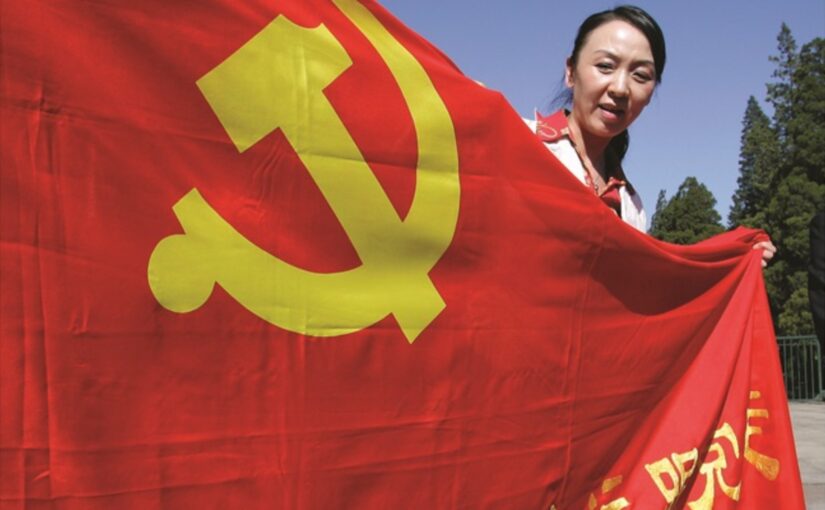
The following is the full text of an interview given by Carlos Martinez to the Global Times, marking the 105th anniversary of the founding of the Communist Party of China (CPC). An abridged version was published by the Global Times on 12 July 2026 as part of a special series of interviews with international scholars reflecting on the party’s century-long journey.

In the interview, conducted by GT reporter Xia Wenxin, Carlos explores the meaning of the CPC’s “fighting spirit”, or “spirit of struggle” – a concept he argues is routinely misread in the West as blind confrontation or factional intrigue, but which in fact flows directly from the dialectical core of Marxism. Struggle, in this sense, is not a mood but a method: the recognition that development happens through contradiction, and that a serious revolutionary party must identify the principal contradiction of each period and mobilise the masses to resolve it.

Tracing this thread from Mao Zedong’s 1945 parable of the Foolish Old Man who removed the mountains through to the present day, Carlos discusses how the same method has allowed the party to survive and adapt across a century that saw so many other revolutionary projects defeated. He examines the CPC’s practice of self-revolution and its unrelenting campaign against corruption; the targeted poverty alleviation drive that lifted hundreds of millions out of poverty; and the fundamental difference between the Chinese dialectical understanding of struggle as productive and the Western view of conflict as terminal.

Finally, he considers how this fighting spirit will be tested on the new battlefields of the 15th Five-Year Plan – high-tech self-reliance under conditions of US containment, the green transition, and the assorted domestic challenges on the road to the Second Centenary Goal of 2049. As he concludes, “on the record of the last 105 years, I would not bet against the CPC and the Chinese people surmounting these new challenges.”

The abridged version of this interview first appeared in the Global Times. The full version was first published on Friends of Socialist China.

As the CPC marks its 105th anniversary, it stands as one of the longest-governing political parties in modern history. Looking back at this journey, how do you evaluate the role of the “fighting spirit” in helping the party navigate historical crises and constantly adapt to changing eras?

I think that, for the CPC, “fighting spirit” is closely related to the dialectical core of Marxism: the recognition that development happens through contradiction, that nothing valuable arrives without meaningful effort, and that a serious revolutionary party has to identify the principal contradiction of each period and work to resolve it. Struggle, in this sense, is not a mood; it is a method.

This is not a recent slogan grafted onto the Party; it runs right through its tradition. One of the clearest statements of it is Mao’s closing speech to the Seventh Party Congress in June 1945, “The Foolish Old Man Who Removed the Mountains”, in which he retold an old fable. A foolish old man sets out to dig away two great mountains that block the way to his house; when a wise old man mocks the folly of it, he replies, “When I die, my sons will carry on; when they die, there will be my grandsons, and then their sons and grandsons, and so on to infinity. High as they are, the mountains cannot grow any higher and with every bit we dig, they will be that much lower. Why can’t we clear them away?” The two mountains, Mao said, were imperialism and feudalism, and the task of the Chinese people was to dig them out. What turns the parable into a statement of strategy is its ending: “Our God is none other than the masses of the Chinese people. If they stand up and dig together with us, why can’t these two mountains be cleared away?”

Fighting spirit, in this conception, is not so much heroic individual will as the conviction that an apparently immovable obstacle yields to patient, collective, intergenerational effort, once the masses are mobilised to do the digging.

That method is exactly what has allowed the Party to survive and adapt across a century in which so many of the other revolutionary projects of its generation were defeated. Consider the sheer range of conditions it has had to navigate: a semi-colonial, semi-feudal country torn apart by foreign invasion and civil war; the construction of an entire industrial and social base from near-zero after 1949; the turn to reform and opening up; and then the collapse of the Soviet Union and the Eastern European states in 1989–91, when counter-revolution triumphed almost everywhere – but was resolutely defeated in China. As Deng Xiaoping told Julius Nyerere in 1989, “so long as socialism does not collapse in China, it will always hold its ground in the world”.

That the People’s Republic did not collapse was not luck. It was the product of a party willing to struggle on every level: against foreign domination, against feudalism, against poverty, against underdevelopment, against corruption, and against ideological ossification.

Continue reading Interview: Fighting spirit has allowed the CPC to survive and adapt over a century

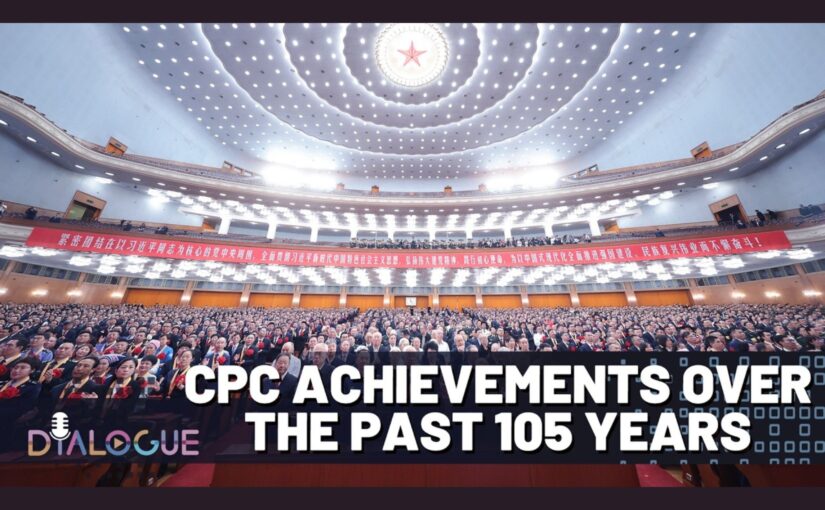
What defines the CPC’s 105-year success? – a CGTN Dialogue

The following is a discussion from CGTN’s Dialogue programme marking the 105th anniversary of the founding of the Communist Party of China. Broadcast in the wake of Xi Jinping’s anniversary speech – in which he hailed the Party’s 105-year history as the “most magnificent epic” of the Chinese nation – it brings together Xia Lu, associate professor at the School of CPC History and Party Building at Renmin University of China; Carlos Martinez, co-editor of Friends of Socialist China; and Radhika Desai, convenor of the International Manifesto Group.

The panel discusses how to evaluate the CPC’s achievements and governing logic; the role of Marxism – seeking truth from facts, the mass line, and the Party’s capacity for self-renewal – in explaining its longevity and legitimacy; and the distinctiveness of Chinese modernisation. Radhika Desai argues that the Chinese revolution, following the Bolshevik revolution, set humanity on a path to socialism, and that amid a declining capitalism China has become an “ocean of stability”. Carlos Martinez stresses that China’s is a modernisation achieved without colonialism, slavery or war – shattering the Eurocentric assumption that to modernise is to Westernise. Xia Lu reads the Party’s six outstanding qualities through the lens of dialectical and historical materialism, and emphasises the mass line and the Party’s vigilance against detachment from the people.

This discussion was originally broadcast by CGTN’s Dialogue. The video and a transcript follow.

Transcript

Host: Hello and welcome to Dialogue. Addressing a gathering marking the 105th anniversary of the Communist Party of China, General Secretary of the CPC Central Committee Xi Jinping hailed the 105-year history of the Party as the “most magnificent epic” of the Chinese nation. He urged the Party to press ahead to build China into a modern socialist country on schedule. So how should we evaluate the Party’s achievements and governing logic over the past 105 years? What does the speech tell us about the Party’s discipline and capacity for self-renewal? And as China moves toward its long-term modernisation goals, what challenges lie ahead? Joining me today from Beijing are Xia Lu, associate professor from the School of CPC History and Party Building at Renmin University of China; Carlos Martinez, author of The East is Still Red: Chinese Socialism in the 21st Century and co-editor of Friends of Socialist China; and also Radhika Desai, convenor of the International Manifesto Group. Welcome to the show. Radhika, I’ll start with you: I’m sure you followed the speech, so I wonder what were your major takeaways?

Radhika Desai: Well, first of all, President Xi’s speech really grasps the fundamentals of the achievements of the Party. I would say that for this party to be more than a century old – 105 years old – while retaining its legitimacy among a billion-strong population, and having essentially transformed the people of China not only into an agent of their own history, giving the destiny of the people into the hands of the people of China, but into an agent of world history – that is a tremendous achievement. The second major event setting the world on a path to socialism after the Bolshevik revolution was the Chinese revolution. And the Bolshevik revolution is no longer; the Chinese revolution is still going. So it set humanity on a path to socialism, and it continues there – at this particular time in history when circumstances have become extremely dangerous, thanks to the decline of that very capitalism. In its decline, capitalism is unleashing chaos, destruction and economic disruption all over the world. In this context, the CPC not only holds great legitimacy among the people of China, but shows the way forward to the rest of the world, and has become a beacon, an oasis of stability, and a visionary path to the future.

Host: Carlos, President Xi said the Party’s endeavours over the past 105 years have fundamentally transformed the future of the Chinese people – as Radhika said, blazed the right path toward the rejuvenation of the Chinese nation, demonstrated the strong vitality of Marxism, had a profound influence on the course of world history, and made the CPC a powerful communist party. What do you make of such a statement?

Continue reading What defines the CPC’s 105-year success? – a CGTN Dialogue

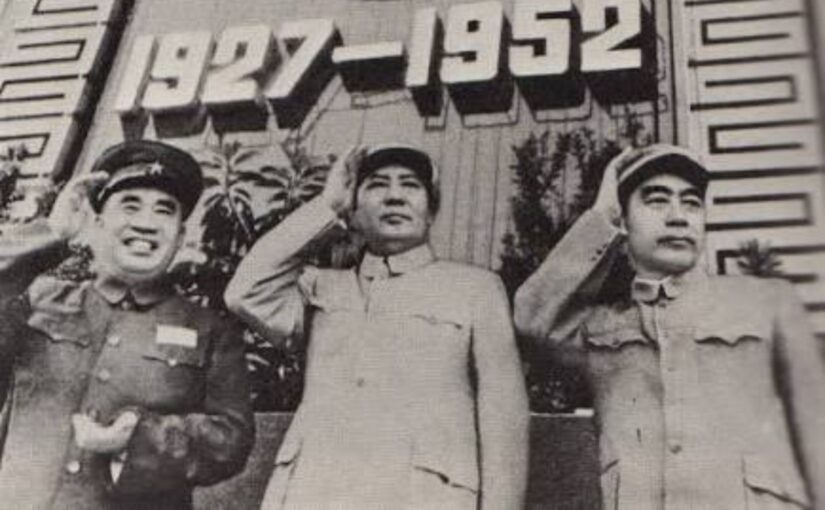
The Great Road – Zhu De, fifty years on

The following article by Carlos Martinez marks the 50th anniversary of the death of Zhu De – founder of the People’s Liberation Army and, with Mao Zedong, one of the leading architects of the Chinese Revolution’s victory.

Drawing on the classic accounts of Agnes Smedley, Edgar Snow and Evans Carlson, it traces Zhu De’s journey from a tenant’s hut in Sichuan, through to the founding of the Red Army and the rostrum at Tiananmen Square – and asks what his life still teaches, half a century on.

This article was first published on Friends of Socialist China.

Fifty years ago, on 6 July 1976, Zhu De died in Beijing at the age of 89. It was a year of terrible losses for the Chinese people: Zhou Enlai had died in January; Mao Zedong would follow in September. Of the three, Zhu De is the least remembered in the West – and yet the army he built, the People’s Liberation Army, remains the guarantor of everything the Chinese Revolution has achieved, and his life traces the arc of that revolution more completely than almost any other.

Red Virtue: origins in Sichuan

Zhu De was born in December 1886 into a tenant family in Yilong county, Sichuan, on an estate whose landlord was known locally as the “King of Hell”. By what Edgar Snow called “a strange accident of language”, the two characters of his name mean “Red Virtue” – a fact his parents could hardly have foreseen, “or they would surely have changed it in terror”.

His mother bore 13 children; the last five were drowned at birth because the family could not feed them. She herself, he recalled, “was so humble that she had no name of her own”. The clan pooled its resources to educate a single son who could talk back to the tax collectors – and so Zhu De, almost by accident, became literate, passed through the old examination system in its dying days, and entered the Yunnan Military Academy, where he joined Sun Yat-sen’s revolutionary Tongmenghui (a radical secret society and precursor to the Kuomintang) and took part in the 1911 Revolution and the campaigns that destroyed Yuan Shikai’s attempted monarchy.

The hardest battle

By his mid-thirties Zhu De was a general in the warlord armies of the south-west: wealthy, decorated, and addicted to opium. The 1911 Revolution, he concluded, had been “aborted by republican compromise with foreign imperialism”; warlordism was a dead end, and he was part of it. So he walked away. He gave up his commands and his fortune, and broke his opium addiction alone – pacing the deck of a Yangtze steamer for a month, in what Snow called “the hardest battle of his life”, proof that “this man had more steel in his will than his acquaintances supposed”.

Then he asked to join the infant Communist Party. His reasoning was characteristically direct: if the foreign imperialists attacked this party with everything ugly in their vocabulary, “it was the party for Chu Teh” (Chu Teh being the older Western spelling of his name). Rejected in Shanghai by then CPC General Secretary Chen Duxiu – who could not believe a former warlord general capable of becoming a communist – he sailed for Europe, and in Berlin in late 1922 presented himself to a student organiser more than ten years his junior named Zhou Enlai. His old life, he said, “had turned to ashes beneath his feet”. He was admitted to the party he would serve for the remaining 54 years of his life.

Continue reading The Great Road – Zhu De, fifty years on

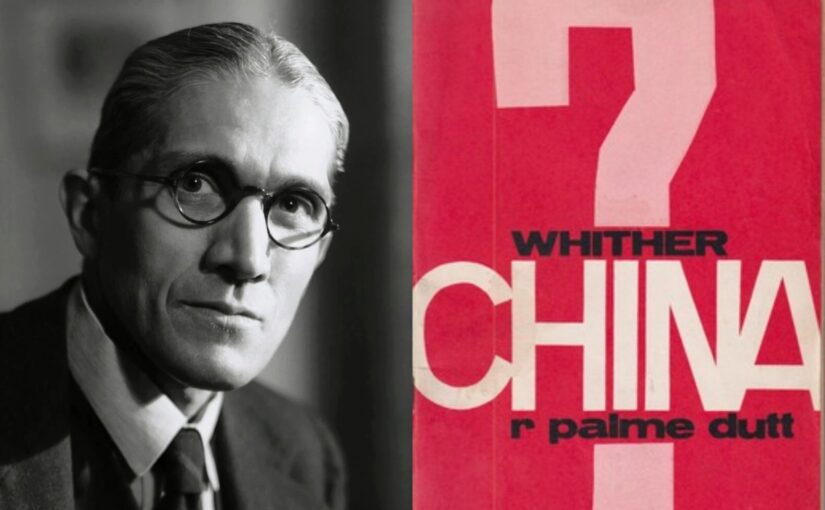
What would Rajani Palme Dutt have made of contemporary China?

To mark the 130th anniversary of the birth of Rajani Palme Dutt – theoretician, organiser and, for half a century, one of the foremost Marxist minds in the British movement – Carlos Martinez asks what he would have made of contemporary China, testing his 1967 pamphlet Whither China? against the verdict of history.

This lecture was delivered on 27 June 2026 at the R. Palme Dutt Memorial Lecture 2026 at SOAS University of London, organised by the Students’ Federation of India UK and the Young Communist League.

The text was first published on Friends of Socialist China.

Comrades and friends. Thank you to the Students’ Federation of India UK and the Young Communist League for organising this event, and for asking me to speak.

We gather to mark the 130th anniversary of the birth of Rajani Palme Dutt – theoretician, organiser, anti-imperialist, and for half a century one of the foremost Marxist minds in the British movement. A man whose very name – the Bengali ‘Rajani’ and ‘Dutt’ alongside the Swedish ‘Palme’ – embodied the internationalism he preached and practised.

I want to use my time to ask a particular question. Palme Dutt died in 1974. He did not live to see China’s reform and opening up, the collapse of the Soviet Union, China’s rise to becoming the second-largest economy on earth, or the New Cold War now being waged against the People’s Republic. So: what would Rajani Palme Dutt have made of contemporary China?

It might seem a strange or pointless question to pose. The most substantial thing Palme Dutt wrote about China was his 1967 pamphlet Whither China? – which is, on its surface, a sharp polemic against the Chinese leadership, written at the height of the Sino-Soviet split, a year into the Cultural Revolution.

Palme Dutt was of course very much on the Soviet side in that split. Nonetheless, his pamphlet was not a simple repetition of the Soviet line, but a careful and serious analysis from a fundamentally comradely perspective.

So the question is posed not as a parlour game, but as a way of asking what a great Marxist of the past would make of the present; of testing his analysis against the reality of history; and of separating enduring principles from contingent positions.

A pamphlet of its moment

The Sino-Soviet split was, of course, one of the greatest setbacks our global movement has ever suffered, and reading Palme Dutt’s pamphlet, you feel the weight of it on every page. He is clearly shocked and deeply saddened by the bitterness of the situation.

And with the hindsight of six decades, we can recognise that both sides were at fault and went too far. As Deng Xiaoping put it to Gorbachev in 1989, when the two parties finally normalised relations again, “there was a lot of empty talk on both sides”. Deng’s verdict – “we no longer think that everything we said at that time was right” – could stand as an epitaph for the whole dispute.

So let me look at the substance of a few elements of Palme Dutt’s critique, and subject it to the test of history.

Continue reading What would Rajani Palme Dutt have made of contemporary China?

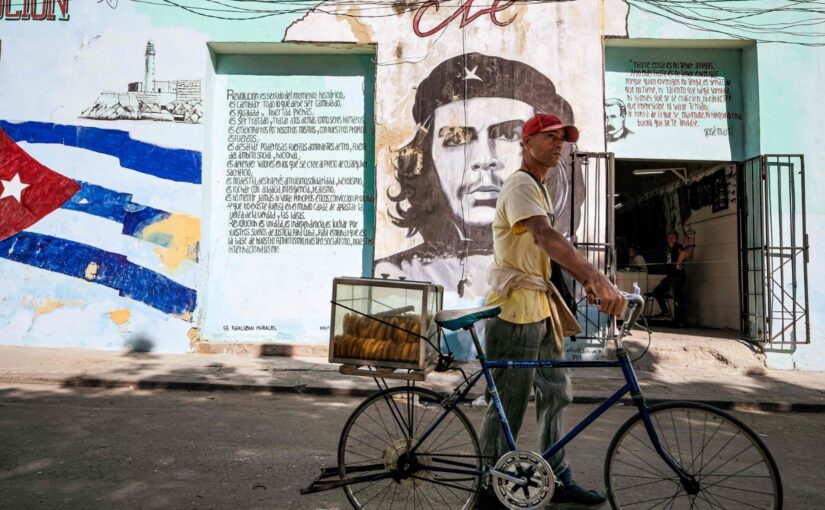
Cuba’s economic reforms and the prospects for socialist renewal

This month Cuba approved the most far-reaching changes to its economic model in more than 60 years. In this article, Carlos Martinez argues that – far from the blockade finally breaking the Revolution – the reforms are best understood as a defence of socialism under siege, following the strategic logic China has pursued since 1978: the controlled use of markets and foreign investment to develop the productive forces while the Communist Party retains political power and public ownership of the commanding heights.

This article first appeared on Friends of Socialist China. A version of the article, translated into Portuguese, can be found on Brasil de Fato.

This month Cuba announced the most far-reaching changes to its economic model in more than 60 years. Approved by an Extraordinary Plenum of the Central Committee of the Communist Party of Cuba and passed unanimously by the National Assembly, the programme runs to 23 strategic axes and 176 concrete measures. Predictably, much of the Western press – along with a substantial section of the Western left – has rushed to interpret it as the moment the blockade finally broke the Revolution, as proof that Havana has at last been forced onto the capitalist road.

Such a reading misunderstands both the content of the measures and the history that has produced them. The reforms are best understood as Cuba’s attempt to do what several other besieged socialist states have had to do before it: to defend itself by developing its productive forces, on its own terms, but under conditions not of its choosing. As the Cuba specialist Isaac Saney puts it, the measures, “far from representing a retreat”, in fact constitute “a strategic effort to preserve and deepen the social gains of the Revolution in the face of relentless external pressure and unprecedented economic challenges”.

For those that have followed China’s development, the framework on display in Havana is immediately recognisable. Cuba is reaching, under enormous duress, for the strategic logic that has guided the Chinese Revolution since 1978: the controlled use of markets and foreign investment to develop the productive forces, while the Communist Party retains political power and public ownership of the commanding heights. It is also reaching for the support of its longstanding friends. China and Vietnam have been Cuba’s most consequential partners in weathering the present siege, and the deepening relationship between their parties forms an essential part of the backdrop to these reforms.

What the reforms actually do

Under the new package, Cuba will scrap the long-standing requirement that foreign investors partner with a state-owned company. It will authorise large private firms, permit private banks to operate, allow private real estate development, and open the door to domestic and foreign investors acquiring stakes in state enterprises, some of which are to be converted into joint-stock companies.

Cubans living abroad will be actively encouraged to invest, donate, import technology and build businesses at home. State-owned enterprises – which remain the principal pillar of the economy – will be granted far greater autonomy over investment, hiring, pricing and financial management, while municipal governments will gain expanded powers to pursue local development. Wage ceilings that have motivated significant numbers of skilled professionals to leave the country are to be lifted.

Continue reading Cuba’s economic reforms and the prospects for socialist renewal

Interview: Can the working class win?

The video below is an interview of Carlos Martinez by Jason Smith, for CGTN’s The Bridge to China podcast. Recorded in the lead-up to the 105th anniversary of the founding of the Communist Party of China, the wide-ranging conversation covers the nature of China’s economic system, the achievements of Chinese socialism, the state of the left in the West, and the transition to a multipolar world.

Carlos argues that China is best understood on its own terms, as socialism with Chinese characteristics: a fundamentally socialist system with a significant market component, in which the state holds the commanding heights – banking, energy, telecommunications, rail and the top levels of industry – and directs investment through national planning. The presence of markets, billionaires or inequality does not make a country capitalist; what matters is which class holds power, and the ultimate measure is the living standards of ordinary working people.

On that measure, China stands apart: it is the country that has eliminated extreme poverty, effectively ended homelessness, and pursued common prosperity, a world-leading renewable energy build-out and the saving of lives during the Covid pandemic. If China is socialist and succeeding, Carlos contends, that vindicates the project of the global left – which is precisely why the West’s new cold war is aimed at preventing a socialist alternative from succeeding.

The interview surveys the scale of China’s transformation – some 800 million people lifted out of poverty, the “seven guarantees” that underpin poverty alleviation, life expectancy rising from around 35 at liberation to over 79 today, near-universal mortgage-free home ownership, and the most extensive public infrastructure in the world. Comparing China with India – liberated within two years of one another, from similar starting points – Carlos draws out what a revolution and Communist Party-led planning have made possible: sovereign development free of IMF discipline, coherent five-year plans, and the capacity for mass mobilisation, exemplified by the three million cadres deployed in the poverty alleviation campaign.

Turning to the West, Carlos describes the long retreat of the left under the neoliberal counter-revolution – de-industrialisation, the rise of the precariat, and a social peace bought with the super-profits of imperialism that are now drying up. He points to the crisis of confidence deepened by Gaza and to the Corbyn moment as signs that material reality is shifting, and to a growing openness to China – from “Chinamaxxing” and the RedNote migration to the surge in inbound tourism. The dogmatism that still leads much of the Western left to withhold recognition of China’s decidedly socialist achievements, he argues, plays into a US grand strategy whose core is the encirclement and containment of China.

The lesson for developed and developing countries alike, Carlos concludes, is that public ownership is not inefficient but the precondition for any serious industrial policy, that long-term planning beats short-term shareholder value, and that the West must come to terms with an inevitably multipolar world – starting, at a minimum, with adherence to the United Nations Charter.

A full transcript follows below. Individual answers will also be posted as separate clips on the Invent the Future YouTube channel.

Transcript

Jason Smith: Socialism, China, and the West. Hey everyone, I’m Jason Smith, originally from sunny California, now living in beautiful Beijing. Joining us today is Carlos Martinez, a British Marxist writer, researcher, and anti-imperialist activist. He is co-author of The East Is Still Red: Chinese Socialism in the 21st Century, and co-editor of Friends of Socialist China. Welcome back to The Bridge to China.

Carlos Martinez: Hey Jason, great to be with you. I think this is the third time.

Jason Smith: I think it is. I really wanted to have you on because the 105th anniversary of the founding of the Communist Party of China is coming up, and I wanted to get your thoughts on socialism, Marxism and Western perspectives of Chinese socialism. But before we get there — people may not have seen our previous interviews, or may not be familiar with your work. Can you tell us a little bit about your experience with China and how you got into studying it?

Continue reading Interview: Can the working class win?

Why does China still love Mao so much?

The standard Western story about modern China is that Mao has been quietly buried by the Communist Party, that Deng Xiaoping repudiated his legacy, and that the China that emerged after 1978 is no longer really socialist. By implication, China’s success is the success of capitalism, not of the revolution.

So why do ordinary Chinese people still travel in their millions to Shaoshan – the village in Hunan where Mao was born, now one of the most-visited tourist sites in China – to pay their respects to the founder of the People’s Republic? Stand there among the crowds and the Western story falls apart on contact.

In this video, Carlos Martinez draws on a recent trip to Shaoshan, and on the hard development data from the Mao era, to answer that question: the Mao era and the reform era are not opposed phases of Chinese history. They are two stages of a single revolutionary project, and the Chinese people know it.

Between 1949 and 1976, life expectancy in China rose by 32 years – the fastest improvement ever recorded by any country in human history. Adult illiteracy fell from over 80 per cent to 33 per cent by 1978. Land was redistributed. Women were emancipated. A complete industrial base was built from near-zero. The treaty ports were abolished. The country was unified after a century of fragmentation. This is the China the post-Mao leadership inherited – not the impoverished backwater of Western myth.

Without Mao, no Deng. Without 1949, no 1978. As the late Egyptian Marxist Samir Amin put it, the take-off of the post-1978 period “would not have been possible without the economic, political and social foundations that had been built up in the preceding period.” It is also exactly how the Communist Party of China understands its own history, in Xi Jinping’s doctrine of “the two cannot negates.”

Sources and further reading:

Carlos Martinez, “No great wall: on the continuity of the Chinese Revolution”
https://invent-the-future.org/2021/05/no-great-wall/

Samir Amin, “China 2013”
https://monthlyreview.org/articles/china-2013/

Domenico Losurdo, “Has China Turned to Capitalism? Reflections on the Transition from Capitalism to Socialism”
https://redsails.org/losurdo-on-china/

Friends of Socialist China
https://socialistchina.org

Transcript

Hello and welcome. In April this year, I had the privilege of visiting Shaoshan, the small village in Hunan province where Mao Zedong was born in 1893. And Shaoshan is one of the most visited tourist sites in China. Ordinary Chinese people travel there in their millions every year. The Mao family home is preserved as it was. There’s a major statue erected in 1993 for the centenary of his birth. And across China, there are museums, study halls, and exhibition rooms commemorating the life of the man Chinese people overwhelmingly regard as the founder of modern China.

And I wanted to talk about Shaoshan because what you see there very much goes against the narrative that Western ruling class media and academia have been telling us about China for the last half century or so. The standard story runs like this. Mao’s been quietly buried by the Communist Party of China. Deng Xiaoping repudiated his legacy. The reform era China that emerged after 1978 is essentially a market economy with red branding, no longer connected to the revolutionary project that began in 1921, or to the founding of the People’s Republic in 1949. And the implication is that China’s success story is not a function of socialism. The achievements you can see across the country today are the achievements of capitalism. And Mao is some kind of embarrassing relic that the party can neither fully claim nor fully repudiate.

Continue reading Why does China still love Mao so much?

Lenin walks around the world

The following article by Carlos Martinez, discussing Lenin’s contribution to understanding the global applicability of Marxism, was originally published on 20 January 2024 in the Morning Star, to coincide with the centenary of Lenin’s death.

The original slogan of the communist movement, ‘Workers of the world unite’ – the rallying cry and final phrase from the Communist Manifesto, written by Marx and Engels in 1848 – was put forward at a time when the nascent communist movement was geographically limited to Europe and North America, and focused almost exclusively on the industrial working class.

Lenin’s study of global political economy, and particularly of the dynamics of monopoly capitalism and the emergence of modern imperialism, led him to an acute understanding of the expanded – global – applicability of Marxist thought.

Study of imperialism

Marx had already outlined the economic dynamics of an emerging international capitalism in Volume 1 of Capital, first published in 1867: “A new and international division of labour springs up, one suited to the requirements of the main industrial countries, and it converts one part of the globe into a chiefly agricultural field of production for supplying the other part, which remains a pre-eminently industrial field.”

By the end of the 19th century, the extraordinary concentration of capital and the supremacy of finance capital had brought the era of ‘free market’ capitalism to an end and ushered in an era of monopoly capitalism – in which phase capitalism remains.

Having dominated and saturated the home market, monopolies were increasingly driven abroad in pursuit of profit. Lenin wrote in Imperialism, the Highest Stage of Capitalism that “the export of capital greatly affects and accelerates the development of capitalism in those countries to which it is exported.” Export of capital stimulated the incorporation of the “chiefly agricultural” economies of the Global South into the world capitalist system, introducing industrial production and creating a social class that had no option but to sell its labour power – the working class.

With the internationalisation of capital and the subjugation of the greater part of the planet by a handful of wealthy nations, capitalism became more and more militarised. Extreme force was needed to keep colonies and “spheres of influence” under control, and furthermore was a key feature of the rising competition between the imperialist countries for control of the world’s land, labour, natural resources and markets. Such competition was the basis for World War 1.

Lenin understood that, with capitalism having “grown into a world system of colonial oppression and of the financial strangulation of the overwhelming majority of the people of the world by a handful of ‘advanced’ countries”, the capitalist class of the metropolis had become an enemy not just to the working class in the advanced capitalist countries but to the broad masses of the oppressed in all countries. “Imperialism is leading to annexation, to increased national oppression, and, consequently, also to increasing resistance.”

This analysis provided the theoretical basis for a strategic unity of the socialist and national liberation movements, on which basis Lenin and the Bolsheviks proposed the development of a worldwide united front of the working class and all peoples oppressed by imperialism. Such a united front would be capable – indeed still is capable – of taking the fight to the oppressors, of defeating imperialism, of establishing national independence and sovereignty for the peoples of the Global South, and thereby opening the possibility for a global advance to socialism.

Hence at the second congress of the Communist International (Comintern) in 1920, ‘Workers of the world unite’ was updated to ‘Workers and oppressed peoples of all countries, unite’.

In Lenin’s report to the Third Congress of the Comintern in June 1921, he enthused: “The revolutionary movement among the hundreds of millions of oppressed peoples of the East is growing with remarkable vigour.” He elaborates on this in his letter Better Fewer, But Better, the last document he wrote:

“In the last analysis, the outcome of the struggle will be determined by the fact that Russia, India, China, etc account for the overwhelming majority of the population of the globe. And during the past few years it is this majority that has been drawn into the struggle for emancipation with extraordinary rapidity, so that in this respect there cannot be the slightest doubt what the final outcome of the world struggle will be. In this sense, the complete victory of socialism is fully and absolutely assured.”

Summing up this theoretical contribution in his 1924 book Foundations of Leninism, Joseph Stalin wrote that “the interests of the proletarian movement in the developed countries and of the national liberation movement in the colonies call for the union of these two forms of the revolutionary movement into a common front against the common enemy, against imperialism” and, further, that “the victory of the working class in the developed countries and the liberation of the oppressed peoples from the yoke of imperialism are impossible without the formation and the consolidation of a common revolutionary front.”

Imperialism and the split in socialism

Unfortunately, the pursuit of a global revolutionary anti-imperialist front was not a consensus position in the communist movement of the time. Many of the large workers’ parties in the West rejected – explicitly or implicitly – such a strategy and worked towards a tacit alliance with their ‘own’ imperialist ruling classes.

The material basis for such an alliance was provided by the superprofits of imperialism. The “high monopoly profits for a handful of very rich countries” opens up “the economic possibility of corrupting the upper strata of the proletariat, and thereby fosters, gives form to, and strengthens opportunism” (Lenin, Imperialism, the Highest Stage of Capitalism).

Further: “A few crumbs of the bourgeoisie’s huge profits may come the way of the small group of labour bureaucrats, labour aristocrats, and petty-bourgeois fellow-travellers. Social chauvinism and opportunism have the same class basis, namely, the alliance of a small section of privileged workers with ‘their’ national bourgeoisie against the working class masses.” (Lenin, Opportunism and the Collapse of the Second International)

Lenin labelled this phenomenon social chauvinism – “socialism in words, chauvinism in deeds” – and described it as “the utter betrayal of socialism” and “complete desertion to the side of the bourgeoisie.” In his 1916 article Imperialism and the Split in Socialism he wrote that “the opportunists (social chauvinists) are working hand in glove with the imperialist bourgeoisie precisely towards creating an imperialist Europe on the backs of Asia and Africa”, and that “objectively the opportunists are a section of the petty bourgeoisie and of a certain strata of the working class who have been bribed out of imperialist superprofits and converted to watchdogs of capitalism and corruptors of the labour movement.”

He pointed out that the ruling classes themselves perfectly well understand and deliberately implement this strategy. Indeed, he cites the notorious colonialist Cecil Rhodes, writing in 1895:

I was in the East End of London yesterday and attended a meeting of the unemployed. I listened to the wild speeches, which were just a cry for “bread, bread, bread,” and on my way home I pondered over the scene and I became more than ever convinced of the importance of imperialism. My cherished idea is a solution for the social problem, i.e. in order to save the 40 million inhabitants of the United Kingdom from a bloody civil war, we colonial statesmen must acquire new lands to settle the surplus population, to provide new markets for the goods produced by them in the factories and mines. The Empire, as I have always said, is a bread and butter question. If you want to avoid civil war, you must become imperialists.

Lenin concluded that, to defeat the social chauvinist trend and to move forwards with the global class struggle, communists must go “lower and deeper”; must seek out, educate and organise the most oppressed sections of the working class, “who are more oppressed than before and who bear the whole brunt of imperialist wars.” These strata are far less corruptible; are far more capable of learning “to appreciate their true political interests, to fight for socialism and for the revolution through all the long and painful vicissitudes of imperialist wars and imperialist armistices.”

Success of Leninism in practice

In words and deeds, the Bolsheviks pursued the global anti-imperialist front, seeking (in Lenin’s words) to “convert the [masses of the oppressed countries] into an active factor in world politics and in the revolutionary destruction of imperialism” (Third Congress of the Communist International).

This effort bore historic fruit. The Soviet Union rendered indispensable support to the national liberation and socialist movements in Africa, Asia and the Americas.

In his 1960 essay The Path Which Led Me To Leninism, Ho Chi Minh movingly describes his years in Paris in the early 1920s, participating in the debates between the Leninists and the social chauvinists.

My only argument was: “If you do not condemn colonialism, if you do not side with the colonial people, what kind of revolution are you waging?” … At first, patriotism, not yet communism, led me to have confidence in Lenin, in the Third International. Step by step, along the struggle, by studying Marxism-Leninism parallel with participation in practical activities, I gradually came upon the fact that only socialism and communism can liberate the oppressed nations and the working people throughout the world from slavery.

Similarly, Mao Zedong stated in 1949, just two months before the proclamation of the People’s Republic, that “it was through the Russians that the Chinese found Marxism. The salvoes of the October Revolution brought us Marxism-Leninism. The October Revolution helped progressives in China, as throughout the world, to adopt the proletarian world outlook as the instrument for studying a nation’s destiny and considering anew their own problems.”

In turn, the Chinese communists have played a crucial role in developing Lenin’s ideas of anti-imperialism and applying them in practice. The overthrow of imperialist domination and the construction of socialism in China, Korea and Vietnam represented a profound shift of the revolutionary centre of gravity in the world towards the East and the South. The radical governments emerging in the Sahel and Latin America today represent a continuation and deepening of this process.

Such are the outcomes of a revolutionary strategy based on the slogan ‘Workers and oppressed peoples of all countries, unite’. The outcomes of class collaborationist social democracy in the West are, it is fair to say, less impressive.

Lenin lives

Lenin was, above all, a revolutionary Marxist, and there are two famous quotes from Marx which to a significant degree encapsulate Leninism today: “A nation that oppresses another cannot itself be free”, and “Labour in the white skin can never free itself as long as labour in the black skin is branded.”

To be Marxist-Leninists in the 21st century means to return to a strategy of a worldwide united front between the socialist countries, the oppressed nations, and the working class in the imperialist countries. It means standing up for Palestine. It means continuing the fight for a united Ireland. It means opposing the campaign of containing and encircling China. It means opposing NATO. It means supporting the emerging multipolar trend. It means standing with Cuba, with Vietnam, with the DPRK, with Laos, with Venezuela, with Nicaragua, with Syria, with all countries defiantly standing up against imperialist hegemony. It means opposing racism, sexism and all forms of exploitation and oppression, rejecting collaborationism and social chauvinism, going “lower and deeper” and fighting resolutely for a socialist future.

Summary of ‘The CPC: Its Mission and Contributions’

This article by Carlos Martinez, originally published on Friends of Socialist China, summarises the document ‘The CPC: Its Mission and Contributions’, recently released by the Publicity Department of the Communist Party of China Central Committee. An abridged version of the article appeared in the Morning Star on 1 September 2021. The article has been translated into Dutch by our friends at ChinaSquare.


On 26 August 2021, the Publicity Department of the Communist Party of China (CPC) Central Committee released an important document, entitled ‘The CPC: Its Mission and Contributions’. The publication, consisting in its English translation of over 28,000 words, clearly represents a wide-ranging discussion within the CPC, reflecting on its contributions of the last hundred years and its goals and challenges for the future.

Continuity

The document emphasises the basic continuity at the heart of the CPC’s mission. Since its founding in July 1921, the CPC has devoted itself to the project of building socialism, establishing China’s sovereignty, creating a better life for the population, and contributing to a peaceful and prosperous future for humanity.

Continue reading Summary of ‘The CPC: Its Mission and Contributions’

Samir Amin: obituary

This article first appeared in issue 5 of Transform: A Journal of the Radical Left, November 2018.


On 12 August 2018, the global revolutionary movement lost one of its most outstanding thinkers. Born in Cairo in 1931, Samir Amin studied in Paris and received his early political education as a member of the French Communist Party. Moving back to Egypt in 1957, he worked as an economic advisor to the Nasser government before moving to Mali (1960) and then Senegal (1963). In 1975, he co-founded the Third World Forum, a network of intellectuals in Africa, Asia and Latin America, working to formulate models of development outside the context of imperialism.

Through his work and his writing, Samir Amin exercised significant influence on progressive governments and movements around the world, from China to Cuba, Venezuela to South Africa. The breadth of his influence is easily evidenced by the tributes that followed the announcement of his death, including from South Africa’s ANC, Venezuelan President Nicolás Maduro,1 and Bolivian President Evo Morales, who wrote that “the legacy of his ideals of social justice will be eternally acknowledged.”2

Overcoming Eurocentrism

Amin coined the term Eurocentrism in the mid-1970s to describe the ideology promoted by modern capitalism: a model that places Europe at the heart of global history and that considers (explicitly or implicitly) all human development to be of European origin, starting with the Greeks and Romans. Amin demonstrated, with great clarity and lucidity, how this ideology is leveraged to reinforce an actually existing global capitalism that consolidates wealth and power in Europe (and its Anglophone off-shoots) whilst perpetuating poverty and subjugation in Africa, Asia and Latin America.

Amin ruthlessly deconstructs the Eurocentric view of history, pointing out for example that Ancient Greece wasn’t in the slightest bit ‘European’ in its outlook; it was engaged in intense exchange of ideas and goods with Egypt, Mesopotamia and Persia (and to some extent China and India), at a time when Western Europe was “a backward and barbarous periphery”. It was only via the Crusades (in the 12th and 13th centuries AD) that the Italian towns were able to start asserting themselves as a global force, having won a monopoly on navigation in the Mediterranean.

Europe did not participate in the general development of the pre-modern system until very late, after the year 1000… At the dawn of the Christian era the population of Europe, including Italy, was about 20 million (8 per cent of the world population, less than 30 per cent of that of China, 50 per cent of that of the Middle East)… Until the year 1000 the productivity of European agriculture was greatly inferior to that of the civilised regions of China, India and the Middle East, and the continent still had no towns.3

By exposing the clear logical flaws of Eurocentric universalism, Amin was able to show that the dominance of modern global capitalism, far from being a permanent and pre-ordained set of affairs (or ‘end of history’), is the prodeuct of the very specific circumstances arising from Western Europe’s two major take-offs – at the end of the 15th century (the colonisation of the Americas) and the 19th century (the industrial revolution and the colonisation of much of the rest of the world). Once this ideology is challenged, it becomes far easier to visualise alternative political and economic systems to the Eurocentric nirvana of monopoly capitalism.

Critic of capitalism

Samir Amin made an in-depth analysis of modern wild-west capitalism – widely referred to these days as neoliberalism, but labelled more specifically by Amin as a “system of generalised monopolies based on an extreme centralisation of control over capital, accompanied by a generalisation of wage-labour”.4 This is different from the monopoly capitalism of a hundred years ago, in that “monopolies are now no longer islands in a sea of other still relatively autonomous companies, but are constitutive of an integrated system.” Even small and medium companies “are locked in a network of control put in place by the monopolies. Their degree of autonomy has shrunk to the point that they are nothing more than subcontractors of the monopolies.”5 Such a system is held in place throughout the globe via the monopolisation of technology, natural resources, finance, the media, and military capacity.

Although the capitalist class considers itself to be very modern and scientific, it has merely replaced a heavenly god with a metallic one. “‘Moneytheism’ has replaced monotheism. The ‘market’ rules like the ancient God.”6 This chimes with Marx’s biting observations about the ‘fetishisation’ of commodities under capitalism.

In the world of politics, this system of generalised monopolies is manifested as a “low-intensity democracy” in which people are encouraged to be passive, “devoid of authentic freedom, reduced to the status of passive consumers/spectators”. In essence Amin describes a plutocracy, with the nuance that “you are free to vote for whomever you want, because your choice has no importance”.7 This broadly correct assessment of course has its exceptions and caveats, and Amin was enthusiastic about the possibilities of Podemos and Syriza in terms of challenging the status quo in Europe.8

The long transition to socialism

In the same way that capitalism first developed within feudalism before breaking out of it, the long transition of world capitalism to world socialism is defined by the internal conflict of all the societies in the system between the trends and forces of the reproduction of capitalist relations and the (anti-systemic) trends and forces, whose logic has other aspirations – those, precisely, that can be defined as socialism.9

Although his analysis of capitalism makes for bleak reading, Samir Amin nonetheless remained a revolutionary optimist, a firm believer in a socialist future that will emerge – indeed is emerging – through the irreconcilable contradictions of capitalism. He vigorously rejected the idea that socialism has failed and that capitalist ‘liberal democracy’ has been permanently established as the pinnacle of social and economic organisation. As Vijay Prashad notes, “he was not interested in defeat”.10

In this framework, the retreats suffered by the socialist world – particularly the collapse of the European socialist states between 1989 and 1991 – should not be considered as the death of the socialist project, but rather as part of the inevitable ebb and flow of a complex historical trajectory that could take hundreds of years but which nonetheless has an inexorable tide. A similar idea was formulated by the Communist Party of China in response to the collapse of the USSR and the European people’s democracies. Deng Xiaoping famously observed in 1992: “Feudal society replaced slave society, capitalism supplanted feudalism, and, after a long time, socialism will necessarily supersede capitalism. This is an irreversible general trend of historical development, but the road has many twists and turns. Over the several centuries that it took for capitalism to replace feudalism, how many times were monarchies restored! Some countries have suffered major setbacks, and socialism appears to have been weakened. But the people have been tempered by the setbacks and have drawn lessons from them, and that will make socialism develop in a healthier direction. So don’t panic, don’t think that Marxism has disappeared, that it’s not useful any more and that it has been defeated. Nothing of the sort!”11

On the controversial subject of China and its role in the global transition to socialism, Amin displayed a clarity of understanding that is all too rare. In his recent writings, he spoke of China as “perhaps the only country in the world today which has a sovereign project.” That is: China is successfully pursuing its own development model, designed by its own government and not the institutions of international finance capital. “China is walking on two legs: following traditions and participating in globalisation. They accept foreign investments, but keep independence of their financial system. The Chinese bank system is exclusively state-controlled… That is the best model that we have today to respond to the challenge of globalist imperialism.”12 The results of China’s strategy have been “simply amazing. In a few decades, China has built a productive, industrial urbanisation that brings together 600 million human beings, two-thirds of whom were urbanised over the last two decades (almost equal to Europe’s population!). This is due to the plan and not to the market.”13

The indispensable nature of multipolarity

Samir Amin considered that, given the economic, political and ideological stranglehold imposed by western finance capitalism, the first step towards a globalised socialism was to encourage the development of a multipolar world: a world with multiple power bases; a set of geopolitical spaces in which political and economic control is exercised by the people of those spaces rather than by the European and North American elite; a world which will bring about “the defeat of Washington’s hegemonic project for military control of the planet”.14 Such an environment “makes possible the maximum development of anti-systemic forces.”15 Multipolarity is an increasingly popular concept, but Amin was a very early proponent, having first discussed it in his 1985 book Delinking: Towards a Polycentric World.

Amin witnessed and welcomed the left tide in Latin America, the rising cooperation between China and Russia, the establishment of BRICS, ALBA and other major projects of regional or south-south cooperation that are slowly breaking down hegemonism. However, he also recognised the possibility of a violent, unpredictable and irrational reaction to all this – such as the Make America Great Again lunacy of the current US administration. “The world now is in serious danger. The collective imperialism of the US, Western Europe and Japan are run by US leadership. In order to keep their exclusive control over the whole planet, they do not accept independence of other countries. They do not respect the independence of China and Russia. That is why we are about to face continuous wars all over the world. The radical Islamists are the allies of imperialism, because they are supported by the US in order to carry out destabilisation. This is permanent war.”

He went on to propose a clear strategic response: “Russia should unite with China, the Central Asian countries, Iran and Syria. This alliance could be also very attractive for Africa and good parts of Latin America. In such a case, imperialism would be isolated.”16

Taking Samir Amin’s work forward

Samir Amin was a brilliant and creative Marxist, an uncompromising anti-imperialist, a powerful voice for the oppressed, and a visionary of a socialist world. His work mapping the past, present and future of humanity is a weighty inheritance that the global progressive forces must now take forward.


  1. Via Twitter, 12 August 2018 

  2. Via Twitter, 12 August 2018 

  3. Samir Amin: Global History: A View from the South, Pambazuka Press, 2010 

  4. Samir Amin: The Implosion of Contemporary Capitalism, Monthly Review Press, 2013 

  5. Pambazuka: Audacity, more audacity, 2001 

  6. Global History: A View from the South, op cit 

  7. The Implosion of Contemporary Capitalism, op cit 

  8. MR Online: Glory to the Lucid Courage of the Greek People, Facing the European Crisis, 2015 

  9. Samir Amin, Russia and the Long Transition from Capitalism to Socialism, Monthly Review Press, 2016 

  10. The Hindu: Death of a Marxist, 2018 

  11. Deng Xiaoping, Excerpts from Talks Given in Wuchang, Shenzhen, Zhuhai and Shanghai, 1992 

  12. Defend Democracy Press: Samir Amin: How to Defeat the Collective Imperialism of the Triad, 2016 

  13. Monthly Review: China 2013 

  14. Samir Amin, Beyond US Hegemony? Assessing the Prospects for a Multipolar World, Zed Books, 2013 

  15. Russia and the Long Transition from Capitalism to Socialism, op cit 

  16. How to Defeat the Collective Imperialism of the Triad, op cit