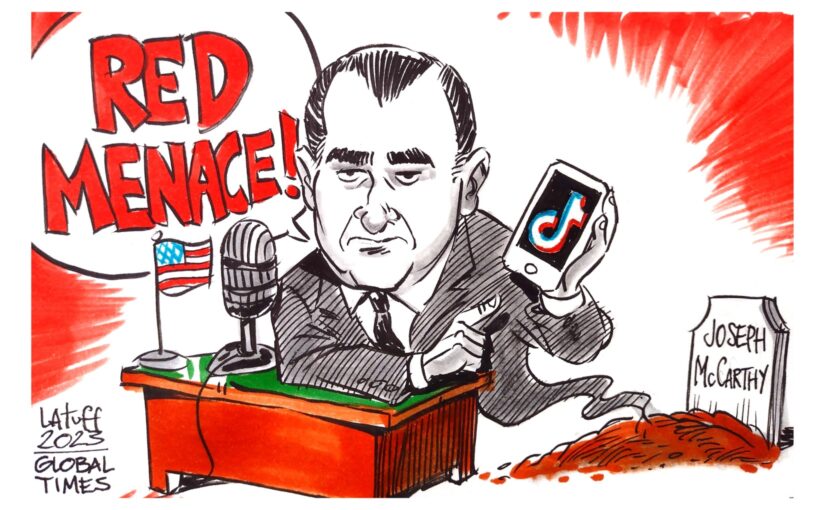
Two stories eight days apart, both from London newspapers, both pushing a McCarthyite agenda – one aimed at Britain, one at the United States. The Telegraph announced that “China is funding pro-Palestine marches in UK”. The Times reported that members of the Democratic Socialists of America had signed a public statement of support for Chinese socialism and, worse, had travelled to China.
Neither story alleges a crime. Neither produces a document showing a payment from the Chinese state or an instruction from the Communist Party of China. Both rest on the same syllogism: people hold anti-war positions that are also held in Beijing; therefore they hold them because of Beijing; therefore anti-war campaigners are not citizens exercising their rights but instruments of a foreign power.
The following article takes the two chains apart – four degrees of hedged separation in the British case, and in the American one the discovery that socialists are interested in socialism – and sets them against how Washington and London actually operate, from AIPAC’s congressional junkets and the State Department’s International Visitor Leadership Program to the pro-Israel lobbyists who have donated to half of Keir Starmer’s cabinet.
It then places the episode in its proper lineage. Ellen Schrecker’s segregationists blamed “outside agitators”; the NAACP was investigated for communist infiltration; Paul Robeson lost his passport for eight years; W.E.B. Du Bois was indicted as an unregistered foreign agent in his eighties. The purpose was never to prove foreign control, but to deny that the people protesting had minds of their own.
And it examines the machinery now being assembled: 3,061 terrorism-related arrests in Britain in the year to March 2026, 92 percent of them relating to Palestine Action; the Foreign Influence Registration Scheme and the campaign to add China to its enhanced tier; and, in the United States, presidential memorandum NSPM-7, which lists “anti-Americanism, anti-capitalism, and anti-Christianity” among the indicators federal agencies are to investigate.
The following article by Friends of Socialist China co-editor Carlos Martinez is an expanded version of a piece that first appeared in the Morning Star. This version was published on Friends of Socialist China.
Two stories, eight days apart, both from London newspapers, pushing a McCarthyite agenda in two different countries. The Telegraph announced that “China is funding pro-Palestine marches in UK”. The Times reported that members of the Democratic Socialists of America – “the left-wing group behind Zohran Mamdani’s rise” – had signed a public statement of support for Chinese socialism and, worse, had travelled to China.
Neither story alleges a crime. Neither produces a document showing a payment from the Chinese state, an instruction from the Communist Party of China, or any kind of broken law. Both rest on the same syllogism: people hold anti-war positions that are also held in Beijing; therefore these positions are taken up because of Beijing; therefore anti-war campaigners are not citizens exercising their basic democratic rights, but instruments of a foreign power.
Britain: four degrees of separation
Take the evidence as presented by the Telegraph. US congressional investigators are examining £250,000 in “alleged” payments to a company “linked to” CodePink in the UK, from firms “connected to” Neville Roy Singham, a US businessman “accused of” financing pro-China content.
Four degrees of separation, with every link in the chain a substantial hedge, from which emerges a headline asserting that the People’s Republic of China is funding the mass movement in Britain against genocide in Gaza. Singham is a US citizen who made his money building a software consultancy and now spends it on causes he believes in. What the allegations amount to, at most, is a US businessman with left-wing opinions funding a US peace group that has a British affiliate.
And what are the recipients of this money charged with doing? Organising protests against Britain’s involvement in genocide. Campaigning for peace with Iran. Calling for the removal of British military bases in Cyprus. Visiting China and saying that it is not our enemy. Every one of those is a lawful (and obviously principled and correct) political position, and several of them are held by most of the British public. Polling by YouGov in July found that 50 percent of Britons believe Israel is committing genocide in Gaza against 17 percent who believe it is not, and that 55 percent think Britain should no longer treat Israel as an ally.
Also, consider the sums under discussion. A quarter of a million pounds would barely cover the placards at London’s anti-genocide demonstrations, let alone the portaloos. Spread across the half of the country that has reached the conclusion Beijing supposedly paid for, it comes to less than a penny a head. If that is the price of British public opinion, the Chinese state has driven a remarkable bargain.
The US: socialists found to be interested in socialism
The US version of the story is, remarkably, even thinner. The Times has made the extraordinary discovery that socialists are interested in socialism.
Thirteen members of the DSA, it reports, have signed the Friends of Socialist China statement, declaring that they aim to support the People’s Republic and to promote understanding of Chinese socialism. This is a public statement, published on a public website, which anyone may sign and which has attracted just shy of 1,000 signatories to date from dozens of countries. Thirteen of them turn out to belong to a US socialist organisation. Many readers may struggle to identify a scandal.
Then comes the evidence of sinister coordination: some DSA members went to China. A provincial foreign affairs office in Guizhou helped arrange an itinerary. They attended the parade marking 80 years since the victory over Japanese fascism. According to one of them, they were – gasp – treated well.
From this, the anti-China campaigner Alexander Reid Ross concludes that the trips “exhibit fingerprints of extraordinarily high-level co-ordination by the People’s Republic of China”, and speculates that these individuals’ standing within the DSA “has been improved precisely through the efforts of foreign parties”, raising the question of “who they’re working for”. No offence is alleged and no evidence is offered.
It is probably not a coincidence that the story has surfaced just as Washington is making a concerted effort to revive its Xinjiang campaign. One of the DSA members had visited Xinjiang and reported that he found nothing to support Western accusations of forced labour. To go to Xinjiang and decline to repeat the slanders is evidently the graver offence. Better by far to be one of those who have built entire careers on Xinjiang atrocity claims and who have, for the most part, never set foot in the place.
Set this against how Washington and London actually work
The double standard is easily identified. AIPAC’s affiliate flies members of Congress to Israel as a matter of routine. The State Department’s own International Visitor Leadership Program has hosted more than 230,000 foreign leaders since 1940, over 500 of whom went on to become heads of state or government – a rate of return on hospitality that Guizhou could barely dream of. The National Endowment for Democracy funds journalists, opposition parties and NGOs across the planet and publishes the grant lists in its annual reports.
Meanwhile in London, pro-Israel lobbyists have donated to half of Keir Starmer’s cabinet, a sum considerably higher than the £250,000 that so alarmed the Telegraph.
None of that is considered “foreign interference”, but a Chinese provincial foreign affairs office booking a few hotel rooms is a matter of national security.
The New Red Scare
None of this is new.
The historian Ellen Schrecker describes how segregationists in the American South always insisted that the region’s black population was perfectly content with its subordinate status, and that demands for change were “the product of ‘outside agitators’”. Linking those agitators to the Communist Party, she writes, gave the segregationists “new allies as well as a more modern rationale” for their campaign against the civil rights movement. The same device had served US employers for decades before that: strikes were never the product of legitimate grievance but the work of outside agitators, “usually foreign-born”.
The purpose was never to prove foreign control. It was to deny that the people doing the protesting had minds and interests of their own.
So the NAACP (the National Association for the Advancement of Colored People, founded in 1909 and considered the US’ oldest civil rights group), by then a decidedly moderate organisation, was investigated for communist infiltration and became, as Gerald Horne records in Black and Red, among the first targets of the red scare. Paul Robeson had his passport confiscated for eight years and was systematically denied concert venues, the object being, in Horne’s phrase, to make him “radioactive”. Rev. Martin Luther King Jr. was wiretapped and briefed against, with J. Edgar Hoover’s FBI formally designating him “the most dangerous Negro of the future in this Nation from the standpoint of communism”.
And the world-famous scholar Dr. WEB Du Bois, co-founder of the NAACP, then in his eighties, was indicted as an unregistered foreign agent under the Foreign Agents Registration Act.
The damage was not confined to the individuals named. Schrecker’s verdict is that opposition to the Cold War became so completely identified with communism that “it was no longer possible to challenge the basic assumptions of American foreign policy without incurring suspicions of disloyalty”. That is the actual purpose of an exercise like this one: not primarily to convict any particular individual, but to make a set of opinions – against war, against racism, against genocide, against the encirclement of China – too expensive and too dangerous to hold.
The machinery now being built
In Britain, Palestine Action has been proscribed under terrorism legislation, and the consequences show up in the government’s own figures. In the year ending March 2026 there were 3,061 terrorism-related arrests, an increase of 1,186 percent on the previous year, and 2,819 of them – 92 percent – related to alleged support for Palestine Action. Quite an upsurge in “terrorism” – without a single fatality or even injury. Charges under section 12 of the Terrorism Act, which covers support for a proscribed organisation, had run at around five a year between 2019 and 2023; in 2024 there were 17. A counter-terrorism apparatus built to deal with bombers now focuses nine-tenths of its arrests on a protest movement, perhaps a majority of whom are pensioners, and only a small fraction of those arrested are ever charged.
As Sara Vivacqua documents in the Canary, the same powers have been turned on journalists covering the genocide. Asa Winstanley of The Electronic Intifada had his home raided in October 2024 and his devices seized, containing material capable of identifying sources in Palestine, and has never been charged. Kit Klarenberg was stopped at Luton Airport under Schedule 3 of the Counter-Terrorism and Border Security Act, and says the questioning made plain that the object was his journalism rather than terrorism.
The Foreign Influence Registration Scheme went live last year; its enhanced tier, which makes it a criminal offence to act at the direction of a specified foreign power, in areas beyond just political influence, without declaring it, currently applies to Russia and Iran, and there is a sustained campaign to add China to the list. Put that together with a year of newspaper stories linking the Palestine movement to Beijing, and the state acquires a mechanism for treating anti-war protest as a hostile foreign operation.
In the United States the equivalent already exists, and it is the same statute. Presidential memorandum NSPM-7, signed in September 2025, directs federal agencies to investigate nonprofits, activists and their donors, listing “anti-Americanism, anti-capitalism, and anti-Christianity” among the indicators to be looked for, and assigning Joint Terrorism Task Forces to pursue violations of the Foreign Agents Registration Act. An organisation whose members are on record supporting Chinese socialism, and who may have accepted a hotel booking from a Chinese provincial government, is precisely the kind of thing that memorandum was drafted to capture.
What is actually being defended
Ordinary British people did not need the Communist Party of China to make them angry about Gaza. Nearly three years of televised mass killing, British-made components in the aircraft, RAF surveillance flights out of Akrotiri feeding information to an army facing genocide proceedings at the International Court of Justice: millions of people in Britain concluded that their government was complicit and reaching that conclusion required no assistance whatsoever from Beijing. Nor do young Americans need instructions from Guizhou to notice that they cannot afford rent, and that a country which has eliminated extreme poverty and become the world’s first green energy superpower might be worth studying.
Which is what the accusation is for. Not to show that anyone took Chinese money – nobody has shown that anyone did – but to disqualify a position rather than answer it. An argument traced back to a foreign capital need never be met on its merits. So the Times assembles a chain running from rent control in New York through the DSA and a Guizhou hotel booking to Beijing, and the Telegraph assembles one running from a march against genocide through CodePink and a US software millionaire to the same destination. And it has to be China at the end of both chains, because China is the country doing most to prove that socialism works and that a better world is possible.
It’s essential that we see through this cynical manoeuvre, defend those being targeted, and resist the creeping authoritarianism that is being normalised in the name of “security”. The people marching for Palestine are not instruments of a foreign power. They are ordinary human beings who are disgusted with their own government’s complicity in genocide. And on this issue at least they represent the views of the majority.