
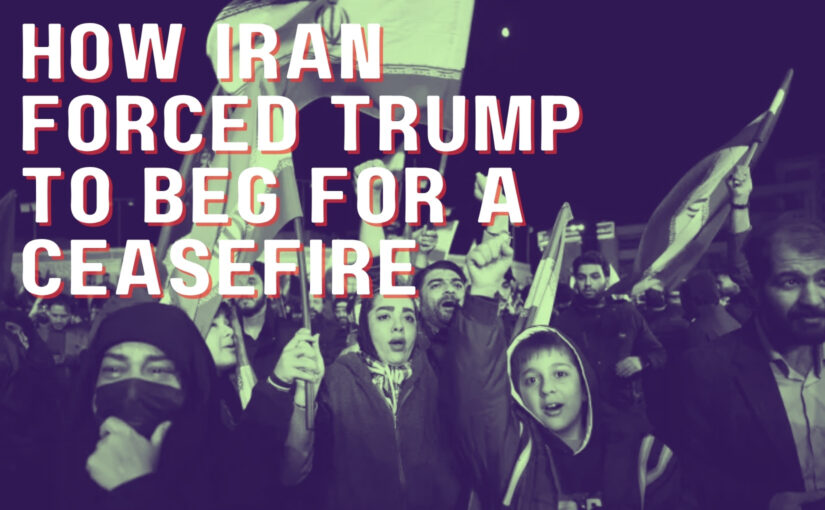
After 40 days of US-Israeli military aggression, Iran forced Washington to the negotiating table – on Iran’s terms. Trump agreed to a two-week ceasefire based on a 10-point Iranian proposal that included the lifting of all sanctions, acceptance of Iran’s enrichment rights, payment of war reparations, and the withdrawal of US combat forces from the region. This is a historic defeat for the US empire and a historic victory for the Iranian people. In the video below, Carlos Martinez breaks down:
- The crucial China-Russia veto at the UN Security Council – which happened just hours before the ceasefire and closed off the US escalation pathway, leaving Trump with no option but to negotiate.
- Iran’s 10-point proposal and what it means – compared to what Trump and Netanyahu actually set out to achieve.
- Why the ceasefire is not a capitulation but a continuation of the battlefield by diplomatic means.
- The “too early to celebrate” critique – and why the Iranian leadership, not foreign commentators, gets to decide how Iran resists.
The war on Iran was supposed to demonstrate US power. Instead it has demonstrated its limits. The Iranian people have paid an enormous price – we honour that by taking their victory seriously.
The embedded video is followed by the transcribed text.
After 40 days of war the US has pushed for a two-week ceasefire with Iran, with negotiations towards a lasting peace beginning this Friday in Islamabad. It’s worth pausing to understand just how significant this moment is, and why it happened the way it did.
Let me start with something that happened just hours before the ceasefire was announced. At the UN Security Council on Tuesday, Bahrain — backed by Jordan, Kuwait, Qatar, Saudi Arabia and the UAE — put forward a resolution calling on states to “coordinate efforts to protect commercial shipping in the Strait of Hormuz.” This was, in plain terms, the US trying to use the UN to legitimise military action to forcibly reopen the Strait on its own terms.
Bahrain had already watered the resolution down significantly — removing any explicit authorisation of force — in an attempt to get it through. It didn’t work. China and Russia vetoed it.
The resolution provided for a major escalation, with the Gulf states fully involved, quite possibly involving a ground invasion. China and Russia’s veto took away that escalation pathway and left the Trump regime with no option other than to beg for a ceasefire on Iran’s terms.
US ambassador Mike Waltz was left fuming, condemning the vetoes as “a new low.” France “deplored” them. But within hours — hours — Trump announced the ceasefire. That’s almost certainly not a coincidence.
So China’s consistent position — demanding a ceasefire, condemning the US-Israeli illegal aggression, opposing military escalation, supporting negotiation, supporting Iran’s sovereignty — has been vindicated in real time. As has Pakistan’s consistent position and its provision of mediation and a platform for negotiations.
As for the ceasefire itself.
Iran has declared — and I’m going to read this directly — “a historic and crushing defeat of the United States and the Israeli regime.” It says that “the enemy had no way forward but to submit to the will of the great nation of Iran and the honourable Axis of Resistance.” And it describes the past 40 days as “one of the heaviest combined battles in history.”
Iran’s 10-point proposal — which Trump himself has described as “a workable basis on which to negotiate” — includes: a US commitment to no further acts of aggression; continued Iranian control of the Strait of Hormuz; acceptance of Iran’s nuclear enrichment rights; the lifting of all primary sanctions; the lifting of all secondary sanctions; the termination of all UN Security Council resolutions against Iran; the termination of all IAEA Board of Governors resolutions against Iran; payment of damages to Iran for losses suffered in the war; withdrawal of US combat forces from the region; and cessation of hostilities on all fronts — including Lebanon.
Let that sink in for a moment. The Trump and Netanyahu regimes went into this war promising regime change. Promising to take control of Iran’s energy resources. Promising to deliver Iran back into the US-Israeli orbit — to return it to the kind of subservient status it had before the 1979 revolution.
What they’ve ended up accepting, at least as a basis for negotiation, is the permanent recognition of Iranian sovereignty, Iranian control of Hormuz, Iranian enrichment rights, an end to sanctions, and a US military withdrawal from the region.
Trump of course is spinning this as hard as he can. He’s claiming the US has “already met and exceeded all military objectives.” He claims the ceasefire is some sort of gesture of magnanimity. It’s face-saving nonsense, and everyone knows it.
Now I want to address something directly, because a lot of people are saying that it’s too early to celebrate, that the conflict could easily restart. Some people are even saying that Iran shouldn’t have agreed to this ceasefire which will give the US and Israel a chance to regroup and rearm.
Firstly, who are we to tell Iran how to resist? Iran has been under assault for 40 days. Thousands of civilians have been killed, including 168 schoolgirls in Minab. Iran’s cities have been bombed. Its infrastructure has been targeted. Its supreme leader was assassinated. And through all of that, Iran has held firm. Iranian people have been out on the streets in their millions every night protesting this war and showing their support for the government, for the armed forces, for the constitution. Iran has kept Hormuz closed. It struck US military assets across the Gulf. It has smashed the myth of Israel’s golden dome. It’s forced the most powerful military in the world to the negotiating table on Iran’s terms.
The Iranian leadership knows what it’s doing. The Supreme Council statement makes clear that “the negotiations are a national negotiation and an extension of the battlefield” — Iran is not laying down its arms, it is taking the battlefield into the diplomatic arena from a position of strength.
The statement also points out: “Our hands are on the trigger, and the moment the slightest mistake is made by the enemy, it will be answered with full force.” This is very much not a capitulation.
Of course we need to be vigilant. Of course we can’t simply trust Trump and Netanyahu to honour what’s been agreed. These are people who tore up the JCPOA. Who assassinated Qassem Soleimani. Who launched the 12-day war while Iran was negotiating. Who launched the current war while Iran was negotiating.
The history of US commitments to Iran is a history of betrayal. The Iranian leadership knows this better than any of us do.
So the ceasefire is not a victory lap. It’s the beginning of a negotiation. And the outcome of that negotiation is not guaranteed. There are real risks — Israeli sabotage, US backsliding, hawkish elements in Washington who will be pushing to re-escalate.
But we can’t allow that caution to negate this historic victory by Iran. The US military machine, for all its firepower, could not break the heroic Iranian people. Trump threatened to destroy “a whole civilisation” if Iran didn’t submit. Iran didn’t submit. And now the US is sitting down to negotiate on Iran’s terms.
Let’s take a look at the big picture.
This war has been about gaining control of Iran’s energy resources; getting rid of the only sovereign power in the region; breaking the Axis of Resistance; ending state-level support for Palestinian resistance; reasserting US dominance over the Middle East; squeezing China’s energy supply lines; disrupting the Belt and Road Initiative; and ultimately about upholding the Project for a New American Century and maintaining US global hegemony.
None of that has been achieved. In fact, the opposite. The US military presence in the Gulf has been devastated. The Western alliance has fractured. The dollar’s role in oil pricing has been further undermined. The Global South has watched, and drawn its conclusions. And China — which has stood firm throughout, vetoing punitive resolutions, sending envoys, proposing ceasefire frameworks alongside Pakistan — has emerged with its credibility as a force for peace substantially enhanced.
The war on Iran was supposed to demonstrate US power. Instead it has demonstrated its limits.
The devastation of 40 days of bombing cannot be undone. The Iranian people have paid an enormous price. We should honour that by taking their victory seriously, by continuing to build solidarity, and by pressuring our own governments in the West to respect Iran’s sovereignty, to support a just and lasting peace, and to end their own warmongering in the region.
But today is a day to acknowledge what Iran and its people have achieved. Against overwhelming firepower, against genocidal threats, against the full weight of the US-Israeli military machine: Iran held strong, and the empire blinked first.