
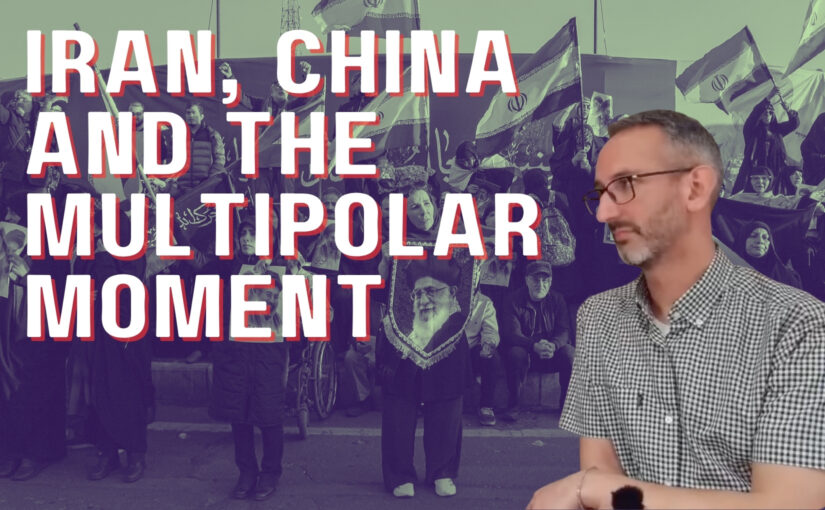
Recorded in Changsha, China, this wide-ranging conversation between Carlos Martinez and Danny Haiphong focuses on some of the most urgent questions in contemporary world politics: the Iran ceasefire, the Strait of Hormuz, the collapse of US military credibility, and what it all means for China and the multipolar world.
Carlos argues that Iran is playing a sophisticated and restrained game – responding precisely and proportionately to every US provocation, never escalating beyond what the situation requires. The IRGC’s recent seizure of Israel-linked vessels attempting to bypass Iran’s Hormuz regulations was not aggression but enforcement: Iran exercising sovereign control over its territorial waters in response to a US blockade that itself violates the ceasefire terms. With 34 Iranian oil tankers having bypassed the blockade and reached global markets, the attempt to economically
strangle Iran is visibly failing.
The military picture for the US is stark. Drawing on Center for Strategic and International Studies (CSIS) analysis, Carlos and Danny detail the extraordinary depletion of US munitions – nearly half of Patriot and THAAD interceptors, 45 percent of precision strike missiles, 30 percent of Tomahawk stockpiles – expended in just 40 days of hostilities. Replacing these systems will take years. Meanwhile Iran has been rapidly replenishing its stockpiles of missiles and drones. The asymmetry is decisive: Iran has more cards to play, more escalation options unused, and a population of 93 million ready to defend their country. A land invasion, Carlos notes, would be the greatest US military defeat since Vietnam, and perhaps in history.
The conversation turns to the deeper strategic logic of the conflict – which is not only about Iran, but about Palestine, regional hegemony, and the long-term objective of suppressing China’s rise. Control of Venezuelan oil, disruption of Iran’s energy relationship with Beijing, dominance of the Strait of Hormuz: these are moves in a long game aimed at encircling China before a potential hot war in the Pacific. The irony, Carlos argues, is that the war has achieved the opposite – depleting US military capacity, accelerating the multipolar trajectory, and motivating the countries of the ‘intermediate zone’ in Europe and elsewhere to engage more deeply with China as a stable and responsible global actor.