The US president has said he expects the Cuban government to be gone “by the end of the year”. His administration has indicted Raúl Castro, killed nearly 200 people in extrajudicial strikes in the Caribbean and Pacific, and tightened a blockade now in its 64th year. So it’s worth asking, seriously: what is the actual alternative to socialist Cuba that’s being proposed by the imperialists?
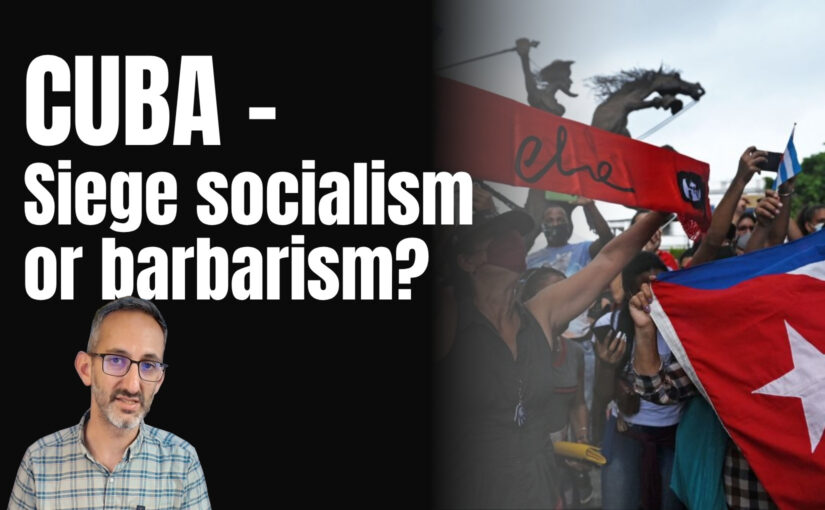
In this video, Carlos Martinez takes up the late Michael Parenti’s concept of “siege socialism” from his 1997 book Blackshirts and Reds, and argues that Cuba is the canonical example of it today. The video looks at what Cuba has held onto under siege – life expectancy higher than the US, infant mortality lower than the US, world-leading literacy and medical training – and compares it with the countries in the region that took the path Washington wanted them to take, such as Haiti, the Dominican Republic, and pre-revolutionary Cuba itself.
Carlos also looks at why the trajectory may be turning: Chinese investment in 92 solar parks, the rise of multipolarity, and the prospect of energy sovereignty as the way out of the siege.
Rosa Luxemburg’s “socialism or barbarism” was a philosophical statement in 1916. In the Caribbean in 2026, it is a concrete choice.
Note an article version of the video has been published in the Morning Star.
Sources and further reading:
Michael Parenti, Blackshirts and Reds (1997)
Cuban government statement on the indictment of Raúl Castro
China stands with Cuba against illegal indictment of Raúl Castro
Transcript
Hello and welcome.
A few weeks ago, Donald Trump told reporters that he expects the Cuban government to be gone by the end of this year. He called Cuba a failed country and added, “Other presidents have looked at this for 50, 60 years doing something and it looks like I’ll be the one that does it.” His Secretary of State, Marco Rubio – more commonly referred to as Narco Rubio – has declared that Cuba has consistently posed a threat to the national security of the United States, which is essentially the standard preamble for regime change operations.
Last week, the Department of Justice unsealed a federal indictment against Raúl Castro for events that took place 30 years ago and in which Cuba acted in a completely just, completely legal manner.
The USS Nimitz carrier strike group has entered Caribbean waters and in the Caribbean and the Pacific, the US Navy has, over the course of the last few months, killed almost 200 people and destroyed 57 vessels in what are, by any reasonable definition, extrajudicial executions. So I want to pose a simple question: what is the actual alternative to socialist Cuba? Not in the abstract, but what does the option that Washington’s actually offering look like in practice in this year 2026?
To answer that, I want to return to a concept developed by the late great Marxist historian Michael Parenti. In his book Blackshirts and Reds, Parenti made an argument that much of the left has consistently ignored or failed to engage with. He pointed out that for the entire history of actually existing socialism – be it in the Soviet Union, in China, in Vietnam, in Cuba, in Korea and elsewhere – there’s never been a single example of a socialist project that’s been allowed to develop in peace, to pursue its own development model according to its own cultures, its own preferences, its own traditions.
Every socialist state has existed in a context of imperialist encirclement. Each of them has faced invasion, sabotage, blockade, embargo, sanctions, coup attempts, assassination attempts, proxy wars, and so on.
Parenti argued that you can’t judge any of these societies without taking that into account. To compare actually existing socialism with a sort of imaginary, abstract socialism that would have been allowed to develop in peace is intellectually dishonest. The socialism that actually exists is, in his phrase, siege socialism. It’s shaped and distorted and sometimes scarred by the conditions under which it’s been built – and how could it not be?
That’s certainly true of Cuba too. Cuba today is perhaps the canonical example of siege socialism. It’s very literally under siege. The US blockade, 64 years old and counting, is now the most comprehensive economic siege in modern history.
Over the course of the last couple of years, fuel imports have been cut by 90%. The country is now experiencing blackouts of up to 20 hours a day in places. Hospitals are operating on emergency generators. Some crops are rotting in the fields because there’s no diesel to move them. Medicines, basic foodstuffs, replacement parts, fertilizers – all of these are being squeezed by a sanctions regime which is purposely designed to bring about hunger and poverty and to generate discontent against the government, against the system of socialism.
And yet, under that siege, what has Cuba been able to hold on to?
It’s held on to a life expectancy of 78 years, which is higher than the United States. It’s held on to an infant mortality rate of around five per thousand, lower than the United States. It’s held on to a literacy rate of over 99% and an education system that produces doctors in such abundance that Cuba actually exports more medical personnel to the rest of the world than the World Health Organization, UNICEF, and Médecins Sans Frontières combined.
When hurricanes hit the Caribbean, Cuba consistently has the lowest death toll of any country in the region. Last year, Hurricane Oscar killed seven people in Cuba and 235 in nearby Haiti, despite hitting Cuba first and hitting it harder.
This is what socialism, even under suffocation, even under blockade, can still deliver. This is what a basic orientation towards the needs of the people, rather than profit, can do.
What are we comparing Cuba with? The standard framing from the West is that we are comparing Cuba as it is versus a sort of imaginary prosperous “market democracy” that would exist if only the Cuban people would get rid of socialism. But that’s not actually a legitimate comparison. It’s much more instructive to look at the other countries in the region, particularly the ones that did take the path that Washington wanted them to take.
Compare Cuba with Haiti, which has been subjected to non-stop US intervention and interference for over a century and which is today, by pretty much any metric, a humanitarian catastrophe. Compare Cuba with Dominican Republic, with Guatemala, with El Salvador – countries that have suffered the kind of regime change Trump is now openly threatening Cuba with, and that have spent the decades since exporting their populations northwards because life at home was made unlivable.
We can also compare Cuba today with pre-revolutionary Cuba – the Cuba of Batista, where Havana was a mafia gambling capital and a brothel for North American tourists, where illiteracy and child malnutrition were endemic, where the US Marines came and went as they pleased, and the presidents were effectively chosen in Washington. That’s the Cuba that the US is trying to bring back: a playground for the rich, a colony in all but name.
And that’s really what Trump’s talking about when he says he wants the Castro regime gone.
So, Cuban socialism is very much worth saving. The next question is: can it be saved? I believe the answer is yes.
Firstly, the Cuban people are incredibly resilient, and they’ve proven that over the course of many decades. The second thing is, they are fiercely independent, and they will protect their sovereignty to the last. And the third thing is that Cuba is not alone.
This energy siege has been so devastating partly because in the years following the collapse of the Soviet Union, Cuba was in a very tough situation. The unipolar moment of the 1990s was really the worst possible global environment for a small socialist country in Washington’s backyard. There was no meaningful opportunity to develop, to build out energy sovereignty, especially in a situation where Cuba had very minimal fossil fuel resources. Venezuela stepped in to provide subsidized oil after Chávez was elected 25 years ago, but the kidnapping of President Maduro and the subsequent US takeover of Venezuela’s oil flows have largely closed off that avenue.
However, more promising is that China is now Cuba’s largest energy partner, its largest infrastructure partner, and one of its most important sources of food and medicine. Just this week, Chinese and Cuban officials sat down in Beijing for talks on expanding agricultural cooperation, framed around the building of a Cuba-China community of shared future. On the same day, the first 15,000 tons of a 60,000 ton Chinese rice donation arrived in Havana, and Foreign Minister Bruno Rodríguez called this “a new display of solidarity and brotherhood between both nations in the current difficult context for Cuba and the world.”
On top of that, Cuba is financing the construction of 92 solar parks across the island, due to come online by 2028 and projected to cover roughly half of Cuba’s daytime electricity demand.
At the Chinese Foreign Ministry this week, spokeswoman Mao Ning declared that China firmly supports Cuba in safeguarding its sovereignty, security, and development interests – the second time in a week that the ministry has spoken out in defence of the island. Her colleague Geng Shuang has explicitly called on Washington to end its blockade and all forms of coercion and pressure against Cuba.
Russia, meanwhile, is attempting to continue its oil shipments. Vietnam is investing in Cuban agriculture. Iran, which is itself obviously under siege, is engaged in quite profound technical cooperation with Cuba. And within the region, Venezuela, Nicaragua, Mexico, and Brazil are all providing a level of solidarity with Cuba that would have been more or less unthinkable in the 1990s.
The biggest single vulnerability the US has been exploiting is Cuba’s dependence on imported fuel for electricity generation. The solar buildout with Chinese support is designed to attack that vulnerability directly. Once a country generates its own electricity from the sun, the whole architecture of the energy blockade begins to crumble. Energy sovereignty isn’t going to solve every problem, but it does dismantle this central weapon that’s being used to cause misery for the Cuban people right now.
The deeper, longer-term point is that the multipolar world that’s emerging – with multiple centres of trade, technology, and finance, and with the Global South increasingly able to organise around its own sovereign development – is a far more hospitable environment for projects such as the Cuban Revolution.
If Cuba can hold the line throughout this period, the conditions on the other side of it are going to be qualitatively different. It’s absolutely essential that Cuba survives. The alternative on the table has nothing to do with freedom, nothing to do with democracy. It’s the Miami exile establishment. It’s a return of the old oligarchy. It’s the carve-up of every public asset by foreign capital. We don’t have to speculate about what that looks like – we’ve seen it in post-Soviet Russia under Yeltsin, in Libya after 2011, and in numerous other places.
That’s the option on offer. It’s not really socialism or capitalism. It’s socialism or barbarism. Rosa Luxemburg coined that phrase back in 1916, in the middle of the First World War. She meant it as a general philosophical statement about humanity’s choices. In the Caribbean, 110 years later, it’s an actual concrete question on the table.
Cuba has stood for 67 years as a beacon of hope for the oppressed and exploited around the world. It’s been a source of inspiration for generations of activists, a symbol of resistance against imperialism, a model of what a different kind of society can look like.
The whole world must stand with Cuba now in its hour of need. We must demand an end to the blockade, an end to sanctions, an end to threats. We must support Cuba’s right to self-determination, to sovereignty, and to development on its own terms. Thank you very much for watching and I’ll see you next time.