
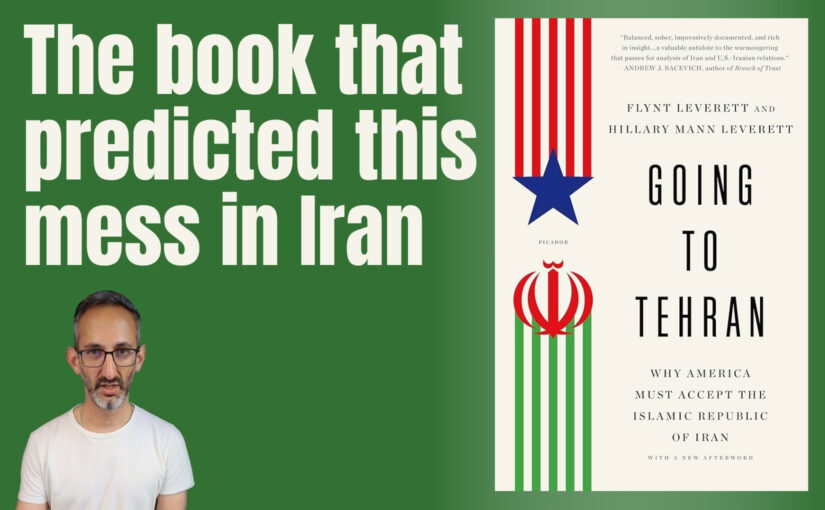
In 2013, two former US national security officials – Flynt Leverett and Hillary Mann Leverett – published a book called Going to Tehran. In it they argued, on the basis of insider experience, that the United States was making a strategic mistake of historic proportions in its policy towards Iran; that the Islamic Republic was a stable, legitimate, rational political entity; that decades of US sanctions, isolation and threats would fail; that Iran would emerge from any direct confrontation stronger, not weaker; and that the only rational US course was the kind of grand rapprochement Nixon achieved with China in 1972.
The US foreign policy establishment declined to read it. Months into a war on Iran that the US is manifestly losing, every one of the Leveretts’ predictions has come to pass – and the establishment is implicitly conceding it. Robert Kagan in the Atlantic. Gideon Rachman in the Financial Times. Dan Shapiro in the Washington Post.
In this video, Carlos Martinez reviews Going to Tehran, explains its central arguments, and makes the case that it is one of the most important unread books of the twenty-first century.
Sources and further reading:
Flynt Leverett and Hillary Mann Leverett, Going to Tehran (2013)
Robert Kagan, “Checkmate in Iran”, The Atlantic (May 2026)
Gideon Rachman, “Iran is beating Trump at the art of the deal”, Financial Times (May 2026)
Mohammad Marandi’s interviews on multiple channels
Transcript
Hello and welcome. Those of you who, like me, listen to a lot of interviews with Said Muhammad Marandi will know that he is one of the most incisive and insightful analysts of Iran’s politics and foreign policy. He’s also one of the most candid and direct. He’s been recommending a book that he says is essential reading for anyone who wants to understand Iran, called Going to Tehran.
It’s written by two former US national security officials and was published in 2013. Marandi often says that if the US foreign policy establishment had read it and paid attention to it, then some of the disasters of the last few months could have been avoided. So I read it.
It’s excellent. You should probably read it, too. And in this video I’ll give an overview of the book and try to explain why it’s so important, why it’s so relevant.
So who are the authors? Flynt and Hillary Mann Leverett are not anti-imperialist pragmatists. They are in fact former senior US national security officials. Flynt worked at the CIA, then at the State Department, then on the National Security Council where he ran Middle East policy under George W. Bush in 2002 to 2003. Hillary served at the State Department and on the NSC and was the US delegate in talks with Iran on Iraq, Afghanistan, and al-Qaeda in the early 2000s.
They both walked away from their careers in disgust at successive administrations’ failures, and Going to Tehran is the book they wrote afterwards. It belongs to the genre of more or less “how to save the empire from itself”. It is, in other words, a book written for Washington – and too bad Washington declined to read it.
The central thesis of Going to Tehran is that for nearly five decades now, the US has been making the same fundamental mistake about Iran. It’s refused to recognise the Islamic Republic as what it actually is: a stable, popular, legitimate political entity with rational and consistent national interests that is not going away. Every US president from Jimmy Carter to Donald Trump has treated Iran instead as an illegitimate revolutionary anomaly on the verge of collapse, and has built policy around the assumption that the next round of pressure will finally tip it over the edge.
And every time, Iran has failed to collapse, has emerged from the pressure stronger, and has consolidated its regional position further.
The consequences of this misreading have been, in the authors’ words, “arguably the largest amount of influence and wealth squandered by a great power in the shortest period of time.”
The book names three standard pretexts that the US has cycled through again and again to justify its hostility towards Iran. The Leveretts call them the “trifecta”: Iran’s nuclear programme, its support for movements Washington designates as terrorists, and its human rights record. They note that these are essentially the same three pretexts that the US used to justify the invasion of Iraq in 2003 – an invasion based on weapons of mass destruction that didn’t exist, non-existent support for terrorism, and massively exaggerated claims about human rights violations of the sort that Washington itself perpetrates and is perfectly happy to overlook in client states across the region.
The book systematically dismantles every leg of that trifecta. On the nuclear programme: Iran’s enrichment is legal under the Non-Proliferation Treaty. No credible evidence of a weapons programme has ever been produced. The fatwa against nuclear weapons issued by Khomeini and reiterated by Khamenei is a genuine, binding religious-political constraint within the Iranian system.
On terrorism: Iran’s support for Hezbollah, Hamas, Ansarallah, and the Iraqi resistance is support for movements that have broad popular support and that represent constituencies marginalised by Western-backed local regimes. These are resistance movements struggling against colonial and neo-colonial occupation.
On human rights: the West’s selective indignation about Iranian internal politics is, as a moment’s comparison with Saudi Arabia or the Gulf monarchies makes painfully clear, not really about human rights at all. Indeed, we could take a look at the US’s own human rights record, including in Iraq or in Guantánamo Bay.
The most important historical argument in the book is what the Leveretts call the “Nixon parallel”. In 1969, Richard Nixon and his national security adviser Henry Kissinger looked at the deteriorating US position in Asia and concluded that the only way to rescue it was to end 20 years of containment and demonisation of the People’s Republic of China and instead come to terms with it. So they went to Beijing, they met Mao, they acknowledged that the CPC was the legitimate government of China and was not going to be overthrown. They opened a relationship on the basis of mutual interest – and, apart from anything else, that laid the ground for US capitalists to make an awful lot of money in China over the ensuing five decades.
The Leveretts argue that the US today stands in a similar position vis-à-vis Iran to the one it occupied vis-à-vis China back then. Iran is the dominant regional power in West Asia, materially and politically. The Islamic Republic is its legitimate government. It is not on the verge of collapse, and decades of US policy aimed at containing it, isolating it, and bringing it down have failed at every turn. The only rational course is to do with Tehran what Nixon did with Beijing: recognise it as a legitimate political entity, address its central security interests, and build a relationship on the basis of mutual respect. Every other path leads to failure and ultimately to war.
The Leveretts made this argument in 2013. Three US administrations have ignored it, and now there is a catastrophic war taking place.
Before I move on, I want to add something the Leveretts didn’t themselves dwell on, but which I think is the substantive heart of what Going to Tehran actually means in 2026.
The Nixon parallel is structurally correct, but in terms of what rapprochement might actually look like, it doesn’t necessarily mean Donald Trump getting on a plane to Tehran for a photo op. The substantive content of any genuine US opening to Iran – the policy equivalent of what Nixon and Kissinger did with Beijing – would be the US and its allies, after nearly five decades of obstruction, finally honouring their obligations under the Nuclear Non-Proliferation Treaty.
Most people forget that the NPT is a bargain with three pillars, not one. Non-nuclear states agree not to acquire nuclear weapons – that one everybody remembers. The nuclear-armed states agree to move towards disarmament – that one most people forget. And the third pillar, which everyone forgets, is that the nuclear-armed states agree to share civilian nuclear technology with the non-nuclear states. That was the original Western promise, articulated by Eisenhower in his famous “Atoms for Peace” speech to the UN General Assembly in December 1953 – just four months after the same Eisenhower had signed off on the CIA coup against Mohammad Mosaddegh.
The “Atoms for Peace” doctrine became the conceptual basis of the International Atomic Energy Agency, founded in 1957, and ultimately of the NPT itself.
The Western powers have systematically violated that third pillar with regard to Iran for decades. They’ve sanctioned legitimate civilian nuclear development. They’ve sabotaged equipment. They’ve assassinated Iranian nuclear scientists. They’ve demanded that Iran renounce its enrichment rights, to which it’s explicitly entitled under the NPT. And finally, and most recently, they’ve bombed Iran’s civilian nuclear facilities. This is a gross violation of international law and of Iran’s sovereign rights.
So “Going to Tehran” would mean the US honouring the NPT as it was actually written: ending the sabotage, lifting the sanctions on legitimate civilian nuclear cooperation, and actively assisting Iran in developing the peaceful nuclear energy programme to which it has a sovereign and treaty-given right.
One of the things that makes the book indispensable is its analysis of Iran’s ideology and governance system. Most Western writing about Iran assumes that the Islamic Republic is an irrational regime, hostage to religious zealots, that doesn’t behave like a normal state. Whereas the Leveretts take Iran seriously as a strategic actor and explain its conduct in terms its own leaders would actually recognise.
They locate the foreign policy project of the Islamic Republic in two ideas: first, an absolute insistence on sovereignty and independence; and second, the slogan put forward by Ayatollah Khomeini – “neither do injustice nor accept it”.
The first – the commitment to sovereignty – is born of a long and bitter history of foreign manipulation, from the Anglo-Russian Convention of 1907, through the CIA-organised coup against Mohammad Mosaddegh in 1953, through the brutal Iran-Iraq War of the 1980s, which the Western powers were only too happy to foment.
The second is the principle that resistance to oppression is a duty – including resistance to the oppression of others – which is the framework in which Iran supports the Palestinian, Lebanese, and Yemeni resistance. It’s the framework in which Iran supports Cuba and Venezuela today. It’s the framework in which Iran supported the South African liberation movements during apartheid.
All of this has nothing to do with the cartoonish picture of Iran “sponsoring terrorism for ideological kicks”. The Leveretts point out that Iran’s political Islam is both political and Islamic, and they quote Khomeini’s very direct articulation of this back in 1970, nine years before the establishment of the Islamic Republic. He told his students: “Pray as much as you like. It’s your oil thereafter. Why would they worry about your prayers? They’re after our minerals, and they want to turn our country into a market for their goods.”
Meanwhile, the Constitution of the Islamic Republic declares that “the freedom, independence, unity, and territorial integrity of the country are inseparable from one another, and their preservation is the duty of the government and all individual citizens.”
So it’s genuinely a little startling to read this book having lived through the last year. The Leveretts predicted in detail that the US strategy of sanctions, isolation, and threats would fail. That Iran would emerge from any direct military confrontation stronger and more consolidated, not weaker. That the regional powers would ultimately not line up behind Washington. That the Islamic Republic’s alignment with Russia and China would deepen. And that the long-term direction of travel was the erosion of US primacy in West Asia and the strengthening of Iran’s regional position.
Each of those predictions has now come to pass. Robert Kagan – of all people, co-founder of the Project for the New American Century, the man who championed the invasion of Iraq – recently published a piece in the Atlantic titled “Checkmate in Iran”, conceding that “the roles of China and Russia as Iran’s allies are strengthened, the role of the United States substantially diminished.” Meanwhile, Gideon Rachman writes in the Financial Times that Iran is “beating Trump at the art of the deal”. Dan Shapiro, the former US ambassador to Israel, concedes that Iran has “taken the US and Israel’s best punch and survived.”
So you have the Western establishment conceding this book’s central argument.
Of course, the book isn’t perfect. Apart from anything else, it was published 13 years ago in 2013, which means it predates the JCPOA, Trump’s withdrawal from the JCPOA in 2018, the Soleimani assassination in 2020, the Ukraine conflict, and of course the war on Iran itself. The reader has to do some of that updating work – but the analytical framework absorbs all of these later developments. In fact, every one of them is pretty much exactly the kind of US policy failure the Leveretts predicted their framework would produce.
The second limitation, you might argue, is that the book is written for an American foreign policy audience in the language and idiom of that audience. The Leveretts are not Marxists. They are not anti-imperialists in the structural sense. They write essentially as patriotic reformers of an empire they believe could be saved. Readers from outside that tradition will find the framing sometimes a little limited – but the empirical and analytical work is very rigorous, and the insider authority aspect gives the book a huge amount of weight.
So, to finish where I started: Professor Marandi was exactly right. If the US foreign policy establishment had read this book when it came out and had been sane enough to act on it, the current disaster could have been avoided. The Middle East wouldn’t be in flames. The US wouldn’t be subjected to the humiliating defeat it’s currently being handed.
Going to Tehran is really one of the great unread books of the 21st century.