
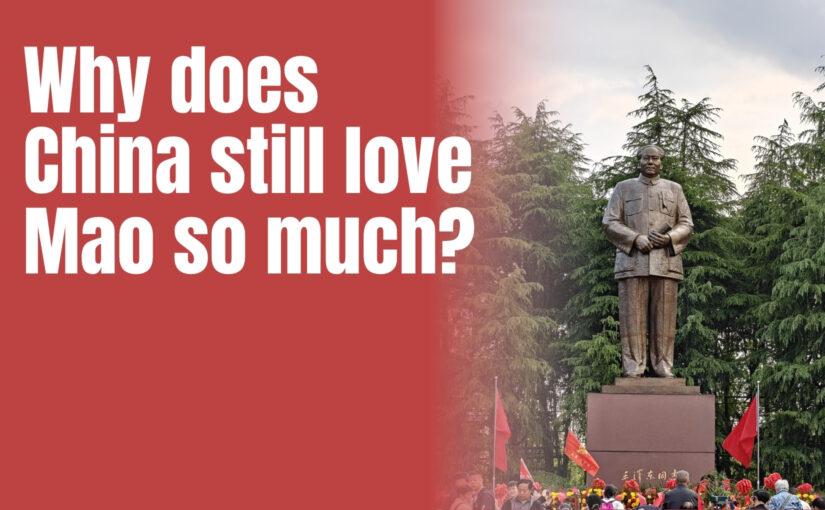
The standard Western story about modern China is that Mao has been quietly buried by the Communist Party, that Deng Xiaoping repudiated his legacy, and that the China that emerged after 1978 is no longer really socialist. By implication, China’s success is the success of capitalism, not of the revolution.
So why do ordinary Chinese people still travel in their millions to Shaoshan – the village in Hunan where Mao was born, now one of the most-visited tourist sites in China – to pay their respects to the founder of the People’s Republic? Stand there among the crowds and the Western story falls apart on contact.
In this video, Carlos Martinez draws on a recent trip to Shaoshan, and on the hard development data from the Mao era, to answer that question: the Mao era and the reform era are not opposed phases of Chinese history. They are two stages of a single revolutionary project, and the Chinese people know it.
Between 1949 and 1976, life expectancy in China rose by 32 years – the fastest improvement ever recorded by any country in human history. Adult illiteracy fell from over 80 per cent to 33 per cent by 1978. Land was redistributed. Women were emancipated. A complete industrial base was built from near-zero. The treaty ports were abolished. The country was unified after a century of fragmentation. This is the China the post-Mao leadership inherited – not the impoverished backwater of Western myth.
Without Mao, no Deng. Without 1949, no 1978. As the late Egyptian Marxist Samir Amin put it, the take-off of the post-1978 period “would not have been possible without the economic, political and social foundations that had been built up in the preceding period.” It is also exactly how the Communist Party of China understands its own history, in Xi Jinping’s doctrine of “the two cannot negates.”
Sources and further reading:
Carlos Martinez, “No great wall: on the continuity of the Chinese Revolution”
https://invent-the-future.org/2021/05/no-great-wall/
Samir Amin, “China 2013”
https://monthlyreview.org/articles/china-2013/
Domenico Losurdo, “Has China Turned to Capitalism? Reflections on the Transition from Capitalism to Socialism”
https://redsails.org/losurdo-on-china/
Friends of Socialist China
https://socialistchina.org
Transcript
Hello and welcome. In April this year, I had the privilege of visiting Shaoshan, the small village in Hunan province where Mao Zedong was born in 1893. And Shaoshan is one of the most visited tourist sites in China. Ordinary Chinese people travel there in their millions every year. The Mao family home is preserved as it was. There’s a major statue erected in 1993 for the centenary of his birth. And across China, there are museums, study halls, and exhibition rooms commemorating the life of the man Chinese people overwhelmingly regard as the founder of modern China.
And I wanted to talk about Shaoshan because what you see there very much goes against the narrative that Western ruling class media and academia have been telling us about China for the last half century or so. The standard story runs like this. Mao’s been quietly buried by the Communist Party of China. Deng Xiaoping repudiated his legacy. The reform era China that emerged after 1978 is essentially a market economy with red branding, no longer connected to the revolutionary project that began in 1921, or to the founding of the People’s Republic in 1949. And the implication is that China’s success story is not a function of socialism. The achievements you can see across the country today are the achievements of capitalism. And Mao is some kind of embarrassing relic that the party can neither fully claim nor fully repudiate.
But standing in Shaoshan, surrounded by many thousands of Chinese visitors paying their respects to the founder of the People’s Republic, that story starts to fall apart. So in this video I want to do two things. First, give you some of the hard empirical data on what the Mao era actually achieved. And second, to make the broader political argument that the Mao era and the reform era are not opposed and opposite phases of Chinese history, but two stages of a single revolutionary project.
The standard Western framing is that China was a very poor, backward basket-case country until 1978, when Deng Xiaoping turned to the markets and capitalism saved China. And variations of this story can be found in newspapers, in history books, in undergraduate textbooks, and in the speeches of Western politicians. The story does a fair amount of ideological heavy lifting for the people that tell it. For supporters of capitalism, the implication is that China had to give up on socialism in order to develop, and that capitalism is therefore the only viable road for humanity. And there’s just one small problem with it: the story is wrong by an enormous margin.
In 1949, when the Communist Party of China took power, the country it inherited was one of the poorest, most underdeveloped nations on Earth. Life expectancy was around 35 years. Adult literacy stood between 10 and 15%. The population level had been stagnant for over a century at between 400–500 million. The country had been carved up by foreign empires for 100 years: treaty ports, extra-territoriality, opium economies, foreign concessions in every major city. Women lived under total feudal subjugation; foot binding, infanticide, and child marriage were widespread. Famine was a constant feature of rural life. There was almost no modern industry. The civil war and the Japanese invasion had left tens of millions dead and the country in ruins.
What happened over the next three decades is one of the most remarkable transformations in human history, and it happened under Mao Zedong. Land reform distributed agricultural land away from the landlord class, eliminating the feudal economy at a stroke. The barefoot doctors programme extended basic medical care to hundreds of millions of peasants who’d never seen a doctor in their lives. Mass literacy campaigns took the adult literacy rate down from over 80% in 1949 to 33% by 1978. Foot binding was abolished. Women were brought into the workforce as workers and citizens with equal legal standing. The treaty ports were abolished. Extraterritoriality was ended. Foreign domination was decisively broken. The country was unified after a century of fragmentation.
And the result, in the language of basic development statistics, was the fastest improvement in life expectancy ever recorded by any country in human history. Between 1949, at the time of the founding of the People’s Republic, and 1976, when Mao Zedong died, average life expectancy in China rose from around 35 years to around 67. That’s an improvement of more than three decades in less than three decades. By 1978, Chinese life expectancy was 67–68. India, which had begun its independent existence with broadly comparable conditions in 1947, had managed in the same period to reach an average life expectancy of 55. Impressive progress, but nowhere near as impressive. The Chinese socialist project added an additional 12 or 13 years to the average human life compared with the capitalist Indian alternative.
China’s population went from 400–500 million to around 900 million – it doubled. The country built from a near-zero baseline a complete industrial system. By the mid-1960s, it was producing atomic weapons and putting satellites into orbit. So by the time Deng Xiaoping kicked off the reform process at the end of the 1970s, the country had a literate workforce, basic universal health care in the countryside as well as the cities, near-universal primary education, an industrial base, and a unified sovereign state. That’s the China that the post-Mao leadership inherited: not the utterly poor backward country of Western myth, but a country that had just lived through three decades of the most rapid improvement in human welfare ever recorded, on the basis of a socialist revolution.
Which is not to say that everything was perfect and that there were no problems. Those decades also clearly included serious errors, which the CPC itself admits. But the net trajectory of the period is still the fastest gain in human well-being ever recorded.
And all that provided the structure that made reform and opening up possible. Reform didn’t happen in a vacuum. It happened on a foundation that was built in those three decades of socialist construction. All the achievements of the reform period – and they’re certainly extremely impressive – were built on the foundations laid by the revolutionary period. The literate workforce that staffed the new factories: that was built by Mao-era mass literacy. The basic health care system that kept the workforce productive: that was built by Mao-era public health. The unified country that could plan economic development on a national scale: that was built by the revolution that ended foreign domination and civil war. The state apparatus capable of running long-term industrial policy: again, built from the founding of the CPC in 1921. Even the opening to the US, which is often cited as a hallmark of the reform era, starts with the rapprochement of the early 1970s, with Henry Kissinger visiting Beijing in 1971 and Richard Nixon in 1972.
The Egyptian Marxist Samir Amin puts all this in very clear terms. He says that the economic take-off of the post-1978 period would not have been possible without the economic, political, and social foundations that had been built up in the preceding period. Without 1949, there’s no 1978. Without Mao, there’s no Deng.
And honestly, none of this is controversial within Chinese Marxism. It’s exactly how the CPC itself describes the relationship between the two eras. Xi Jinping has articulated the idea of “the two negates” – in Chinese, liang ge bu neng fou ding. The formulation is that the two periods – the first three decades of socialist construction and reform and opening up – are by no means separated from or opposed to each other. We should neither negate the pre-reform phase in comparison with the post-reform phase, nor the converse. That’s the official CPC line. That’s the framework that’s taught in Chinese schools. That’s the position that animates the displays at Shaoshan, where Mao’s revolution and the reform era are presented as continuous stages of one historical project.
The Western either/or framing – Mao or Deng, revolution or reform – is therefore not just empirically wrong about pre-1978 China. It’s politically wrong about the shape of the Chinese socialist project as a whole. The CPC doesn’t view itself as having broken with the revolution in 1978. It views itself as having entered a new historical stage of the same revolution. And Deng Xiaoping’s own framing is consistent with that. The fundamental task for the socialist stage, he said, is to develop the productive forces, and reform was the strategy for doing that in a country that under Mao had built the political, social, and economic foundations of socialism.
Incidentally, there’s a curious inversion of the standard Western narrative that can be found among certain Marxist circles who say that Chinese socialism was doing brilliantly until the late 1970s, until Deng Xiaoping came along and introduced capitalism, and now everything’s terrible. Which again doesn’t have much foundation in reality, and actually just ends up providing people with an excuse not to support and not defend China.
Anyway, bringing this back to Shaoshan and to what you can actually see in China today. Walking around Mao’s birthplace, looking at the thousands of people there with you – and when I went, it was just a regular Thursday afternoon in April, not a public holiday or anything like that – they’re not just elderly nostalgics that maybe the Western press accounts would have you believe. They’re families with young children, school groups on visits, university students, working-class Chinese people on holiday, peasants from neighbouring provinces. They’re ordinary contemporary Chinese citizens for whom Mao is not a forgotten figure, but is the founder of the country whose successes they have lived through. And they understand the continuity because they’ve lived it themselves. The Western either/or framing makes no sense to them because the actual historical experience makes no sense in those terms.
And the same continuity is everywhere in the country once you start looking for it. The high-speed rail running across the Hunanese countryside was made possible by an industrial base that was built under Mao. The clean green mega-cities of the eastern seaboard are inhabited by a population whose health, longevity, and literacy were established under the Mao period. The current campaign for common prosperity rests on the social policy infrastructure that was first built under Mao. And the principal philosophical commitments of the CPC – seeking truth from facts, concrete analysis of concrete conditions, the long-term development of the productive forces in the service of human emancipation – are the same commitments that animated the party from the Yan’an period onwards. The methods have evolved, but the substance remains the same.
So defending Chinese socialism doesn’t require choosing Mao against Deng or Deng against Mao. It requires understanding that these are stages of a single revolutionary project, each with its own historical tasks, each connected to the others by the analytical framework of Marxism applied honestly to concrete conditions. The CPC certainly doesn’t feel the need to repudiate Mao in order to recognise the success of the reform era, nor does it feel the need to repudiate the reform era to recognise the achievements of the Mao era. The CPC has worked out in its own theory and its own practice an integrated understanding of its own history. The Chinese people themselves understand this continuity, which is why they travel in their millions to Shaoshan, to the Yan’an caves, to the memorial sites of the Long March, to the museums commemorating the founding of the People’s Republic.
The story the West has been telling about Mao and Deng, about revolution and reform, about poor and Maoist becoming rich and capitalist, is not really a story about China. It’s a story about the West’s need to believe that capitalism is the only road – but it’s not a story with any basis in reality. Thank you very much for watching.
Very concise historical analysis of the economic conditions of China from 1949 to 1978 under Mao and the continuing development of the economic conditions for Chinese citizens up to the present time. It would be great to read such an analysis in the mainstream newspapers in Britain.
But we all know why that does not happen.