
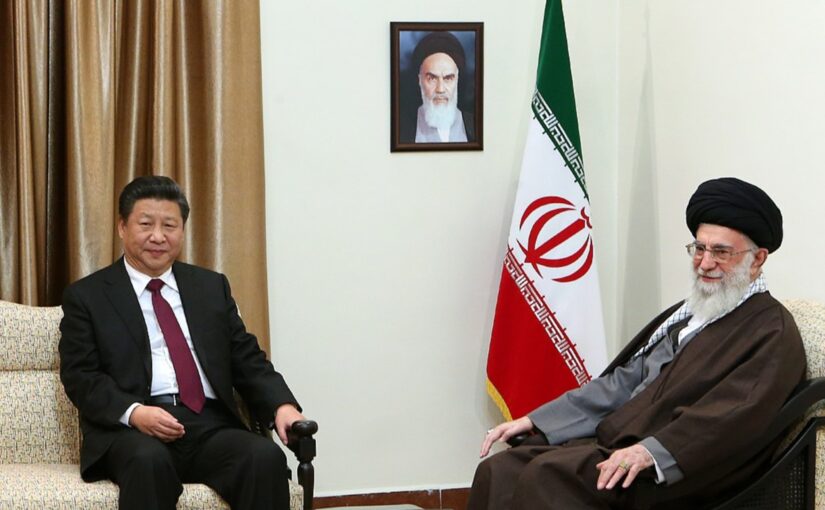
The US-Israeli war on Iran has been defeated – and the world’s response to it, above all from China and the Global South, reveals how profoundly the global balance of forces has shifted. In the article below, Carlos Martinez argues that Iran’s victory provides important evidence that the unipolar moment is over.
The criminal US-Israeli war on Iran has wrought devastation on a horrendous scale. The campaign has included the assassination of Iran’s Supreme Leader and numerous other political leaders and scientists; the bombing of schools, hospitals, bridges and energy infrastructure; and, from April, a naval blockade of Iran’s ports. Aerial attacks have killed around 3,500 civilians, including 168 children at an elementary school in Minab, in one of the gravest single atrocities since the Vietnam War.
This is a war of aggression, pure and simple. There has been no Security Council authorisation, and UN human rights experts have denounced the assault as a violation of the most basic principles of the UN Charter. The pretext – that Iran was on the cusp of acquiring a nuclear weapon – is the same threadbare story Benjamin Netanyahu has been telling since 1992, and is roughly as credible as Tony Blair’s claim in 2003 that Iraq could deploy weapons of mass destruction within 45 minutes.
But something distinguishes this war from the Iraq war a generation ago. In 2003, Washington could assemble a “coalition of the willing”, browbeat the UN, and assume the world would fall into line. In 2026, the world is conspicuously refusing to do so. And the war has not merely been opposed – it has been defeated. As of late June it stands suspended under an interim memorandum of understanding whose terms read like a list of concessions wrung from Washington. The response to this war – above all from China and the Global South – tells us a great deal about how profoundly the global balance of forces has shifted.
A different kind of world response
China condemned the strikes from day one as a violation of the UN Charter and the basic norms governing international relations, pointing out at the Security Council that the US and Israel had attacked a sovereign country in the middle of negotiations. At the end of March, China and Pakistan put forward a five-point initiative calling for an immediate ceasefire, peace talks and the restoration of normal navigation in the Strait of Hormuz. The African Union welcomed the proposal as “a timely and constructive contribution” to de-escalation. And it was this diplomacy that produced the ceasefire of 7 April – fragile, repeatedly violated, but the foundation on which the present truce was eventually built.
Across the Global South, the machinery of collective resistance is being assembled. The Hague Group – co-chaired by South Africa and Colombia – has been coordinating legal measures to ensure there is “no safe haven” for the perpetrators of genocide, war crimes and the crime of aggression, and there is growing pressure for an emergency special session of the UN General Assembly to declare the assault on Iran exactly what it is: a war of aggression.
Compare all this with the response of the West. Keir Starmer’s government, having briefly hedged that the operation was “not sufficiently anchored in international law”, proceeded to widen permission for the US to use the British-controlled base at Diego Garcia, and to grant access to its Cyprus bases for strikes on Iranian missile sites. Once again, a Labour government has attached Britain to a criminal war opposed by the bulk of humanity – and, as it turns out, to the losing side of it.
More than words
China’s stand has gone well beyond declarations. Beijing has continued to buy Iranian oil throughout the war, providing an economic lifeline. And when Washington started sanctioning Chinese refineries for the crime of purchasing that oil, China’s Ministry of Commerce countered by ordering Chinese companies and banks to disregard the sanctions altogether, on the grounds that they constitute a violation of international law and of China’s own Anti-Foreign Sanctions Law.
The significance of this is hard to overstate. The US sanctions weapon – the principal instrument of economic coercion deployed against Cuba, Venezuela, Zimbabwe, the Democratic People’s Republic of Korea (DPRK) and dozens of other states – only functions to the extent that the world complies. The world’s largest trading nation has now formally refused to comply, and made compliance with US secondary sanctions illegal under its own law.
Meanwhile, when Presidents Xi and Putin met in Beijing in May, their joint statement condemned “treacherous military strikes against other countries” and “the assassination of leaders of sovereign states”. The message to Washington could hardly be clearer: Iran will not be isolated and picked off.
The terms of a defeat
The clearest proof that this war has failed is to be found not in any commentary but in the deal Washington has been forced to accept. The interim memorandum that suspended the fighting in mid-June did not impose terms on Iran; it extracted concessions from the United States. Washington lifted its naval blockade – the very instrument meant to strangle the Iranian economy – and agreed to let Iran sell its oil and be paid for it. Days later the US Treasury went further, waiving sanctions to let Iran sell its oil in dollars, including to US buyers, for the first time in decades – effectively legalising the “shadow fleet” of tankers it had spent years trying to interdict. A former senior Treasury official called it “a fundamental departure from the Iran sanctions architecture” built up over 20 years.
The concessions did not stop there. Trump agreed to release some $6 billion of Iran’s frozen funds held in Qatar, with a further tranche to follow. Speaking after the G7, he conceded that Iran must be allowed to enrich uranium, had a right to its ballistic missiles, and would have sanctions lifted – abandoning, one after another, every “red line” in whose name the war had been launched. And Washington backed Iran’s demand for a permanent ceasefire in Lebanon, with Vice President JD Vance reportedly ordering Netanyahu to stand down.
A war to destroy the Islamic Republic has ended with the United States lifting the blockade, unfreezing funds, conceding enrichment, and disciplining its own closest ally on Iran’s behalf. Iran, for its part, retained throughout the leverage that made all this possible: its ability to disrupt the flow of oil and gas through the Strait of Hormuz, the chokepoint for a fifth of the world’s energy trade – leverage it demonstrated again on 20 June by briefly declaring the strait closed in response to violations of the agreement.
The verdict of the establishment
That the war has failed is no longer a claim confined to the anti-imperialist left; it is the verdict of the Western foreign policy establishment itself. Gideon Rachman wrote in the Financial Times that “Iran is beating Trump at the art of the deal”. Robert Kagan – co-founder of the Project for the New American Century, and one of the original architects of the drive to war with Iran – published a piece in the Atlantic titled “Checkmate in Iran”, concluding that Iran “emerges as the key player in the region”, that the roles of China and Russia are strengthened, and that the role of the United States is “substantially diminished”. A former US ambassador to Israel, Dan Shapiro, conceded that Iran took “the United States’ and Israel’s best punch” – and survived.
The blow to Israel has been heavier still. Netanyahu staked everything on a legacy-defining victory over his Iranian nemesis and lost; in the process he has poisoned the US-Israel “special relationship” to the point where, for the first time, more Americans sympathise with Palestinians than with Israelis. The Abraham Accords are effectively dead, and the project of assembling a US-aligned “Middle East NATO” around a normalised Israel has collapsed. All of this unfolds against the backdrop of Israel’s ongoing genocide in Gaza, which a UN Commission of Inquiry has now found to involve the deliberate targeting of Palestinian children.
Why Iran survived
How has Iran been able to score such a historic victory? Partly because of the extraordinary unity and resilience of the Iranian people. Iran also held a powerful card of its own throughout, in its capacity to throttle the Strait of Hormuz, that no amount of US firepower could neutralise. But it survived, too, because the world has changed. Iran is a member of BRICS and the Shanghai Cooperation Organisation (SCO); it has a 25-year strategic partnership with China and a deepening relationship with Russia; it is a key partner in the Belt and Road Initiative.
And the war has driven it further east still. In the days after the ceasefire, Iran’s parliament speaker Mohammad Baqer Qalibaf – now also Tehran’s special representative for China affairs – declared Iran a “full-fledged, reliable and long-term partner” of China. The decades-old argument within Iran about whether its future lies with accommodation to the West or with integration into the emerging Eurasian order has, for now, been settled by the war itself.
In 1953, Britain and the US could overthrow Mossadegh’s government with a handful of agents and a pile of bribes, and install a compliant dictatorship free from unorthodox ideas about nationalising resources. In 2026, the combined military might of the US and Israel has not been able to break Iran – at least in part because Iran is deeply woven into an emerging multipolar world that is increasingly capable of defending itself against imperial aggression.
Lessons for the Western left
The war on Iran was never only about Iran. It was also a geostrategic move in the broader struggle for global hegemony between the US and the rising powers of the Global South. Its failure indicates strongly that the unipolar moment is over; what is being born is a world in which the majority of humanity – organised through BRICS, the SCO, the African Union, the Community of Latin American and Caribbean States (CELAC) and a dense web of South-South cooperation – is standing up for itself against the declining empire.
For the left in the imperialist heartlands – in Britain, across Europe and in the United States – the conclusions follow directly. Our governments have once again attached our countries to a criminal war opposed by the bulk of humanity, lending it bases, weapons, diplomatic cover and the pretence of legitimacy. The task of the Western left is to break that complicity: to oppose our own ruling classes’ wars rather than the official “enemy” of the day, to demand the closure of the foreign military installations through which those wars are waged – starting, in the British case, with Diego Garcia and Cyprus and their return to their rightful owners – and to insist on a foreign policy based on peace, international law and cooperation with the rising majority of humanity, rather than subordination to a declining empire engaged in a futile Project for a New American Century.
The most urgent thing for the Western left is to ensure that, when the empire reaches for war, it can no longer count on the consent of the populations in whose name it claims to act.