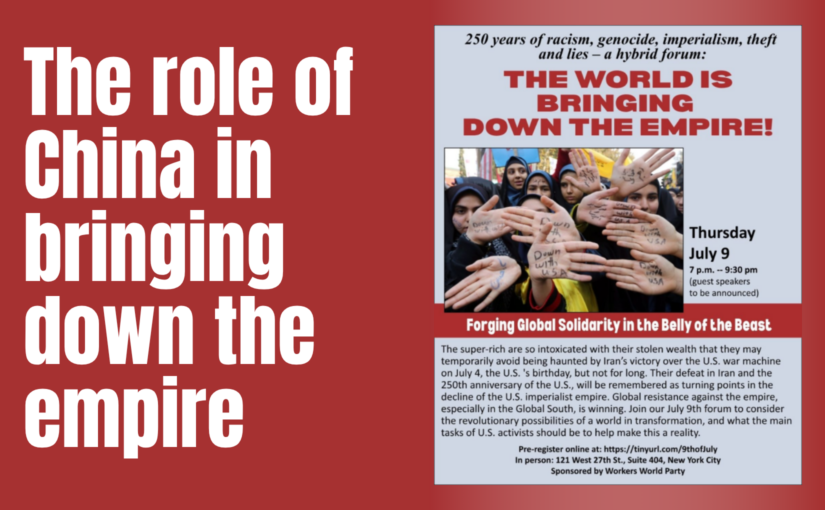
In the video embedded below, Carlos Martinez speaks on the role of China in the global project of bringing down the empire, at the Workers World Party hybrid forum “The World is Bringing Down the Empire!” (9 July 2026).
The single biggest factor in overcoming imperialism in the present epoch is the emergence of a multipolar world – and the single biggest factor in that process is the rise of People’s China. This talk traces how China’s role has evolved from the overt anti-imperialism of the 1950s, through the “hide your strength and bide your time” period of Reform and Opening Up, to the leading role it takes in world affairs today: the Belt and Road Initiative, the Community of Shared Future for Humanity, and the Global Development, Security, Civilisation and Governance Initiatives.
Along the way, Carlos addresses war and peace, China’s engagement with Africa, the recent war on Iran, and the argument – associated with Samir Amin – that a multipolar world provides the framework for the necessary overcoming of capitalism.
Transcript
Comrades, thank you very much for inviting me.
I’ve been asked to speak on the role of China in the global project of bringing down the empire. I want to start with a simple claim, which is that the single biggest factor in overcoming imperialism in the present historical epoch is the emergence of a multipolar world. And the single biggest factor in that process is the rise of People’s China.
So let me talk about what China’s role actually is, how it’s changed over the decades, and why it matters so much for everyone who wants to see a different world; a world of peace, equality, prosperity, friendship and solidarity.
On the small matter of war and peace.
As you know, the US has been at war for over 90 percent of its history. It maintains something like 800 overseas military bases in 80 countries and spends over a trillion dollars a year on its armed forces. People’s China, by contrast, hasn’t fought a war in close to five decades. It has never seized a colony, never carried out a regime-change operation, never imposed a unilateral sanctions regime. And it remains the only major nuclear power unambiguously committed to no first use of nuclear weapons.
That’s not an accident of circumstance. It flows from a long-established orientation – one China has articulated since the 1950s in the Five Principles of Peaceful Coexistence: sovereignty, non-aggression, non-interference, equality and mutual benefit, peaceful coexistence. Respect for the UN Charter and international law isn’t rhetoric China reaches for when it’s convenient. It’s the actual content of its foreign policy.
Now, history doesn’t move in a straight line, and while the principles of China’s foreign relations have been consistent, the practical implementation of those principles has shifted over time.
In the first decades of the People’s Republic, China was overt in its support for global anti-imperialism. Just a year after the revolution, three million Chinese soldiers went to Korea to help beat back a genocidal US war – around 180,000 of them never came home. China gave material backing to liberation movements in Vietnam, Algeria, Mozambique, Zimbabwe and beyond. It was poor, blockaded and isolated, and it stood with the colonised world anyway.
In the early 1970s the door to the US opened; China regained its seat at the UN in 1971. And from the late 1970s, with Reform and Opening Up, the whole national focus shifted to economic development. That meant, in Deng Xiaoping’s phrase, “hide your strength and bide your time” – dialling down support for armed struggle abroad, keeping a low profile, cultivating good neighbours, in order to build national strength.
Some on the left have read that as a betrayal. I’d argue it was a necessary foundation. On that foundation, apart from anything else, China has lifted hundreds of millions out of poverty, turned itself into the world’s only green energy superpower, and built a modern industrial economy, on the cutting edge of science and technology. That itself provides an important material basis for global anti-imperialism.
And over roughly the last decade China has again started to take up a leading role in world affairs. The Belt and Road Initiative. The vision of a Community of Shared Future for Humanity. The Global Development Initiative, the Global Security Initiative, the Global Civilisation Initiative, and now the Global Governance Initiative.
Together these sketch an architecture for international relations built on common development, common security and sovereign equality.
In that sense you can see arguably a quite profound continuity between the anti-imperialism of the 1950s and the multipolarity of today. They are two stages of a single project, adapted to very different conditions.
Some people argue that multipolarity is simply the latest version of inter-imperialist rivalry and that China is seeking to replace the US as the world’s hegemon. But that is a misunderstanding of what multipolarity actually is, and it ignores the substance of China’s engagement with the world.
Look for example at China’s relations with Africa. At the China–Africa forum in 2018, President Xi Jinping stated:
“We respect Africa, love Africa and support Africa. We follow a ‘five-no’ approach in our relations with Africa: no interference in African countries’ pursuit of development paths that fit their national conditions; no interference in African countries’ internal affairs; no imposition of our will on African countries; no attachment of political strings to assistance to Africa; and no seeking of selfish political gains in investment and financing cooperation with Africa.”
Wouldn’t it be nice if the US and Europe followed this ‘five-no’ approach regarding Africa?!
And Xi Jinping’s statement was not just words. China invests in Africa without conditions of austerity or privatisation. It invests in infrastructure, in energy, in agriculture, in industry, in schools and hospitals. China is actively helping Africa to break the chains of underdevelopment.
That’s why Fidel Castro called China “the most promising hope and the best example for all Third World countries”.
The most recent example of the contrast between China and the US’s approach to international affairs is the criminal war on Iran.
That war was in many ways a sort of last throw of the dice for the Project for a New American Century – aimed not just at the last great pole of resistance in West Asia, but at China, at the Belt and Road, at the whole multipolar project. And it backfired spectacularly. The US burned through perhaps 30 percent of its Tomahawks and half its THAAD interceptors – weapons stockpiled for a future confrontation with Beijing – and it suffered a humiliating defeat.
And where the US brought bombs, China brought a different kind of power. China condemned the war. It kept buying Iranian oil, and openly told its firms to defy US secondary sanctions. Together with Russia it vetoed a war-enabling Security Council resolution – having learned the lesson of Libya in 2011.
When a ceasefire was brokered by Pakistan, it was done with the backing of Beijing. The US did everything it could to break Iran; China helped Iran to defend itself.
Obviously, China isn’t going to save us. No one country can do that. The struggle against imperialism and for socialism is a global one. But the Egyptian Marxist Samir Amin argued that a multipolar world “provides the framework for the possible and necessary overcoming of capitalism” – and that’s a crucial point. By breaking the monopoly of the imperialist core over the periphery, multipolarity gives the countries of the Global South room to breathe: room to follow their own development path, to defend themselves from imperialist aggression, to cooperate with each other on their own terms, and even to revisit the socialist experiments some of them were forced to abandon.
Meanwhile, China proves the empire’s way is not the only way. That you can lift a fifth of humanity out of poverty without invading anyone.
So the choice before every country now – and before all of us organising here, in the belly of the beast – is whether to cling to a dying empire, or to join the rising majority of humanity building something better.
I’ll leave the last word to Hugo Chávez, who understood this as well as anyone. “China is large,” he said, “but it’s not an empire. China doesn’t trample on anyone, it hasn’t invaded anyone, it doesn’t go around dropping bombs on anyone.”
Thank you.