US activist and philanthropist James ‘Fergie’ Chambers is being held in Spain, facing extradition to the United States for the ‘crime’ of funding humanitarian relief in Gaza. Carlos Martinez examines a coordinated offensive – from Fergie’s arrest to the proscription of Palestine Action and the anticommunist crackdown on both sides of the Atlantic – that seeks to recast solidarity as terrorism.
This article was first published in the Morning Star.
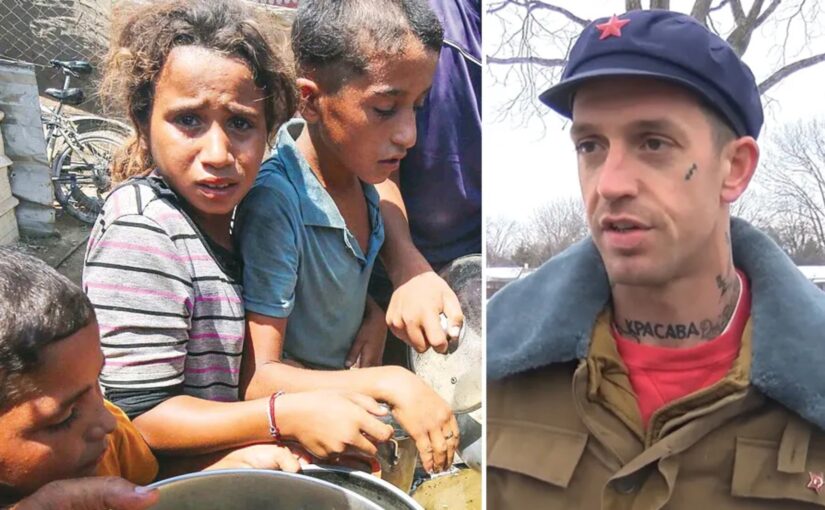
On 10 July, US political activist and philanthropist James ‘Fergie’ Chambers was arrested by police while driving in Ibiza, Spain, with his family. He has been held without bail ever since, awaiting possible extradition to the United States on charges of “international money laundering” intended to provide “material support” to Hamas. If extradited, he could well face decades in prison.
Chambers is not the typical target of Washington’s counter-terrorism apparatus. Heir to the Cox Enterprises media and automotive empire, in 2023 he cut ties with his family, sold his stake for a reported $250 million, and set about giving much of it away to humanitarian and social causes.
Over the course of the last three years, Chambers has donated over a million dollars to humanitarian relief efforts in Gaza, including a quarter of a million dollars to the Sameer Project, funding a bakery that turns out 3,600 free loaves a day, a desalination plant supplying 150,000 litres of clean water daily, and a free clinic in Jabalia treating up to 300 patients a day, with a further $100,000 for the mental-health care of orphaned children. The British-Palestinian surgeon Ghassan Abu Sitta calls him “a vital supporter for the provision of care for children wounded in the genocide”.
Closer to home, Chambers bankrolled the movement against Atlanta’s “Cop City” police mega-base, paid the bail and legal fees of jailed activists, and covered the costs of the direct-action group Palestine Action USA. This is the “material support” for which Washington now wants him locked away.
The indictment is sealed, but by the account of those who have seen it, it offers no evidence that a single cent reached any “terrorist organisation” – only that Chambers moved money from US banks to banks in Tunisia, where he lived since late 2023, and where he has invested in local businesses and even bought the Club Africain football club, one of the longest established and most popular in the north African country. It is the first time the US has sought to extradite anyone for supporting the Palestinian cause. Strip away the absurd vocabulary of counter-terrorism, and what remains is the story of a man being hunted across borders for the crime of solidarity.
A coordinated offensive
Chambers was seized on the very day US Secretary of State Marco Rubio convened ministers from more than 60 countries to confront what his administration now calls “transnational far-left terrorism” – with its counter-terror officials briefing that the entire left constitutes a single terrorist network. Days later the State Department published a hundred-page report, grandly titled Cuba: The Capital of 21st Century Communism, which recasts everyone from Black Lives Matter to the campus encampments against the Gaza genocide as fronts and “fifth columns” for Havana. And at home, Donald Trump reserves his ugliest language for the socialist left, calling communism a “cancer” to be “cut out” and resharing calls to deport New York’s mayor Zohran Mamdani and other “hardcore communist bastards”.
All of this constitutes a single, coordinated offensive by the resurgent hard right – one that seeks to redefine dissent itself as terrorism, and solidarity as subversion.
Britain down the same road
Britain is moving down the same road. Palestine Action was proscribed as a terrorist organisation in July 2025 – the first time a protest group has ever been so designated. Membership or support is now a criminal offence, and hundreds of people have been arrested for nothing more than peacefully holding a placard, in what the United Nations’ own human-rights chief called a “disturbing” misuse of counter-terrorism powers.
This July the government widened the net further, proscribing Iran’s Islamic Revolutionary Guard Corps, an arm of a sovereign state. Meanwhile in April, Ben Jamal of the Palestine Solidarity Campaign and Chris Nineham of the Stop the War Coalition – organisers of the largest demonstrations Britain has seen in a generation – were convicted of breaching police conditions on a march, in what Jeremy Corbyn described as a “dark day for civil liberties”.
The test for Spain
It is against this backdrop that Spain’s position becomes so fraught. The government of Pedro Sánchez has done more than any other in Western Europe to resist this tide: not only recognising the state of Palestine but passing emergency measures against the Gaza genocide, and refusing to let Washington use Spanish soil to attack Iran.
However, the decision on Fergie Chambers will not rest with Sánchez, or the executive branch alone. It rests first with the Audiencia Nacional (high court) – and the Spanish judiciary is one institution the country’s sometimes fraught and partial transition to democracy left largely untouched. The same courts that will weigh Chambers’s fate are those that hounded Catalonia’s elected government into prison and exile for daring to hold an independence referendum. This is lawfare with a long pedigree – indeed Sánchez himself and members of his family are in the sights of just the same judicial and security establishment, as is former social democratic prime minister José Luis Rodríguez Zapatero.
The court has 40 days to rule. If it refuses the extradition, the matter ends there; if it consents, the final decision passes to the Council of Ministers – to the government itself. Should it reach that point, the communists and the other left and progressive forces on whose votes the Sánchez government depends for its survival would surely be right to make their continued support conditional on refusing to hand Chambers over. For Sánchez the logic ought to be fairly plain: a government that allows a largely unreconstructed Francoist judicial machine to deliver a solidarity activist to Trump does not tame that machine; it feeds it and increases its appetite.
Spanish MPs from across the left – Podemos, Sumar, Izquierda Unida, along with the CUP, ERC, and EH Bildu, from Catalonia and the Basque Country, together with others – have already written to ministers demanding that the extradition be refused, warning that solidarity with Palestine, in a context of genocide and occupation, cannot be criminalised as terrorism. If a government can extradite someone for funding a bakery in Gaza, then every donation, every convoy, every act of humanitarian solidarity becomes a potential terrorist offence.
Solidarity is not a crime. Spain should say so, and let Fergie Chambers go home to his family.