
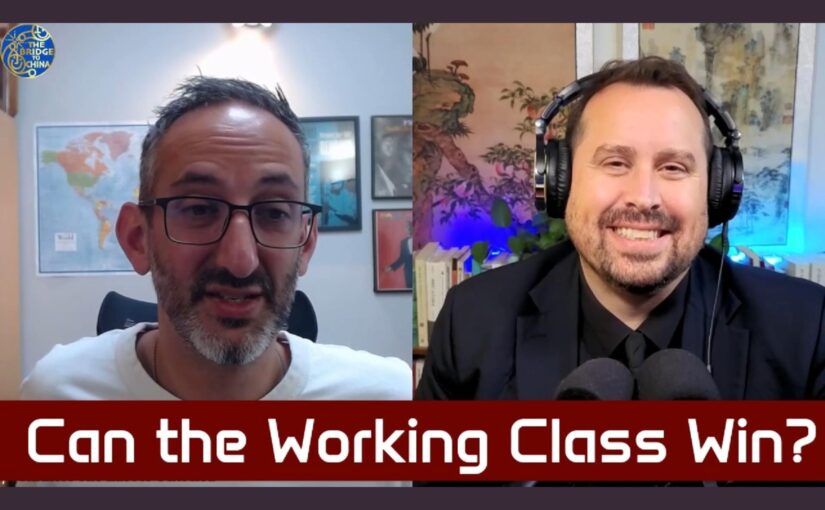
The video below is an interview of Carlos Martinez by Jason Smith, for CGTN’s The Bridge to China podcast. Recorded in the lead-up to the 105th anniversary of the founding of the Communist Party of China, the wide-ranging conversation covers the nature of China’s economic system, the achievements of Chinese socialism, the state of the left in the West, and the transition to a multipolar world.
Carlos argues that China is best understood on its own terms, as socialism with Chinese characteristics: a fundamentally socialist system with a significant market component, in which the state holds the commanding heights – banking, energy, telecommunications, rail and the top levels of industry – and directs investment through national planning. The presence of markets, billionaires or inequality does not make a country capitalist; what matters is which class holds power, and the ultimate measure is the living standards of ordinary working people.
On that measure, China stands apart: it is the country that has eliminated extreme poverty, effectively ended homelessness, and pursued common prosperity, a world-leading renewable energy build-out and the saving of lives during the Covid pandemic. If China is socialist and succeeding, Carlos contends, that vindicates the project of the global left – which is precisely why the West’s new cold war is aimed at preventing a socialist alternative from succeeding.
The interview surveys the scale of China’s transformation – some 800 million people lifted out of poverty, the “seven guarantees” that underpin poverty alleviation, life expectancy rising from around 35 at liberation to over 79 today, near-universal mortgage-free home ownership, and the most extensive public infrastructure in the world. Comparing China with India – liberated within two years of one another, from similar starting points – Carlos draws out what a revolution and Communist Party-led planning have made possible: sovereign development free of IMF discipline, coherent five-year plans, and the capacity for mass mobilisation, exemplified by the three million cadres deployed in the poverty alleviation campaign.
Turning to the West, Carlos describes the long retreat of the left under the neoliberal counter-revolution – de-industrialisation, the rise of the precariat, and a social peace bought with the super-profits of imperialism that are now drying up. He points to the crisis of confidence deepened by Gaza and to the Corbyn moment as signs that material reality is shifting, and to a growing openness to China – from “Chinamaxxing” and the RedNote migration to the surge in inbound tourism. The dogmatism that still leads much of the Western left to withhold recognition of China’s decidedly socialist achievements, he argues, plays into a US grand strategy whose core is the encirclement and containment of China.
The lesson for developed and developing countries alike, Carlos concludes, is that public ownership is not inefficient but the precondition for any serious industrial policy, that long-term planning beats short-term shareholder value, and that the West must come to terms with an inevitably multipolar world – starting, at a minimum, with adherence to the United Nations Charter.
A full transcript follows below. Individual answers will also be posted as separate clips on the Invent the Future YouTube channel.
Transcript
Jason Smith: Socialism, China, and the West. Hey everyone, I’m Jason Smith, originally from sunny California, now living in beautiful Beijing. Joining us today is Carlos Martinez, a British Marxist writer, researcher, and anti-imperialist activist. He is co-author of The East Is Still Red: Chinese Socialism in the 21st Century, and co-editor of Friends of Socialist China. Welcome back to The Bridge to China.
Carlos Martinez: Hey Jason, great to be with you. I think this is the third time.
Jason Smith: I think it is. I really wanted to have you on because the 105th anniversary of the founding of the Communist Party of China is coming up, and I wanted to get your thoughts on socialism, Marxism and Western perspectives of Chinese socialism. But before we get there — people may not have seen our previous interviews, or may not be familiar with your work. Can you tell us a little bit about your experience with China and how you got into studying it?
Carlos Martinez: Sure. To be honest, I’ve always been somewhat interested in China. My parents were both involved in left-wing activism in the socialist and communist movements here in London. They got started in the ’70s, and at that time the Soviet Union and China had split, and they were in the minority that was on the Chinese side of that. So growing up in my mother’s house there were copies of things like Edgar Snow’s Red Star Over China, or Isabel and David Crook’s Ten Mile Inn, and so on. I always had some feeling of connection to China.
Then when I got involved in politics myself, I just found that there was an almost complete lack of understanding of this country — which is obviously a tremendously important country, because in population terms it was then the largest country in the world, and now it’s just about the second largest, but still a population of 1.4 billion, constituting 17 or 18% of the global population. Furthermore it’s a rapidly developing country, led by a communist party, that considers itself to be socialist, and that’s having all these remarkable successes in poverty alleviation, living standards, and technological and scientific development.
So I asked myself: why is no one interested in this country? And when they do take an interest, why do they basically claim that it’s capitalist? If capitalism can achieve all these things that China’s achieving, then capitalism might not be so bad after all. That prompted me to study China a lot more, talk about it more, read more, write more, speak to people, and ultimately to start visiting China and getting a deeper understanding.
Jason Smith: Yeah, I remember you came for your birthday last year — that was quite exciting. Of course, I have a little social anxiety, so I bowed out early before the crowd got really large. You touched on exactly what I want to get into. This is my own personal mission: what is China’s economic system? Some say it’s socialist, some say it’s capitalist, some say it’s state capitalist, and some say it’s a balance of these different elements. But I think it’s even more complicated than that, and you know a lot about China’s economic system — this is what you do. Can you explain how China works, and why is it so successful?
Carlos Martinez: Sure. Is it socialist? Is it capitalist? Is it state capitalist? Is it some combination of all of the above? I think it’s perfectly correct and legitimate to take the Chinese definition of socialism with Chinese characteristics — that it’s a fundamentally socialist system with a significant market component. There are elements of capitalism. There are capitalists — there are people whose job is to own and deploy capital — and there is exploitation of labour. But ultimately the core of the economy is in the hands of the state. The state holds the commanding heights, as they call them. The banks are state-owned, energy companies are state-owned, telecommunications are state-owned, rail and public transport are state-owned. Defence is obviously managed centrally, and the top levels of industry are state-owned. That means those enterprises are accountable ultimately not to shareholders but to the government and, at the end of the day, to the people of China.
Even the parts of the economy that aren’t state-owned are still heavily regulated. They’re expected to act in accordance with the country’s overall plans, to fit into the five-year planning system, and to be responsive to the development needs of the country, adhering to the overall project of building an advanced socialism. One of the big levers the state has is that the big banks are state-owned, so investment decisions are made by the government. The government develops its plans according to national needs and invests accordingly. So even when you’re investing in private companies, or making subsidies available — as China has done with electric vehicles, solar panels, wind turbines — some of those industries are private, but they’ve been the beneficiary of a whole industrial system and strategy built around promoting them, because those are important industries for the country going forward, and indeed for the world.
The other aspect is: who governs in China? A country’s democratic and political system is based primarily on the social class that’s in charge. In China you have a Marxist-Leninist party rooted in the working class and the peasantry and the interests of those groups. So the presence of markets, of billionaires, of inequality, doesn’t make a country capitalist per se. China’s got more billionaires than India — but is China a more capitalist country than India? Clearly not. The ultimate metric is the living standards of ordinary people, of the working class. Where is the capitalist country — including in the developed, wealthy West — that has eliminated extreme poverty? That has essentially ended homelessness? That is committed in the way China is to projects like common prosperity, or that’s had China’s success in building green energy, or in saving lives during a Covid pandemic? Those things are functions of China’s socialist system.
And that’s important not just in China but in the world. If China is socialist and it’s succeeding, then this is a big success for socialism that vindicates the project the left is involved in building around the world. So the stakes for the global left are enormous. Meanwhile the West is obviously waging a new cold war against China, and a big part of that is about preventing a socialist alternative from succeeding. So if we deny that China is socialist, we end up collaborating with that project.
Jason Smith: That’s a really fascinating perspective. You mentioned that China is led by a communist party, which says a lot about the nature of its economic system. You’ve written so many articles — when I go online it’s not just the Friends of Socialist China website, but numerous other publications; I find your work everywhere. When you think about China’s achievements over the past few decades, what stands out to you?
Carlos Martinez: The very obvious and historically important one is poverty alleviation. There’s lots of controversy as to what the actual number is — is it 800 million people lifted out of poverty, or 600 million? The World Bank figure is that 800 million were lifted out since 1978. We don’t know if they’re exaggerating, but what we do know is that the World Bank is not a particularly pro-socialist organisation. In a sense the absolute number doesn’t matter, because the point is that extreme poverty has been eliminated in China. And that goes back to 1949 — that’s where mass poverty alleviation starts, and life expectancy has risen continuously across these 77 years of the People’s Republic. People’s material conditions have improved continuously. It’s been by far the largest improvement in human welfare in history.
Poverty alleviation in China doesn’t just mean you’ve got $2.10 a day in cash income, as the poverty line is defined by the IMF and the World Bank. It includes a level of cash income, but in addition it means you’ve got your seven guarantees. You’ve got housing — a roof over your head. You’ve got modern energy — electricity or gas, or both, piped into your home. You’ve got improved water — clean water piped in. You’ve got dignified clothing on your back. You’ve got a decent, nutritious diet. Your children go to school for a minimum of ten years, guaranteed and free. And you’ve got access to healthcare — if you get ill, you can see a doctor. To do that for a population of 1.4 billion, in a country in Asia, is completely unprecedented.
If relatively poor people in China lived as they do elsewhere — in most of South Asia, Central Asia, Africa or Latin America — they would be considered middle class. If you’re not in intergenerational debt bondage, you own your own home, your kids go to school for ten years, and you’re eating well, you’re doing fine. You don’t have a huge amount of cash for the latest iPhone, but you’re surviving without that constant stress of living paycheck to paycheck.
Parallel to that, life expectancy has increased from around 35 in 1949, at the time of liberation, to just over 79 now. Part of the current five-year plan is that average life expectancy will reach at least 80. Even at 79 it’s higher than in the United States, by most measures the richest country in the world. Literacy has gone from around 10 or 15% in 1949 to functionally 100% now — everyone learns to read and write. There’s universal healthcare coverage, universal free education, and near-universal home ownership, which surprises a lot of people here: more than 90% of Chinese people own their own homes, and the vast majority without even a mortgage. To have that security and not pay a loan every month is something people who are not in that situation could really appreciate.
China’s also built world-class infrastructure — at this point by far the best and most extensive public infrastructure in the world. Nearly 50,000 kilometres of high-speed rail, versus here in Britain where we’re trying to build a couple of hundred kilometres of this HS2 project, which has cost so far £103 billion and seems to be going nowhere. China’s had the world’s largest renewable energy build-out — it’s responsible for about 60% of all renewable energy production worldwide: solar, wind, hydro and nuclear. So China’s achieved some truly remarkable things.
Jason Smith: I’m going to ask you why it matters that China is led by a Communist Party, but first a couple of things based on what you said. To get from 79 to 80, the strategy is really simple: get people to quit smoking. Everywhere in China now, over the last couple of months, there are these massive anti-smoking campaigns. Ten years ago everyone smoked in restaurants; increasingly that’s shut down in big cities — but there was never really an anti-smoking drive, just “don’t smoke inside.” Now it’s “you’ve got to quit.” If they get even half the smokers in China to quit, it’ll be easy to get to 80.
Also the mortgage thing — 80% of people who own their homes in China don’t have a mortgage. I love to say that. One of my co-workers got mad at me because he has a mortgage. Well, you’re in the minority, buddy, sorry. So — China achieved all these great things, but couldn’t a capitalist China have done that? Why does it matter that a communist party is governing China, and how has that been transformative?
Carlos Martinez: Could a capitalist country have achieved that? We don’t have to engage in hypotheticals — we can look around the world and see whether a capitalist country has achieved it on the scale China has. The comparison I always use is India, because it’s right next door, has a long border with China, and achieved its liberation from British colonialism in 1947, just a couple of years before China’s. The two started from pretty similar places: both enormous Asian countries, both with populations of about 1.4 billion now, and both in the late 1940s in an extremely backward state. One took a capitalist path and one took a socialist path.
We can compare where they are now: China’s life expectancy is 12 or 13 years higher than India’s; China’s literacy rate is basically 100% while India’s is still under 80%. India still has a couple of hundred million people living in very deep poverty — in the villages or in peri-urban slums — without access to healthcare, education or reliable employment, many in intergenerational debt bondage. I’m calling it a capitalist country, but in the countryside feudal production relations persist; you still have an essentially feudal land-ownership system. And on infrastructure, telecoms, high-speed rail — on every metric China is leagues ahead.
Ultimately that comes down to the fact that they had a revolution, built socialism, and have been led by a party representing primarily the interests of the working class and peasantry, rather than allowing a capitalist class to be the ruling class. China’s Communist Party-led development has been based on things communist parties have historically been good at: long-term strategic planning through five-year plans, comprehensive industrial strategies, and stringent poverty-alleviation targets. The fact that the working class is the ruling class, and the capitalist class isn’t, allows for a coherent long-term development strategy in a way capitalism simply can’t manage — because capitalism is fundamentally and by definition anarchic. It’s based on competition and on meeting the short-term needs of shareholders. Its whole purpose is not to improve human life but to expand capital, to create profit.
Because the Communist Party of China is in control, unlike the vast majority of developing countries China has been able to exercise sovereign control over its development path. It’s never been subjected to IMF or World Bank discipline; it’s never had to take on structural adjustment programmes. State ownership of the commanding heights — banking, energy, rail, telecoms, key industries — means the surplus can be directed into public goods rather than private dividends. It has a coherent industrial policy, able to pick sectors important for overall development and to sequence its growth.
The other thing a ruling communist party can do is engage in mass mobilisation. The poverty alleviation campaign relied on 3 million cadres who were sent around the country — first to assess the situation and carry out a kind of poverty census, going to the remote areas and villages to find out what people’s needs were, and then staying in those areas for years at a time, working with local communities right down to the family level to figure out a sustainable path out of poverty. In some cases that required building schools; in others, setting up a commercial relationship with a nearby city so it could buy agricultural produce. It was 3 million party members engaged in getting that project over the line. The same was true of the response to Covid-19. You can’t purely rely on competent governance or technocratic measures — though the CPC offers plenty of both. Some things require mass mobilisation, and that’s precisely what a communist party can do. So we’re talking about a whole national project oriented towards the improvement of human life, not towards capital accumulation.
Jason Smith: I want to come back to China, but let me ask you, as a socialist living in the West: where is socialism in the West? What’s going on? Is there progress, or is it just book clubs? What’s the future for socialism in Britain, the United States, or Europe?
Carlos Martinez: Look, there’s nothing wrong with book clubs. But the socialist movement in the West has been going through very difficult decades. The era of this neoliberal counter-revolution — starting with Thatcher and Reagan in the late 1970s and early 1980s — has been a disaster for the working class and for socialism in the West. That economic strategy was accompanied by neoliberal ideology. The working class has been structurally weakened by de-industrialisation; we’ve had the ideological hegemony of neoliberalism; and then the collapse of the Soviet Union removed a kind of gravitational counter-pull to capitalism.
We’ve experienced a crumbling of any serious organised left in most Western countries. The working class in most of Europe and North America hasn’t, in most instances, oriented itself towards a global socialist movement — to the socialist states and the national liberation movements. One very important example is how slow these movements, organisations and parties have been to update their understanding of China and to come around to seeing China’s successes as socialist, Marxist successes.
To some degree material reality is forcing a shift. On the one hand you’ve got the very visible failure of neoliberalism and the crashing impact of austerity in countries like Britain. You’ve got a climate crisis a lot of people are seriously worried about, as well they should be. You’ve got deteriorating living standards — over the last 15 to 20 years prices keep going up while real wages are stagnant or falling. You’ve got crumbling infrastructure and the dismantling of the welfare state. Britain was a trailblazer on the welfare state, on free education, free healthcare and social housing; all of that is dramatically weakened from where it was 20 or 30 years ago, and seems to keep going downward. You’ve had layer upon layer of privatisation and de-industrialisation, and the rise of what people call the precariat.
For someone entering the workforce now — they’ve finished school at 18, or university at 21 or 22 — for the vast majority the only way in is the gig economy: delivery driving, a zero-hour contract in a shop or factory. There’s no question, for most people, of walking into a career you might be in for 10, 20 or 30 years and climbing the ranks. People in the West had it relatively good for a long time, and that’s a function of imperialist exploitation — the super-profits, the wealth extracted from the global south and drawn into the global north, some of which was used to buy social peace at home. Lenin was talking about this more than 100 years ago, and we’ve seen it in very stark terms since. So working-class movements have to some degree been bought off.
Now the global economic dynamics are changing. Imperialism is in a chronic and quite possibly fatal crisis, so there’s simply less money and wealth available to buy off layers of the working class. Consciousness always trails reality, but you can see people becoming more disgruntled, more discontented. There’s more radical opposition to the status quo and much less confidence in it — in the legacy media, in mainstream politics. Meanwhile you’re seeing the rise of China, which people are waking up to: here’s a country that describes itself as socialist, that’s part of the global south and the developing world, but where people increasingly see that life is lived well and impressive things are being achieved. That’s breaking the neoliberal ideological consensus, accompanied by the multipolar process in general and the rise of Brazil, Russia and so on.
The other thing leading to a real crisis of confidence in the West is Gaza. I think history will look back on October 2023 and the events that followed — Israel’s genocide in Gaza — as a very important historic moment. People in the West, for whatever reason, are very interested in this situation. They’re looking at their mobile phones, seeing a genocide in action; then their media tell them it’s not actually a genocide when they can see perfectly well that it is; their politicians defend what Israel is doing; and they see their own countries arming, financing and providing diplomatic cover for these atrocities. That, more than anything, has produced a real crisis of confidence. Prime Minister Starmer’s approval ratings are something like 11 or 12%; Emmanuel Macron’s are similar; Friedrich Merz’s are similar; Donald Trump’s are also historically low.
So at the moment there’s a real gap in the market, a moment of opportunity for the left, for socialists and communists, to regroup and rebuild. We’ve had some bright spots. The fact that Jeremy Corbyn could become leader of the Labour Party — leader of the opposition here in Britain between 2015 and 2019 — there was a real moment around that. Millions of people, especially young people, were excited that here was someone and something within mainstream politics that represented their interests. That wouldn’t have happened 10 or 20 years previously, so the fact that it’s happening in this era indicates that material reality is shifting: capitalism is in crisis, imperialism is in crisis, people’s conditions are worsening, and there’s some willingness to do something about it.
The left as a whole has to find a way to give organisational, institutional and material expression to that — to fill that gap in the market. Align ourselves with the socialist countries, which by definition are doing the most to push socialism forward at a global scale. Align ourselves with a rising multipolar world. Align ourselves with national liberation and the exploited and oppressed peoples of the global south against our own ruling classes — and break that link, there for so long in the West, where we have a tacit non-aggression pact with our own ruling classes as long as we’re all benefiting from imperialism to some degree. Then rebuild and push forward, and see if we can find a new path towards developing socialism in our own countries.
Jason Smith: I’m talking to a series of socialists right now from different places, and the more I talk to people in the US, the more it looks like the pendulum has swung from “China is not socialist” to “we need to learn from Chinese socialism.” Is that accurate in Britain too? Or are there socialists there saying China isn’t socialist — is that a problem? Are people willing to learn from the way socialism has developed uniquely in China?
Carlos Martinez: There’s increasing interest in China, not only on the left but among people in general, and particularly younger people. You’ve no doubt noticed and talked to your guests about this whole “China Maxing” phenomenon. It doesn’t appear to be a particularly political thing — people are focusing on drinking hot water, practising qigong, enjoying tea and so on. But I think there’s something political underneath it, because people being more open to China means they’re rejecting the hysterical anti-China narrative put out by Western ruling classes, and the US in particular, and they’re seeing something in China that they like.
The whole RedNote phenomenon — when the Biden administration was on the cusp of shutting down TikTok in the US, so many people downloaded Xiaohongshu and started interacting with ordinary Chinese people through that platform. They got a sense of how people live in Beijing, Shanghai, Chengdu, Chongqing — what it looks like to buy groceries, go to a doctor’s clinic, go to school or university in China. That helped humanise China after years, even decades, of dehumanisation, much of which was frankly pretty racist. Then you have prominent Western YouTubers going to China — people like IShowSpeed, with 60 million subscribers, going to Chongqing, seeing this incredible infrastructure, this modern technology, the advances being made. For a lot of ordinary people that’s helped open their eyes: something interesting is happening in China that maybe we don’t understand at a deep level, but we’re more open to it than we ever were. And China’s been opening up visa-free travel agreements with dozens of countries — 60 or 70 now with 30-day visa-free access — so inbound tourism has surged in the last couple of years. All of that is changing people’s framing of China.
As far as the left is concerned, the majority of the left in the West, certainly in Britain, still take a fairly dogmatic and sectarian attitude towards China. They look at it and think: here’s a country that calls itself socialist but doesn’t live up to socialist ideals. When we think of making revolution and building socialism in our countries, we think of something different from this. We see billionaires in China, McDonald’s, KFC, Starbucks, markets, pretty vast inequality. The inequality situation is improving, but the fact is it went from being in the 1970s one of the most equal — if not the most equal — societies on the planet to now being a very unequal country. We see the exploitation of human labour, private capital, stock markets — things we don’t want when we build socialism in Britain. None of those things are mentioned in the Communist Manifesto or the writings of Marx, Engels and Lenin.
So in a sense it’s true: what China has today is a very long way from any kind of pure socialism. People see that and think, well, that’s not what we’re fighting for. Unfortunately, that dogmatism and attachment to very specific notions of what socialism should be prevents people from celebrating China’s very real achievements — which I’d argue are decidedly socialist. Eliminating extreme poverty is a very socialist thing. Rebuilding your entire national energy system around renewables is a very socialist thing. Having a target in your five-year plan to raise average life expectancy to 80 is a very socialist thing. Common prosperity, reducing inequality, making sure everybody has their basic needs met, while pushing for a multipolar world, for equality and democracy in international relations, for peace and against war — taking a long-term perspective about the state of the country and the planet in 50, 100 or 1,000 years rather than your shareholders’ bank accounts tomorrow — those are all decidedly socialist things.
People fall into the trap of comparing the reality of a developing socialist country — one that’s besieged, that has been subjected to encirclement and containment from the very beginning. The People’s Republic was established on 1 October 1949, and within months the Truman administration sent the Seventh Fleet of the US Navy to the Taiwan Strait to prevent China from being fully reunified, and the Korean War kicked off, a big part of which was about containing the spread of communism. China was under effective siege from 1949 until 1971–72, the Kissinger and Nixon visits, the start of some rapprochement, and the establishment of bilateral relations under the Carter administration in 1979. But there’s always been this hostility, and now especially with the pivot to Asia and the new cold war — the pivot to Asia starts around 2011, with Hillary Clinton’s document on the subject.
The US and the other imperialist countries have always wanted to restrict China’s rise. To some degree they participated in it — they let China into the World Trade Organization, encouraged trade and investment because they got very rich off it. But it was never the plan that China would emerge as a great power. The idea was that China would produce toys and t-shirts, cheap commodities for consumption in the West, so that a Western working class with declining real wages could still afford some stuff, and the companies building it would make vast profits. The idea that China would suddenly be the world leader in most of the important technologies — on the cusp of leading in semiconductors, quantum computing, nanotechnology, high-speed rail, green energy, nuclear energy including fusion — that was very much not on the table.
So you’ve got the whole imperialist world now mobilised to suppress China’s rise. A lot of what’s going on in geopolitics at the moment — the war against Iran, the kidnapping of Venezuela’s president, the attempt to wipe socialist Cuba off the map — is related to the US’s grand strategy, the core of which is imposing a siege on China. Why is it so important for the US to control energy flows from Iran, through the Strait of Hormuz, and from Venezuela? Because if the US ruling class and military decide to get into a hot war with China, the first thing they’ll want to do is impose an energy blockade, and control of energy flows globally is hugely important to that.
So the left is looking at a socialism that is developing, finding its way — to use Deng Xiaoping’s expression, crossing the river by feeling the stones — hitting numerous roadblocks and struggling with obstacles both domestic and external, under some level of siege or threatened siege, trying to develop no matter what. And it’s saying, well, this isn’t perfect, this isn’t pure socialism, this isn’t what’s in the Communist Manifesto or Das Kapital. They don’t see that this incredible progress — China emerging from desperate poverty, from being one of the poorest and least developed countries in the world, 90% rural at liberation, torn apart by war and foreign domination, always existing in this context of imperialist encirclement — on those terms, at a historical and global level, it shouldn’t be difficult to appreciate China’s achievements as achievements of socialism. But dogmatism and sectarianism get in the way, so the Western left is still struggling to come to terms with China.
There are movements in the right direction; some organisations, people and parties are starting to adjust their understanding — especially, it has to be said, the parties more or less aligned with the Soviet Union during the Sino-Soviet split. With the collapse of the Soviet Union in 1991 and the continuing rise of China, at that time most people probably assumed China would go the same way as the Soviet Union and the people’s democracies of Eastern Europe — that it would collapse or transition into a regular capitalist country. People thought that on the left and on the right; people in the top echelons of the State Department, the White House and the Pentagon probably thought that too. It hasn’t happened, and people who dismissed China in the 1970s and ’80s — as either ultra-left, or later as being on a capitalist road — are starting to question those assumptions. So consciousness is catching up with reality to some degree, but there’s still quite a long way to go.
Jason Smith: Before I ask this question, I’ll confess I don’t know about your national conditions in Britain, but in the United States everything has been privatised to the maximum extent possible — there are practically no national assets left. It wasn’t always like that; at one time we had utilities. When I point out that China built this enormous high-speed rail system — around 60,000 kilometres — people say, “oh, it’s not profitable.” And my response is: exactly, that’s why the state should do it. So when I think about what we can learn as a developed country, I think we should have state-owned enterprises in the US, we should have high-speed rail — if a private company won’t build it because there’s no profit, make a state company, create some fiat cash and build it because we need it. Obviously that’s not going to happen anytime soon. In your national conditions in Britain, are there lessons from China’s system you’d like to see implemented?
Carlos Martinez: Absolutely — and you’ve given a lot of the answer in the question. China shows very clearly that long-term planning beats short-term shareholder value. In the neoliberal era, public ownership of strategic sectors has been classed as inefficient. Mainstream economic theorists say you can’t have public ownership because you need the efficiencies of the private sector — which basically means the most vicious privatisation and exploitation possible: paying well below a living wage, putting people on zero-hour contracts. That’s supposedly how you get efficiency, by spending less money. The experience of privatisation in Britain has shown the exact opposite, and China’s experience shows the opposite too. Public ownership is the way.
If you want to do industrial policy — to develop a coherent industrial strategy at scale — that relies on public ownership, on accountability, on not being beholden to shareholders and the need for a quick return on investment. Large systems in public ownership can still be profitable; even high-speed rail in Qinghai will probably be profitable over the course of a hundred years. But you need to be able to think at a scale of a hundred years, which private companies simply cannot, and governments can or should be able to. So China’s experience shows us something important: public ownership isn’t inefficient. If you really want an industrial policy — to bring industry and manufacturing back to a country like Britain, to leverage comparative advantages in advanced engineering — you’ll have to do it on the basis of public ownership.
Investing in your own people pays back in the long run; that’s what China teaches us. Financialisation, deregulation and privatisation do not. A modern economy is built on infrastructure, education and technology — not on rent extraction. Rent extraction is how a very small number of people get even richer; it’s not how you build out an economy. China’s had 40 years of massive success on the basis of reform and opening up, and that’s an indictment of 40 years of parallel Western policy choices. Some people slander China as neoliberal, saying what Deng Xiaoping introduced in 1978 was the beginning of neoliberalism. But neoliberalism is one of those words that’s overused, sometimes used to mean anything related to a market, which is not what it is. If you look at what China’s actually done, it has nothing to do with neoliberalism — nothing to do with deregulation, mass privatisation and the shrinking of the state. No one, even seeking to be malicious, would say China has a small state that doesn’t get involved in setting economic policy.
So the West really needs to catch up. This Western neoliberal model, the Washington Consensus, is not the only game in town — it’s actually not even viable itself. This notion of an economic “end of history,” what we supposedly reached in the 1990s, where the US-led economic and political models had won and would reign supreme in eternity — we know now that’s completely false. The West needs to learn from this. And at a global political level, the West needs to come around to multipolarity — to the recognition that the multipolar trajectory is inevitable. The global south is rising whether anyone likes it or not. The era of imperialism, neocolonialism and hegemonism is dying whether anyone likes it or not.
Countries like Britain, the United States, Western Europe, Canada, Australia and Japan have a choice to make. Are they going to hang on to a dying world order, push the “Project for a New American Century” that’s going nowhere, try to project US dominance of the 20th century into the 21st even though that’s a pipe dream? Or are they going to come to terms with reality: that the global south is rising, the world is becoming more equal and more democratic — and can we agree on the basic principles of international law and the United Nations Charter, that all nations are equal, that we have sovereign equality, and that all countries have a right to a say in world affairs? If we can agree on that, we can develop in tandem. We can, to use a Chinese phrase, engage in win-win cooperation. Global development doesn’t need to be a zero-sum game. We can live in peace; wars are not necessary; we can develop sustainably at a global level; we can avert climate catastrophe. All of that is possible. All we need to do is accept that hegemonism is dying and the world is necessarily multipolar. We don’t even have to agree on communism, on Marxism, on socialism — we can simply say we agree on the United Nations Charter and start from there. The things the world needs are already built into international law. So let’s all just adhere to international law.
Jason Smith: I think people forget that there wasn’t just a UN Declaration of Human Rights, but a UN declaration of economic rights as well, signed by most members of the United Nations. If we could just follow that — people deserve water, and it turns out… Well, we don’t have any more time. I wanted to ask you so many more questions and I’m not going to get to them, so we’ll have to have you back on the show. I hope you say yes. Where would you prefer people find your work?
Carlos Martinez: There are a few places. I’ve written a couple of books people might be interested in, which can be found online. One is The East Is Still Red: Chinese Socialism in the 21st Century — in terms of what we’ve been talking about today, that’s probably a useful thing to follow up on. There’s another book I’ve co-edited with Keith Bennett called People’s China at 75: The Flag Stays Red, which came out towards the end of 2024 and is a useful edited volume. We’re also working on a new edited volume, out in the next two to three months, about China’s foreign policy, with contributions from Ken Hammond, Chen Fu, Mick Dunford, Andrew Murray, Jenny Clegg and quite a few others — hopefully worth checking out.
Please go to the website socialistchina.org and sign up to our weekly newsletter. From a Western perspective, trying to understand China better — specifically Chinese socialism and its international relations — it’s a pretty useful source. We’ve got social media accounts. I can be found on Twitter as agent_of_change, with underscores. I’m around — people can find me.
Jason Smith: Thank you so much for your time, Carlos Martinez.
Carlos Martinez: Thanks very much, Jason.