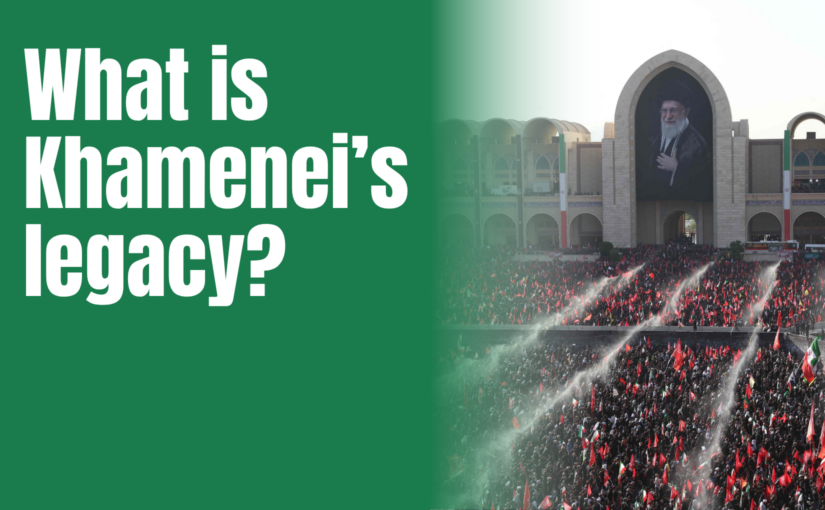
This week, millions of Iranians are filling the streets of Tehran, Qom and Mashhad for the funeral of Seyyed Ali Khamenei, assassinated by the US and Israel on 28 February along with members of his family. Delegations from around a hundred countries have come to pay their respects; not one Western leader is among them.
In this video, Carlos Martinez asks who Ali Khamenei actually was, and why the most powerful country on earth considered him so dangerous: his lifelong defence of Iranian sovereignty after a century of foreign domination; his unmatched support for the Palestinian struggle; the social transformation of Iran under sanctions; his orientation towards the multipolar world; and the austere scholar behind the Western caricature – the man Nelson Mandela called “my leader”.
Transcript
This week, millions of people – the authorities actually expect more than ten million by the end of the week – are filling the streets of Tehran, Qom and Mashhad for the funeral of Seyyed Ali Khamenei, who was assassinated by the US and Israel on the 28th of February, together with several members of his family – including his 14-month-old granddaughter.
The funeral had to be delayed for four months, because the country was under bombardment. And now that the ceasefire is holding – for the moment – the Iranian people are finally able to bury their leader. Delegations from around a hundred countries have come to pay their respects. Not a single Western leader is among them.
So in this video I want to ask a simple question: who was Ali Khamenei, and why are millions of people mourning him? Why did Nelson Mandela call him “my leader”? And why did the most powerful country on earth consider this eighty-six-year-old cleric, poet and scholar so dangerous that it carried out an extrajudicial assassination of him and his family?
Donald Trump called Khamenei “one of the most evil people in history” – this from a war criminal and close personal friend of Jeffrey Epstein, so make of that what you will. The BBC and CNN will tell you he was a dictator, a fanatic, a tyrant. What they don’t do is explain why his coffin is now surrounded by one of the largest crowds of mourners in human history.
Khamenei’s legacy is deeply entwined with the history of Iran, and the project of defending Iran’s sovereignty.
For most of the last century and a half, Iran was not allowed to govern itself. In 1907, Britain and Tsarist Russia simply divided the country between them into “spheres of influence” – without consulting a single Iranian.
In 1953, when the elected prime minister, Mohammad Mossadegh, committed the unforgivable crime of nationalising Iran’s oil, the CIA and MI6 organised a coup, overthrew him, and installed the Shah as a dependable guardian of Western energy interests. For the next quarter of a century, Iran’s oil flowed west, and the Shah’s secret police tortured anyone who objected.
One of the people they tortured, incidentally, was a young cleric named Ali Khamenei, who was imprisoned six times under the Shah’s dictatorship.
The Revolution of 1979 ended Iran’s century of humiliation. And whatever else you want to say about the Islamic Republic, it has stuck firmly to its promise of asserting its sovereignty. The Revolution ensured that Iran would never again be anyone’s client state.
Khamenei embodied that principle for over forty years – as president from 1981, and as Supreme Leader from 1989.
In February this year, when the bombs started falling on Tehran and his advisers begged him to move to a secure location, he refused. He said that since millions of ordinary people in Tehran had nowhere to go, he was staying put. He was in his own home, not a bunker, observing Ramadan, and that’s where he was killed.
What did he stand for? I’d point to four things.
First: Palestine. Under Khamenei’s leadership, Iran was the foremost state supporter of Palestinian liberation – providing decades of material backing to the resistance at a time when almost every other government in the region was making its peace with Israeli apartheid, signing “Abraham Accords”, opening trade offices. Iran resolutely refused to recognise the legitimacy of an ethno-supremacist regime built on the dispossession of another people.
A vast Western-funded propaganda apparatus has been working for decades to convince Iranians that the Palestinians don’t deserve their solidarity, but Khamenei’s line never changed: the Palestinians are the victims of colonial occupation and oppression, and we have a basic moral responsibility to help them. That, more than anything to do with nuclear weapons, is why the empire hated him. He and the martyr Seyyed Hassan Nasrallah are arguably the two non-Palestinians who’ve done the most for the Palestinian freedom struggle.
Second: Khamenei stood with the oppressed of the world. Iran under his leadership supported the struggle against apartheid in South Africa when the West was still labelling Mandela a terrorist. And in 1992, not long after his release from twenty-seven years in prison, Nelson Mandela travelled to Tehran, thanked Iran for its support – and referred to Khamenei as “my leader”. One of the towering anti-colonial figures of the twentieth century, a man the whole liberal world now claims as a secular saint, called Ali Khamenei his leader. Today, Iran stands proudly with Cuba, with Venezuela, and with all countries facing imperialist aggression and siege.
Third: Khamenei represents the transformation of Iran itself. This is a part of the story that never gets told. Before the revolution, roughly half of Iranians couldn’t read and write. Today literacy is over 90 percent, and near-universal among the young. Women, once largely excluded from education, now make up the majority of students in Iranian higher education. And despite suffering under one of the harshest sanctions regimes in history – sanctions designed explicitly to strangle its development – Iran forced itself into systematic self-reliance, and built itself into a scientific, technological and military power capable of doing what no one thought possible: taking the best punch of the United States and Israel, this very year, and emerging with its sovereignty intact.
And fourth: Khamenei stood for multipolarity. Under his leadership, Iran oriented decisively towards the emerging multipolar world – through membership of the Shanghai Cooperation Organisation and BRICS, through a 25-year strategic partnership with China, through deepening ties with Russia and across the Global South.
And what of the man himself? Here the caricature collapses entirely. Khamenei lived austerely – famously so. He allowed his immediate family no businesses, not so much as a shop; his children studied and taught. He was a published poet and a serious scholar of literature – Persian, Arabic, Azeri, and Western too. He read English novels in English; his favourite book, reportedly, was Les Misérables – Victor Hugo’s great hymn to the poor and the outcast. The Western press spent decades painting him as a medieval fanatic. The reality was a man of letters who chose, deliberately, to live simply and to die at home among his people.
Now, the Western media has seized on some remarks that were apparently made at the funeral, about the need to avenge Khamenei’s killing by serving Donald Trump with the same fate.
The Western commentariat is scandalised, of course. But the impulse is not hard to understand. “An eye for an eye” is after all a principle shared across the Christian and Muslim traditions. Khamenei was assassinated, along with his family, in the middle of negotiations that the United States itself had requested. That a grieving nation should cry out for justice is the most human thing in the world – and those who ordered the killing have no standing whatsoever to lecture anyone about the sanctity of leaders’ lives.
But let’s not put an equals sign between Trump and Khamenei, as though they were figures of the same kind, to be weighed in the same scale. One is a billionaire demagogue who ordered the extrajudicial killing of a foreign head of state and his family, while supporting a genocide in Gaza, tightening a brutal blockade on Cuba, and sending stormtroopers onto the streets of American cities to round up immigrants.
The other was a man who devoted his life to the independence of his nation, the liberation of Palestine and the cause of the oppressed. These two men do not belong in the same sentence, still less the same moral category.
The men who ordered Khamenei’s killing imagined it would break Iran. They imagined the Islamic Republic would collapse, that the people would rise up and welcome their liberators. Instead, the assassination united the country – including many who had marched against the government – and turned a martyred leader into a symbol of national defiance. Those millions in the streets this week are the answer to the delusion that this proud nation can be bombed into submission. Khamenei was a student of Imam Hussein, steeped in the tradition of Karbala – of standing with the oppressed against the oppressor, whatever the cost. To die a martyr in that cause is precisely the death he would have chosen.
Mao Zedong famously said that to die for the people is weightier than Mount Tai, but to work for the fascists and die for the exploiters and oppressors is lighter than a feather.
Donald Trump represents the Epstein class: the kleptocrats, the billionaires, the imperialists. When his time comes, he will be mourned by nobody. Ali Khamenei represented the poor, the colonised and the dispossessed. He is being mourned, this week, by millions in the streets of Iran and by countless more across the Global South – and his legacy will inspire generations in the long struggle against imperialism.