
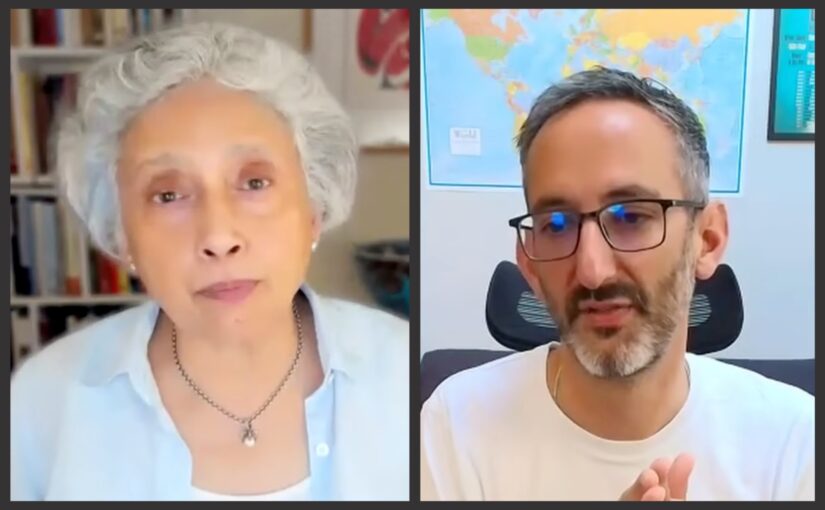
In this discussion with Radhika Desai, Carlos Martinez confronts the charge, common even on parts of the left, that Beijing does far too little for Palestine, Iran, Cuba and Venezuela.
The conversation traces China’s foreign policy from the internationalism of Bandung and the Non-Aligned Movement, through its rapprochement with Washington and entry into the world economy, to its pursuit of a Global Community of Shared Future.
Transcript
Radhika Desai: Hello, viewers and listeners. Welcome to the Geopolitical Economy interview, a series in which I speak with prominent intellectuals, scholars, politicians, journalists, activists and public figures to illuminate the fast-changing political economy and geopolitical economy of our times.
I’m Radhika Desai and you’re watching Radhika Desai, Geopolitical Economist. Today’s topic is China’s foreign policy towards the United States and the West on the one hand, and the oppressed — and I should say oppressed and embattled — nations such as Palestine, Cuba, Venezuela and Iran on the other, in the broader context of rising multipolarity. How should the left make sense of it, particularly given that sections of the left have criticised China for not doing enough for precisely these countries?
I can think of few people better qualified to address this question than Carlos Martinez, who joins me today. Welcome, Carlos.
Carlos Martinez: Hi, Radhika. Lovely to see you. Good to be with you.
Radhika Desai: It’s really great to have you today, Carlos. Let me tell our audience that you are an independent scholar and researcher, co-editor of the increasingly important and influential Friends of Socialist China website, and author and editor of many books on China and on socialism — including the one on China, which is called The East Is Still Red, and the wonderfully titled book on the demise of the USSR, The End of the Beginning. You meant, of course, that this was just the end of the beginning of world socialism.
Carlos, can you begin by addressing the criticisms of China’s foreign policy that are quite widespread in some sections of the left — in a sort of overall, summary fashion — before we go on to investigate its particular aspects, and China’s foreign policy towards particular countries?
Carlos Martinez: Sure. I think there are a couple of broad strands of criticism of China’s foreign policy on the left. One of them is more or less hostile; one of them is more or less friendly and sympathetic. The hostile one is that China is an imperialist country, that it’s a state-capitalist country, that its companies pursue private profit as their central motive, and that China’s foreign policy reflects that. This is essentially the United States State Department position, adopted by parts of the left.
So there’s lots of talk about debt traps. There’s lots of talk about expansionism. There’s lots of talk about China being an imperialist power and engaging in inter-imperialist rivalry with the US, with the West. That’s the position of the Greek Communist Party. That’s the position you’ll typically find in Jacobin and other elements of what might be referred to as the compatible left. Then you’ve got a sort of sympathetic critique.
Radhika Desai: And sorry, just to clarify — compatible with what?
Carlos Martinez: Compatible with capitalism.
Radhika Desai: Continue, please.
Carlos Martinez: I mean, I’m painting in very broad strokes there, and perhaps being a little bit unfair, but we can get into that later if you want. And then there’s a sympathetic critique, which comes a lot of the time from people who are pretty close to us politically, who accept China’s socialist foundation, but who express a disappointment that China’s foreign policy isn’t good enough — that China’s not aggressive enough in pursuit of justice, that it’s not doing enough for oppressed nations, that it’s not doing enough for countries under attack.
And they compare it unfavourably with the Soviet Union in the ’50s, ’60s and ’70s. They compare it unfavourably with, for example, Cuba’s intervention in Southern Africa in the 1970s and 1980s. In terms of this first strand — that China is an imperialist country — I think we don’t need to dwell on it too much here. That’s quite an easy question to deal with, and it’s dealt with at some length in a chapter in a forthcoming book on China’s foreign policy that Keith Bennett and I have put together, and that you very kindly wrote an endorsement for. That should be out in August.
But the simple fact of the matter is that imperialism isn’t an idea, it’s a material reality. What’s the physical component of China’s imperialism? It doesn’t have colonies. Unlike the United States, it doesn’t have 800 overseas military bases — it has one, which is a logistics station in Djibouti. It’s not been at war since 1979. It’s got a purely defensive nuclear posture. Its per capita military spending is about one-twentieth of that of the United States.
It doesn’t engage in proxy wars, coups, assassinations, unilateral sanctions or economic coercion. So from a physical perspective, and a political perspective, and a military perspective, to call China imperialist is borderline insane. From an economic perspective — and this is where the critique usually comes in — China, sure, is a major power. Yes, it has a lot of capital. Yes, it invests in other countries. But the point is that it doesn’t engage in super-exploitation of labour.
It’s not a beneficiary of the system of unequal exchange. Actually, the flow of surplus value has been away from China, to the imperialist bloc. And the largest recipients of Chinese investment are actually the United States, Australia and Britain. China’s not investing in Britain with the idea of extracting surplus labour and benefiting from cheap labour; it’s not plundering the periphery with these investments. And China is obviously a structurally very different country to the Western capitalist countries — there’s no structural drive to imperialism.
It’s a state-led economy where the commanding heights are state-owned and the banks are state-owned. Capitalists don’t constitute the ruling class and are not able to direct foreign policy to their own specific class interests. As for the debt trap, this is a myth that’s been debunked again and again. The British debt charity Debt Justice UK did a really nice analysis of this which shows that China doesn’t dominate investment in the Global South.
China constitutes about 15 percent of debt, of investment, in Africa. Chinese interest rates are typically half their Western counterparts. Their repayment terms are much more flexible and their practices far less predatory. And the fact is that there are no recipient countries of Chinese investment that are calling what China engages in a debt trap. Quite the opposite. You actually have, for example, the Cambodian Deputy Prime Minister saying very specifically, about the accusation of the Belt and Road being a debt trap: “It’s not a debt trap; it’s a lifeline for our social and economic development”.
So the people that are saying that it’s a debt trap are not the recipients but the imperialist countries. So I think you could probably say that this is a case of projection. As for whether China’s foreign policy is good enough — I think we’re going to get into the details on this, so I’m not going to go on about it now. All I will say for the moment is that foreign policy is not actually determined solely by moral values and moral principles.
You in your political work, me in my political work — our foreign policy is determined on a moral and ideological basis exclusively. But for a state, it’s shaped by a complex set of factors, including domestic priorities, international constraints and strategic considerations. So it’s easy to say that China should do more on any number of subjects, but that ignores the constraints China faces. We’re talking about a developing country still.
It’s at what it calls the primary stage of socialism, operating within an imperialist-dominated environment that can’t simply be abolished by decree. Unfortunately, there is no magic wand for dismantling imperialism. And China itself is the principal target of US foreign policy, of the US strategy of containment and encirclement. So strategic caution isn’t something the Chinese leadership engages in because that’s what it thinks is the absolute best, perfect, Marxist approach to foreign policy.
It’s a simple necessity. It’s the only way to protect China’s own development and, along with China’s development, the interests of the Global South and the multipolar project more generally. And within that framework, and with those constraints and limits understood, I think China’s actually doing a lot for countries under attack, for nations under siege. But let’s dive into a bit more detail on that later.
Radhika Desai: Yeah, you raised so many important points, but let me just get a couple of very basic things out of the way. Firstly, I really liked the way in which you opened and talked about different sections of the left, and insisted that it was important not to be unfair to anyone — because the purpose of all this discussion is not to stigmatise sections of the left and say, you are wrong because you are blaming China, and so on.
It is to take the concerns that this criticism represents seriously and address them, because at the end of the day our purpose is not to be sectarian but, in fact, to rise above sectarianism and unite the left. Secondly, I really liked that you made one critically important point which will come up again and again, I think, in our discussion — and that is that the narrative that China and the United States are involved in some kind of great power conflict which can be compared to what happened in the run-up to 1914, for example, is deeply flawed. Because what happened in the run-up to 1914 was a rivalry between peer capitalist powers for colonies, for territory to subordinate, and so on.
Today, we are in a radically, radically different situation. To some extent, of course, it has echoes of the Cold War, in the sense of inter-systemic competition between a capitalist and a communist major power. So in a certain sense this happened before — but of course history never repeats itself. It’s different in a number of ways, and one of the ways it’s different is that we’re looking at essentially the desperation of a declining capitalist West, a declining United States trying to hang on to what remains of their imperial privileges.
And the rise of China, whose very rise is restricting these imperial privileges. So the character of the domestic political system determines a great deal of what foreign policy is going to look like. It’s because the United States is imperialist, which means that the state must do the bidding of its ruling capitalist classes, its ruling corporate capitalist classes. It’s not the ordinary mom-and-pop store owner who is part of the ruling class, but the likes of Elon Musk and Jeff Bezos. And since they require that the US open up different countries for their investments or for them to sell their goods it goes to war, pursues globalisation, which is nothing but a euphemism for the subordination of much of the rest of the world, and so on.
Whereas China has a completely different system. China has, as you said, a state-led socialist economy. Even though it has a lot of elements of capital in it, those elements of capital are controlled by the party. And yes, whenever there are problems generated by elements of capital in the system — for example, the real estate crisis — they are resolved in a radically different fashion, and not at the expense of the rest of the world, and not at the expense of the domestic working class.
So in these ways — and one final point I want to make is that China prioritising the stability and growth of its domestic economy is not some kind of violation of socialist principles. I’ve never really understood this dislike for socialism in one country. Although, of course, China isn’t doing socialism in one country — but this idea that somehow you have to sacrifice the interests of the vast majority of people who brought you to power and keep you in power, in order to run some wild goose chase somewhere else.
No, I think the primary purpose of the party state in China above all is, first of all, to maintain the stability and what it can manage of the prosperity of its domestic economy — a front on which it’s doing very well these days — and then, yes, to do whatever else it can in the rest of the world. So anyway, I just thought I would throw that in, because I think those were really important points that you raised.
Carlos Martinez: On the basic structure of the current conflict, or the current dynamics in global political economy, I’ve been doing a bit of work — or at least starting to think — about the World Association of Political Economy conference, which is coming up in a couple of weeks. And the hypothesis I’m going to put forward is that what we face today is essentially Rosa Luxemburg’s socialism or barbarism in the 21st century. The crux of that is essentially, on the one side, a US-led Project for a New American Century versus a China-led global community of shared future — which is essentially the desperate lashing out in every direction of a dying imperialism versus a rising multipolarity and socialism.
So I think that’s consistent with the analysis that you’ve just laid out. And another very important thing that you alluded to is that the defining character of China’s political posture is the fact that, yes, China has a capitalist class. China has a significant number of people who own and deploy capital, and that’s what they do with their lives, that’s how they make a living — but that class is not the ruling class, and is not allowed to be the ruling class.
As a billionaire in China — and China has a few hundred billionaires, although I’m glad to note that the number of billionaires in China is actually going down over the course of time, which is the right direction, and furthermore that being a billionaire in China is a highly dangerous, risky business; you’re far more likely to be punished at the highest level by the state if you’re a billionaire than if you’re an ordinary citizen — but as a billionaire, you can be a member of the Communist Party if you agree with the aims of the Communist Party, and there are actually several cases of very wealthy people in China who actively support and work towards the aims of the Communist Party and consider themselves socialists and communists and Marxists.
What you can’t do is organise your own political party — a political party that represents the interests of the capitalist class, that aims to give enshrined rights to capital. That very much feeds into what we’re talking about today, because the capitalist class being the ruling class in a country like Britain, or in a country like the United States, means that the capitalist class is able to essentially set foreign policy. It’s able to use its links to government to set up a foreign policy in its own particular interest.
The war in Iran, for example — is the war in Iran being fought in the interests of ordinary people, in the interests of the working class of the United States? It’s not.
Radhika Desai: Absolutely not.
Carlos Martinez: It’s in the interests of, A, the military industrial complex; B, big oil and the energy companies; and C, a group of hardcore ideological lunatics who think that the extension of US hegemony from the 20th century into the 21st century is some kind of viable idea — which of course it isn’t. But these are the people that are able to actually set the course of US foreign policy. So that’s a function of the ruling class being the class that defines a country’s foreign policy.
And so that is a huge difference between the West and China. And that’s a huge difference between the rivalry and conflict and hostility we see now and what you were talking about, the inter-imperialist rivalry that we saw leading up to 1914.
Radhika Desai: And just a couple of things that I thought of as you were talking. This whole idea that somehow China should drop everything and go immediately to the aid of all these countries — it reminded me that when we are on a plane and we are given this usual safety announcement, you are always told to put on your own mask before you help anyone else, even your own child. And I think that China cannot be blamed for carrying out the right procedure.
At the end of the day it’s responsible for the security and wellbeing of 1.4 billion people. And so that is a very substantial chunk of humanity there already. Secondly, you mentioned in whose interest the war is being fought. And I agree with everything else you say — it’s a complex war — but I would also add another thing. The war is being fought in the interests of Donald Trump, precisely because he was totally failing on the domestic front. There was absolutely nothing he was doing that was actually preventing his numbers from declining, and he thought somehow he could produce an easy military victory, expecting that they would bomb Iran for a couple of nights and that would be enough for ordinary Iranians to rise up and overthrow their government — completely underestimating the extent of the legitimacy of the government.
But maybe, before going on to these individual cases of Iran or Cuba or Venezuela — Palestine, of course — maybe we should dwell a little bit on the history of China, the modern history of China, and its foreign policy. I think when people look at China today and it seems like a really great power, and certainly the second biggest, if not the biggest, economy in the world, they forget what vulnerability it suffered in the earliest days.
I mean, after the 1949 revolution, between ’49 and into the ’70s, China did not even have a seat in the United Nations. China suffered the possibility of being attacked with nuclear weapons, acutely aware that at least part of what had led to the bombing of Hiroshima and Nagasaki was that these were Asian countries that were somehow lesser than European countries — so that the United States would sooner bomb China than it would bomb the Soviet Union with nuclear weapons. China fought, of course, on the North Korean side in the Korean War.
China at that time was poorer in per capita income terms than was India, which had become independent just two years before the revolution in China. So if you put together all these things, China has gone through the ringer and survived it, in order to come out the other side and be what it is today.
Carlos Martinez: Yeah, absolutely. As you say, China has been under constant threat. And that begins not with Obama’s pivot to Asia in 2011. That begins with the declaration of the People’s Republic of China in 1949, right? That’s when this campaign of containment and encirclement of China begins, and the whole project of trying to roll back the Chinese revolution, trying to roll back the gains of the Chinese working class and peasantry. In 1950, just a few months after liberation, after the declaration of the People’s Republic, the Truman administration sent the Seventh Fleet of the US Navy to the Taiwan Strait, specifically in order to put pressure on China and to prevent China’s reunification. So, to prevent Taiwan being reunified with the mainland — which it certainly would have been if it hadn’t been for the intervention of US imperialism. Which is why, incidentally, we should consider that Taiwan’s de facto separate status is a hangover of the colonial imperialist era, and why that’s still an important question for anti-colonialists and anti-imperialists.
Then, of course, the Korean War was launched in 1950. That was to a considerable degree about containing China and containing the Soviet Union, and establishing a permanent military outpost and a nuclear threat against the socialist world in East Asia. And, as you alluded to, General Douglas MacArthur threatened a number of times to use the nuclear option against China. And 1950 — this is five years after the only times that nuclear weapons have ever been used in war, which was by the United States in Hiroshima and Nagasaki in August 1945. So that’s very much within living memory. That was very much a serious and significant threat. I think people tend to think of the possibility of a nuclear strike as being slightly remote, a fairly abstract thing now, 81 years later; but in 1950 it was very concrete and a very serious threat. Incidentally, we should take that threat more seriously than we do, but we can come back to that.
So China from the very beginning was under siege. Nonetheless, it pursued a radical, militant and deeply self-sacrificing foreign policy. Within a few months of the declaration of the People’s Republic — about a year after the declaration of the People’s Republic — China made the decision to intervene on the side of North Korea in the Korean War against the United States, NATO and what they called the UN police action against Korea.
In the process of which China lost hundreds of thousands of volunteers. Hundreds of thousands of volunteers from this very new state gave their lives in the defence of Korea, and were crucial, were indispensable, in the outcome of that war. The US thought it would have an easy victory. What they ended up with was an unwinnable war and a truce which remains in place today.
China gave pretty profound support to liberation struggles in Algeria, in Mozambique, in Zimbabwe, Palestine, Southern Asia, Southeast Asia, Latin America. China established a pattern of very long-standing solidarity with Africa, one of the big highlights of which was Zhou Enlai’s visit to Africa in 1963. He visited ten countries, including Algeria, Egypt, Ghana, Mali and Ethiopia, and actually set a precedent which continues today, whereby the Chinese foreign minister’s first trip every year is to Africa.
Radhika Desai: I didn’t know that. That’s interesting.
Carlos Martinez: Interestingly, the current heads of state of both Eritrea and Zimbabwe received military training in China in the ’60s and ’70s as part of their national liberation struggles. And African countries repaid that solidarity in kind: African countries were absolutely decisive in winning the vote for China’s admission to the United Nations in 1971.
China, of course, put forward the Five Principles of Peaceful Coexistence, which were adopted at the Bandung Conference in 1955. They fed into the founding principles of the Non-Aligned Movement in 1961. And they made concrete one key insight, which is that all oppressed and all formerly oppressed countries — all victims of colonialism and imperialism — however different their systems (some of them might be socialist, some of them might be capitalist, some of them might be some or other hybrid, or some or other kind of relatively novel experiment), nevertheless all share a common interest in opposing imperialism, defending their sovereignty, and choosing and pursuing their own development path.
And I think that’s a key insight that remains hugely important to those of us that are promoting some kind of multipolar or pluripolar path. China, for what it’s worth, was one of the first countries to recognise the Palestine Liberation Organization, in 1965. And I’ve got a quote here from Mao Zedong to the PLO representative in 1965. He said: “Imperialism is afraid of China and it’s afraid of the Arabs. Israel and Taiwan are the basis of imperialism in Asia”.
Radhika Desai: Maybe Samuel Huntington read that and wrote The Clash of Civilizations.
Carlos Martinez: China was, if not the first, then one of the first countries outside the Arab world to recognise the State of Palestine. That was done in 1988. Britain and France are endlessly congratulating themselves that they recognised the State of Palestine in 2025. Well, 37 years later — better late than never, I suppose. The form of Chinese solidarity, and the form of its foreign policy, has changed a lot over the years, especially with the rapprochement with the United States that begins in ’71 with the Kissinger visit, and then the Nixon visit in ’72, the Shanghai Communiqué, and then the restoration of bilateral relations in 1979 under the Carter administration; China’s entry into the global economy; China’s entry into the World Trade Organization — these three or four decades where there was heavy investment by United States companies in China, and an awful lot of Americans getting very, very wealthy as a result of essentially exploiting the Chinese working class.
Of course, the Chinese also did well out of the arrangement. But that focus on integration into the global economy and attracting capital, having good relations, learning and upgrading their scientific basis, upgrading their technological basis, and so on and so forth, relied on a relatively peaceful international environment. And on that basis, China’s foreign policy became less radical. For example, Deng Xiaoping meeting with Lee Kuan Yew, the Prime Minister of Singapore, and wanting to attract investment from Singapore. Lee Kuan Yew says, more or less — I’m paraphrasing, I don’t have the quote in front of me, but more or less the vibe is — well, yes, we’re interested in investing in China. We recognise that China’s a big growth market, and of course the majority of Singaporeans are of Chinese extraction and have got family history and have got their laojia, their home villages in China, that they still care about. However, you’re sponsoring militant insurrections against our government, and we don’t want to encourage that. So China moved away from that type of activity, from sponsoring armed insurrections and guerrilla movements and communist parties, and so on and so forth.
But I think if you look at China’s overall policy — what it’s doing in terms of promoting multipolarity, what it’s doing in terms of promoting adherence to international law and promoting the principles and purposes of the United Nations Charter; its engagement with the BRICS, its engagement with Russia, its engagement with the Shanghai Cooperation Organisation; forums like FOCAC, the Forum on China–Africa Cooperation, the G77 plus China, the China–CELAC Forum in Latin America and the Caribbean; its encouragement and stimulation of South–South cooperation; and its attempts to create a path to a multipolar world that’s not dominated by the West. I would argue that the form of its solidarity in its foreign policy has changed, but the content of the foreign policy hasn’t actually changed all that much.
Radhika Desai: No, that’s a very important set of points, and I wanted to respond with some of my own. So the first point I’d make is that after decades of being out in the cold, of course, you had China then receiving President Nixon, and that led to a certain rapprochement between China and the United States — with the very important result that China regained its seat in the United Nations. And what that brought with it was the end of the ridiculous pretence that China’s seat in the United Nations, and above all in the United Nations Security Council, could be held by the province of Taiwan, or what calls itself the Republic of China.
So the People’s Republic of China finally took its seat in the United Nations and in the United Nations Security Council. And I think that, beginning from that point onwards, there was, yes, increasing interaction between the American and the Chinese economies in particular. But what becomes very clear from early in this century is that this increasing interaction was undertaken by the United States in the fond hope that China would forever remain a source of cheap labour for US corporations.
And therefore that this arrangement would continue forever. Of course, like any good Communist Party, China had absolutely no intention of continuing to remain in that position. China had every intention of — and it successfully carried out — a strategy of moving up the value chain, making its economy and its enterprises capable of manufacturing more and more high-technology goods. And as this became more and more apparent, you began to see increasing aggression towards China, which does not just date from Obama’s pivot to Asia.
That was already quite late. It actually dated from earlier in the century, when George W. Bush, I think in 2003 or ’04, imposed steel and aluminium tariffs on China. And of course, essentially that also tells you an enormous amount about the character of US foreign policy. It had nothing to do with making China democratic, or what have you. It had everything to do with subordinating China. So the period of so-called Chimerica, as some people used to call it, came to an end already by the mid-2000s, and since then we have been seeing increasing aggression towards China on the part of the United States.
The second thing I wanted to say is that actually, when we talk about anti-imperialism, the typical image we have is of wars and of fighting imperialist forces in wars. But of course there is nothing more fundamentally and more consequentially anti-imperialist than pursuing the development of your own country, because that allows you to stand up to imperial power. So I just wanted to say that, and maybe also then begin to wind us towards talking about these individual cases.
I mean, you said already something about Palestine, and maybe you can finish your thoughts on Palestine and go on to other countries in whatever order you want.
Carlos Martinez: Yeah, just to come back briefly on this whole Chimerica thing. I think that was always overstated to some degree. There was never an alliance between the two countries, and there were always hostilities, there were always contradictions, there were always problems. For example, going back even earlier than 2003 — I think from the ’90s the US ruling class and US strategic circles were already starting to get an inkling that China wasn’t going to permanently occupy the bottom rung of the global economic ladder, producing toys and producing t-shirts and the cheapest, simplest electronic parts for the Western market.
And it’s in 1997 that Brzezinski releases The Grand Chessboard, right? And he talks about the most dangerous possible scenario for US global primacy being — he specifically singles out — an anti-hegemonic coalition of China, Russia and Iran uniting to challenge American dominance in Eurasia. And nearly 30 years later it’s interesting to see how on the nose he was. And then in 1999, as part of NATO’s war on Yugoslavia, you have NATO bombing the Chinese embassy in Belgrade, which they tried to explain away as being a mistake, but it clearly feeds into the fact that the Chinese were outspoken in their opposition to that illegal war. So, as far as I understand it — certainly as far as the Chinese understand it — the bombing of the Chinese embassy in Belgrade was a message by the United States, by NATO, to China that you better not get ideas above your pay grade, you better not start considering yourself a serious power in international affairs, and you better stick to Deng Xiaoping’s famous dictum from the 1980s that we will hide our strength and bide our time. So the US is saying to China in the ’90s, in the 2000s: carry on hiding your strength and biding your time.
And of course, what you’re seeing over the last few years, especially under the Xi Jinping administration, is that China’s increasingly not following that dictum any more. That it’s asserting itself more — not in defence of its own interests, but to offer China’s experience and Chinese solutions to global problems. China is saying: “We are a world power. We’ve got a valuable role to play in the world — not upholding hegemony or asserting hegemony or imposing hegemony, but in dismantling hegemony and building towards a multipolar future in which all nations enjoy their sovereignty, all nations enjoy their independence, all nations have a role on the global stage.”
And that’s the content of the global community of shared future. That’s the content of the Global Development Initiative; the Global Security Initiative, which makes a very simple point — one which has actually been understood even by intelligent bourgeois analysts for many decades — which is that security has to be indivisible. Everybody has to have security, or nobody has security. The Global Civilization Initiative, and now more recently the Global Governance Initiative.
These provide a sort of institutional framework for this concept of multipolarity, for this concept of a global community of shared future. And China’s no longer being shy, it’s no longer being so cautious, it’s no longer being so reticent about the direction it feels the international order should go in.
Radhika Desai: Yeah, so just on that, before I ask you to comment on some of these other countries, I just wanted to say that I was recently asked to speak at a conference on security issues in Russia, of all places. And as I was there — there was nothing in particular, but it was just the quality of the conversation, the different people presenting different perspectives; there was quite an international group of people there — suddenly something became very blindingly clear to me.
When the West talks about security, what it really means is imperialism. What it wishes to secure are its imperial privileges. When countries like China, or Russia even — and these are the bigger powers outside the West — even when they talk about security, they are essentially talking about countering the imperialist moves, whether it is in the realm of, I don’t know, cybersecurity or environmental security or food security, or outright military security.
In every one of these cases, their position is typically defensive, whereas the position of the West is typically aggressive. And the second thing I wanted to say is that these various initiatives — the Global Security Initiative, the Global Development Initiative, Governance Initiative, Civilization Initiative — they’re really interesting documents. And they hark back to the Panchsheel principles, the Five Principles of Peaceful Coexistence that China also adumbrated back in the ’50s.
And of course, they go back to the principles of the UN Charter. And on the principles of the UN Charter — it’s become very fashionable now to pooh-pooh the United Nations, but people forget that the United Nations has much that is progressive in it. And the reason why all these progressive things are there is because the Charter, and the United Nations itself, is a compromise forced upon the imperialist powers by the loss of their own power and by the rise of anti-imperialist forces, particularly China and Russia, or the Soviet Union.
So in that sense, ordinary things like respect for sovereignty — okay, it is hypocritical; it is honoured more in the breach. But as has been said, hypocrisy is the homage that vice pays to virtue. If at least the homage has to be paid, we’ve made some progress. And I think that this is very important. So please comment on any of that, and then maybe take us, as I say, to finish any thoughts on Palestine, and then Iran and Cuba, Venezuela, and so on — as you wish, in any order.
Carlos Martinez: Sure. That’s really interesting, what you’re saying about the UN Charter. And I think China’s foreign policy is very strongly grounded in the principles of the United Nations Charter, which of course China helped to draft and has consistently defended. China was one of the first, initial signatories, one of the founders of the United Nations, and one of the founding signatories of the United Nations Charter, as was the Soviet Union.
So when there are people who say that the United Nations Charter and the whole framework of international law is essentially imperialist because it reflected, to a significant degree, US interests — and that the most prominent aspect of the international order that has followed 1945 is more or less US hegemony — that forgets that the UN Charter, in the ashes of World War II, specifically represents a framework for peaceful coexistence between the imperialist world and the socialist world and the former colonies.
So, in terms of the principles of the UN Charter that China upholds and defends, I think first and foremost it’s respect for sovereignty. It’s respect for the territorial integrity of other countries. And respect for the principles of non-interference in the internal affairs of other states. Those are the principles that China upholds and that the United States and the capitalist countries of Western Europe and North America and Australia certainly don’t. It also means opposing unilateral sanctions, opposing military intervention and regime change, and seeking peaceful resolution of disputes through dialogue and negotiation. I think that’s very much proven by China’s essential orientation towards peace.
China is of course the only nuclear-armed state that’s got an unambiguous no-first-use policy, which has been in place since its first test in 1964. So China has it more or less written into its constitution that it would never use nuclear arms except in retaliation for a nuclear strike against it, and that it would never use nuclear arms against a non-nuclear state — which means that it specifically agrees never to engage in nuclear bullying, which is the whole reason that the imperialist countries have nuclear weapons: so that they can engage in nuclear bullying.
China consistently uses its weight at the Security Council to push for political settlements against war. That’s been the case with Iran, that’s been the case with Ukraine, that’s been the case with Syria. And as I say, many people point out that the UN Charter, that international law in general, has weaknesses — and it’s true, they do have weaknesses. But China’s position is that they represent a de facto global consensus, and that the world would be a much better place if the United States and its allies abided by them, right?
So the solution to the weaknesses is to strengthen and to reform the UN system, not to abandon it. And that’s the substance of the Global Governance Initiative that was announced a few months ago, I think in September. It’s explicitly a project to repair, reform and democratise the existing UN-centred system, not to overturn it or to build a parallel one. And going back to the four initiatives which you were mentioning — I think what they reflect in totality is quite interesting.
If you look at it deeply from an ideological point of view, and analyse it within a historical context, I think this whole notion of a community of shared future is an assertion of a very different organising principle for international relations — one that replaces the default organising principle of international relations, which is kind of this Hobbesian competitive struggle of self-interested actors, with a notion of cooperation, a notion of mutual benefit, and the conceptualisation of the world as a single family, where the success of one is bound up with the success of all. These are contrasting principles which embody two fundamentally different worldviews. And the Chinese talk about this: the world as a jungle in which the strong prey on the weak, versus a world in which humanity is a single family and the earth is its only shared home.
And if you distil that down to the level of ideology, you would say that one of those principles is the organising logic of capitalism and the other is the organising logic of socialism.
Radhika Desai: Exactly.
Carlos Martinez: So, you wanted to talk about Palestine.
Radhika Desai: Yeah, in any order you like. I mean, and if you prefer not to, I can shift the conversation to something else.
Carlos Martinez: No, no. Let’s go for it. Because this is one of the principal areas in which people have made a strong critique of China, for not doing enough to defend Palestine in Palestine’s hour of need — nearly three years now into Israel’s genocidal onslaught on Gaza. So, in terms of the historical record, as I mentioned earlier, China was among the first to recognise the PLO back in 1965. It was one of the first to recognise the State of Palestine back in 1988.
And China and Palestine have a shared history as targets of imperial aggression. That’s something that’s been recognised by the Chinese leadership, by the Communist Party of China, from the 1950s onwards. In terms of what’s going on recently, at the diplomatic level China has very consistently and very loudly condemned Israel’s brutality. It’s condemned war crimes. It’s called consistently, from the beginning, from the 7th of October 2023 onwards, for an immediate ceasefire and unilateral withdrawal of Israeli troops.
And it’s even, in international forums, upheld the legal right of the Palestinian people to armed resistance against colonial occupation — which is actually a very important statement and measure, and one that hasn’t been commented on enough. In 2024, Wang Yi, China’s foreign minister, convened 14 Palestinian political organisations, essentially all the major Palestinian factions, in Beijing to formulate the Beijing Declaration, the idea of which is to forge unity amongst the different Palestinian factions, such that in a future Palestinian state they’re able to effectively lead the country.
And this is clearly something that no Western power would or could do. China, for what it’s worth, has effectively closed its market to Israeli blood diamonds, and China–Israel relations are at an all-time low. High-level visits have been halted. RAND has been complaining that China’s position on Gaza, Israel and Yemen has angered Israeli officials. China is also providing material support via Palestine’s allies. China buys over 90 percent of Iran’s oil exports, in defiance of US so-called maximum pressure.
It’s reportedly provided air defence systems to Iran, and satellite technology that’s been instrumental in Iran’s successful resistance both last year in the 12-day war and since February 28th this year. Ansar Allah of Yemen have deemed China to be a non-participant in the Gaza genocide, so from the start of their Red Sea blockade Chinese shipping has never been targeted. And actually, you’ve got cases both in the Red Sea and the Strait of Hormuz where ships are literally changing their transponders to claim Chinese ownership, for the sake of getting the protection that gives them.
There was a lot of criticism of China’s response to Resolution 2803 in November last year. That caused a level of fury on the left and among anti-imperialist forces, because this is the resolution that formalised Trump’s so-called Board of Peace and their International Stabilization Force. And it was rightly criticised as essentially a colonial diktat. And China actually supported those arguments, and did so in the strongest terms at the United Nations Security Council.
Fu Cong, the Chinese ambassador at the UN, clearly said: “Gaza belongs to the Palestinian people, not to anyone else. The draft resolution does not demonstrate that important, fundamental principle that has to be upheld, of Palestinians governing Palestine; and Palestinian sovereignty and ownership are not being properly reflected in this resolution.” However, China didn’t veto — China abstained. Why did it do that? I think there are three obvious reasons you could point to.
The regional Security Council members, i.e. Algeria and Pakistan, both supported the resolution. The Palestinian Authority — which, no matter what you think of it, and I, rather like you, I imagine, don’t think much of it, but it is the legal representative of the Palestinian people at the United Nations — the Palestinian Authority and every regional country except Iran voiced support for that resolution. And so a veto would have meant overriding the regional consensus and the only internationally recognised representative of Palestine.
Secondly, the US Ambassador, Mike Waltz, openly threatened that Gaza would return to hell on earth if China and Russia played what he called political games, right? So a veto actually meant a green light for a full-scale resumption of the genocide, and blocking the possibility of any kind of ceasefire. So China wouldn’t and couldn’t, I think, assume responsibility for that level of escalation of atrocities. So I think it was an invidious choice, but it wasn’t a betrayal.
Another thing people criticise, and people ask, is: why doesn’t China cut all trade with Israel? Why doesn’t China impose a boycott of Israel? There’s a couple of things one can say about that — and you don’t necessarily have to agree with them, but it’s worth understanding China’s logic on that. The horrors of Gaza are not of China’s making. The United States supplies more than 70 percent of Israel’s weapons, the arms that are being used against Palestine right now. The US and the Western countries provide Israel’s diplomatic shield. It’s not China that’s doing that.
Also, China imposing a boycott would amount to unilateral sanctions by China against Israel. And China has got a wide-ranging strategy of not using unilateral sanctions, and of criticising unilateral sanctions. Essentially it attempts to hold the high ground in order to oppose the West’s sanctions regime against Cuba, against Venezuela, against Nicaragua, against the DPRK, against Zimbabwe, against Eritrea, against Iran, and so on and so forth.
So, according to international law, sanctions have to be approved by the United Nations Security Council. If they’re not, they’re illegal unilateral sanctions. And so China’s position is that we try our best to avoid imposing unilateral sanctions. And meanwhile, what would be the basis for imposing unilateral sanctions on Israel and not the United States, for example? And beyond that, would a boycott actually have a great deal of useful impact? Israel would simply turn even further towards the US. So…
Radhika Desai: That is such an important set of points. Absolutely.
Carlos Martinez: Yeah. So ultimately this question: why won’t China do more? And could China do more? Would I love to see China do more in relation to the defence of Palestine, in relation to the defence of the people of Gaza? But this isn’t actually a question that’s being asked by Palestinian people. It’s not a question that’s being asked by Palestine, or by the resistance axis, or by the resistance organisations in Palestine. And it’s really, I think, a product — a very understandable product — of Western despair at the disgusting imperialist violence that we’re seeing on our mobile phones on a daily basis.
But really, the important question for us to be asking is not why doesn’t China do more, but what more we can do. It’s our governments that are perpetrating these atrocities. How can we strengthen our movements against imperialism?
Radhika Desai: I think that is a fantastic note on which to end. We haven’t actually managed to cover everything. We never did get to Venezuela and Cuba, but that will have to wait for another time, as will many other subjects that we could talk about. I know, Carlos, that one of the things already pending on the list is your assessment of China’s advances in ecology, which would be a fantastic thing to talk about. And there are many other things — as you were talking, I was thinking that actually a really interesting thing would be to do a kind of deep dive into every one of these initiatives, to actually identify what each of them is about, what the rationale of it is, et cetera — and how different it is from Western imperialist foreign policy. But thank you so much, Carlos, that was fantastic. I’m sure our listeners enjoyed that very much. And folks, if you did, please like, subscribe, share, and if you can, donate. For the rest, until next time, goodbye.