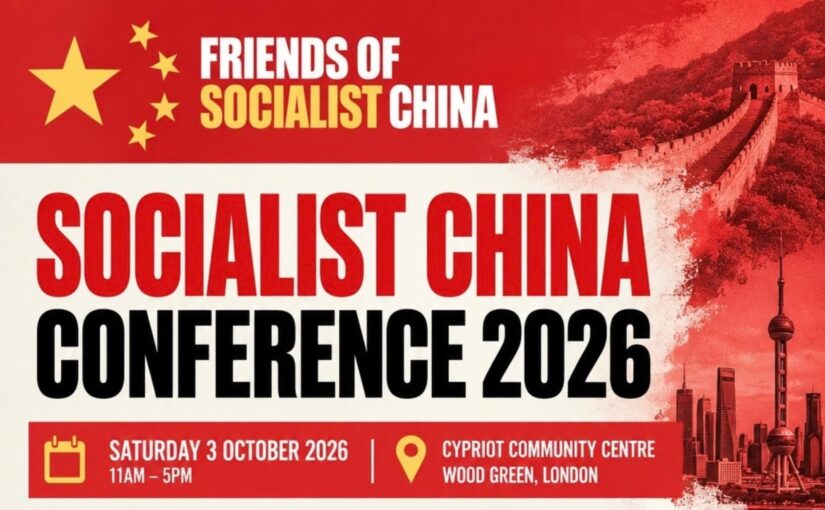
In the following article, Friends of Socialist China co-editor Carlos Martinez sets out the agenda for the third annual Socialist China Conference, taking place in London on Saturday 3 October.
Carlos notes that the British ruling class – the security state and its media representatives above all – talks about China constantly, from Chinese “kill switches” in wind turbines to Beijing supposedly funding the Palestine marches. The conference is a chance for the left to get a word in: on the drive to war in the Asia-Pacific, on what China’s achievements in poverty eradication, infrastructure and renewable energy mean for workers in Britain, on the shifting of global opinion in China’s favour, and on turning the “Chinamaxxing” mood among young people into political understanding.
If the right-wing press is to be believed, Britain is under systematic attack by the cunning Chinese communists.
Over the past couple of months, we have been warned that Beijing is funding the Palestine marches; that these perennial evil-doers are hacking our tractors; that Chinese-made wind turbines may be fitted with kill switches; and that a Chinese-owned hotel in Cyprus has a suspiciously good view of RAF Akrotiri.
Former MI6 chief Sir Richard Dearlove has claimed that China “could switch off our power grid at any second.”
The British ruling class – and particularly the security state and its media representatives – talks about China constantly, so it is probably a good idea for us to get a word in. That is what the third annual Socialist China Conference, in London this Saturday, is for.
War and peace
China’s unprecedented rise took the West by surprise. Washington’s strategists expected the country to remain at or near the bottom of the global economic hierarchy for decades or centuries, but today’s China is the world’s second-largest economy and is growing at more than twice the rate of the US economy; it is also the world’s largest trading nation and manufacturer.
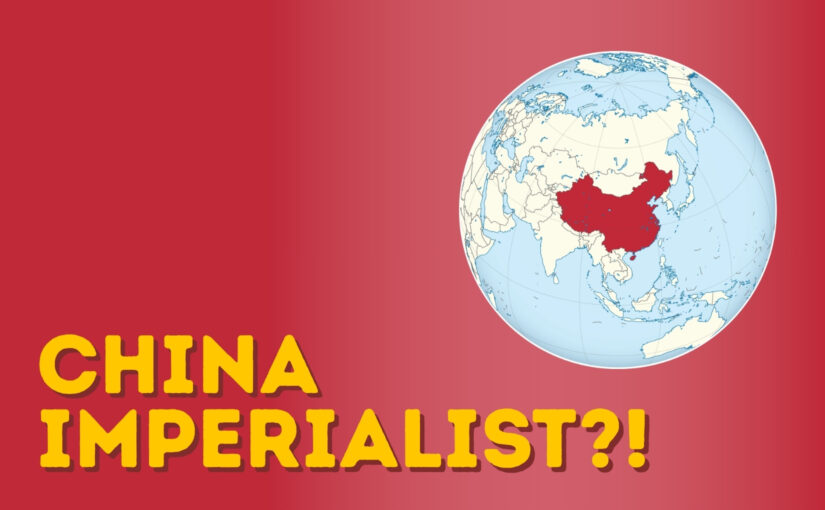
Is China simply another imperialist power, differing from the US only in degree? It’s a claim heard increasingly often on the left, from the Communist Party of Greece to Jacobin. This video sets out why that claim doesn’t survive scrutiny.
Working from Lenin’s classical definition of imperialism, Carlos Martinez examines whether China exhibits the super-exploitation of foreign labour that has always been imperialism’s economic core – and finds the opposite: China has been on the receiving end of value extraction by Western capital, not a source of it. The video looks at the real record of the Belt and Road Initiative against the “debt trap” accusation, at China’s strikingly peaceful military record since 1949, and at whether the underlying class dynamics of Chinese society could ever produce an imperialist foreign policy. And it closes by asking what China’s promotion of a multipolar world order means for the long-term prospects of overcoming imperialism altogether.
Hello and welcome. This video is based on a chapter I’ve written for a newly-released book, co-edited with Keith Bennett: China’s Foreign Policy and the Making of a Multipolar World, out now from Praxis Press – link in the description.
In this video I want to work through the core of that chapter, which addresses a question that comes up again and again on the left: is China imperialist?
That China is an imperialist power is a fairly widespread claim, at least in the West. China is after all a major player on the world stage, with a large economy, a powerful military and expanding global influence, and it routinely faces accusations of “debt trap diplomacy” and other forms of economic coercion.
Some go even further: China has been described as “a rising imperialist power… that increasingly exploits Third World countries in pursuit of raw materials and outlets for its exports.” The Communist Party of Greece says China is “an integral part of the international imperialist system”, with its disputes with the US amounting to nothing more than a quarrel over “the division of the loot”.
In this framing, China is just another imperialist power, differing from the US and Western Europe only in degree, and all the talk of multipolarity is a veneer over the ambitions of a rising hegemon.
The strategic implication of that for the left is clear: if China is an imperialist power, it must be opposed and exposed like any other imperialist power. That’s the line of Neither Washington nor Beijing, which picks up where the old – and unlamented – Neither Washington nor Moscow left off.
I want to show why that’s wrong – that China has never been engaged in the type of economic, political and military domination that the word ‘imperialism’ implies; that its internal class dynamics and the actual geopolitical reality militate against it becoming imperialist, and that the multipolar world order it’s working to build provides a way out of imperialism for everyone.
What is imperialism?
Let’s start with a definition. In his classic pamphlet Imperialism: The Highest Stage of Capitalism, Lenin put forward what he called the “briefest possible definition” – that imperialism is “the monopoly stage of capitalism” – and then set out five basic features: the concentration of capital into monopolies; the rise of a financial oligarchy, essentially the banks, as the driving force of the economy; the export of capital as a key engine of growth; international combines that carve up the world between them – the modern multinational; and the complete territorial division of the world among the major capitalist powers.
That still holds up pretty well. But there’s one important development Lenin couldn’t account for at the time: a few months after he published that book, the Russian working class overthrew the tsarist system and founded the world’s first socialist state, which went on to back national liberation struggles and socialist movements around the world.
That set in train a new phase of human development: the phase of the transition to socialism.
Today’s world still has imperialist powers and it still has oppressed countries, but it also has socialist countries and countries – for example India, Brazil, South Africa, Mexico – that are fairly deeply integrated into the global economy, that export capital like the vast majority of the world’s states, and yet they don’t dominate other countries. That’s a crucial difference from Lenin’s time: since the start of this transitional phase, it’s possible to actively engage in the global economy – to trade and invest on your own terms – without being an imperialist power.
So I’d argue that the most useful working definition of imperialism today is this: a system of economic, political and military domination of some countries over others, driven by the dominant countries’ pursuit of raw materials, land, markets and cheap labour, in which value flows continuously from the periphery (the oppressed countries) to the core (the imperialist countries) through structures that have been put in place and are held in place by means of coercion. That’s a bit of a mouthful, admittedly. More pithy perhaps is the definition by economists Li Zhongjin and David Kotz: “Imperialism is… the economic and political domination of one country by the ruling class of another aimed at extracting economic benefits for that ruling class.”
Super-exploitation is the core of it
The core concept for understanding the reality of imperialism is the super-exploitation of labour in the oppressed countries.
Marx wrote that capital goes abroad “because it can be employed at a higher rate of profit in a foreign country.” The Russian Marxist Nikolai Bukharin identified exactly this dynamic – capital is exported in search of a higher rate of profit, drawn above all from the higher rate of exploitation in poorer countries – as the defining feature of imperialism.
The economist John Smith has done a detailed and useful investigation of what this looks like in the 21st century. He notes that the major imperialist powers have spent decades outsourcing production to low-wage economies, reinforcing a hierarchy in which the US, Western Europe and Japan – what Samir Amin called the “imperialist triad” – remain the core of the global economy, while the Global South is relegated to the periphery.
Eighty-three percent of the world’s manufacturing workforce now lives in the Global South, often exposed to forced labour, illegal overtime and relentless downward pressure on wages and safety. This reflects a process starting in the 1970s where, facing a chronic crisis of overproduction at home, Western capital turned to what Smith calls “global labour arbitrage” as a survival tactic. Paying starvation wages in the Global South is how Western capitalism has propped up its own declining profitability for decades.
Is China a super-exploiter, or the super-exploited?
Where does China fit into all this? Clearly, not on the side of the exploiters. Like South Asia, Africa and Latin America, China has been on the receiving end of huge capital inflows from the imperialist triad, as multinationals leveraged its vast, highly-educated and relatively low-wage workforce.
Certainly throughout the 80s, 90s and early 2000s, value was created in China and captured by the West. John Smith’s 2008 study of Apple’s iPod found that the 12,250 Chinese workers making it earned just six percent of the average US retail wage – and while a similar number of workers were employed on each side, the total US wage bill was 719 million dollars against a Chinese wage bill of 19 million.
The economists Guglielmo Carchedi and Michael Roberts, analysing this kind of unequal exchange, conclude that “there is a clear transfer of surplus value from China to the bloc of imperialist countries, averaging five to ten percent of China’s GDP since the 1990s… China is not an imperialist country by our definition; on the contrary, it clearly fits into the dominated bloc.”
Now, Chinese wages have been rising fast and clearly things have changed since 2008. Chinese companies do invest abroad. But there’s no evidence of systematic super-exploitation of foreign labour by Chinese capital – actually the biggest recipients of Chinese investment are the US, Britain and Australia, and it’s hard to see how those flows could be described as exploiting Western labour.
As for China’s lending to the Global South, this is typically composed of mutually beneficial deals, rather than deals designed to extract superprofits. China is offering developing countries an alternative to the predatory lending of the IMF and World Bank – and that’s a challenge to the imperialist system, not a reinforcement of it.
No imperialism without domination
The word ‘imperialism’ comes from the Latin for command, to rule; obviously it’s very closely connected to the word ‘empire’.
It isn’t just about concentration of capital or foreign investment – fundamentally, it’s about domination. So: does China assert economic, political or military domination over other countries? Has it joined Lenin’s “handful of exceptionally rich and powerful states which plunder the whole world simply by clipping coupons”?! Quite obviously not.
And yet the Belt and Road Initiative is routinely condemned as neocolonialism – China luring developing countries into debt traps to dominate them. This doesn’t stand up, and I’ve got another video on this topic that I’ll link in the description. But even the reliably reactionary Economist admits debt-trap accusations are “largely unfair”, noting that China “has financed roads, ports, railways and other needed infrastructure, when private lenders and other countries were often unwilling to do so.”
Chinese interest rates typically run at about half those of Western banks, without the austerity conditions the IMF attaches. Tim Jones of the charity Debt Justice calls the whole debt trap narrative a distraction by Western countries, and asserts that “their own banks, asset managers and oil traders are far more responsible”.
Of Chinese loans to Africa, 40 percent has gone to power generation and 30 percent to transport – addressing Africa’s infrastructure gap.
The people actually living with these loans agree. Cambodia’s Deputy Prime Minister, responding to debt-trap accusations last year, said: “The Belt and Road Initiative is not a debt trap… it is a lifeline for our social and economic development.” Angola’s Minister of Energy and Water says that “China has never imposed any projects on us; each project was selected by us… Nobody offered us support except China.”
And China is actively sharing technology the West has always hoarded – payment systems, satellite networks, telecoms, renewable energy – opening up a pathway out of Western dependence.
Is there such a thing as peaceful imperialism?
Another thing is that China is remarkably peaceful for an imperialist power.
As Hugo Chávez put it: “China is large but it’s not an empire. China doesn’t trample on anyone, it hasn’t invaded anyone, it doesn’t go around dropping bombs on anyone.”
This directly connects to the political theory. Bukharin observed that the struggle to invest capital abroad “is always reinforced by military pressure”, and Rudolf Hilferding argued that finance capital needs a state strong enough to “intervene in every corner of the globe”.
The entire imperialist system was built through military force – Britain’s empire on naval supremacy over sea lanes on which, famously, the sun never set and the blood never dried; Japanese, French, German, Dutch, Spanish, Portuguese and Italian imperialism were all built on brutal conquest; the US itself was built through war against Indigenous nations, against Mexico, and then across Latin America and the Pacific. And even after formal colonialism ended, the imperialist powers carried on using force to maintain their dominance – the wars on Korea, Vietnam, Yugoslavia, Iraq, Libya, Afghanistan and today Iran; the proxy wars on Syria and Yemen; the sanctions strangling Cuba, Zimbabwe, Nicaragua and other countries.
As Thomas Friedman famously put it in the New York Times, with remarkable candour: “the hidden hand of the market will never work without a hidden fist – McDonald’s cannot flourish without McDonnell Douglas”.
China’s record simply looks nothing like this. China participated in the Korean and Vietnam wars on the side of the victims of imperialism. Then it had a brief border war with Vietnam in 1979. In the nearly half-century since, China hasn’t dropped a single bomb on foreign territory. Its per-capita military spending is around one-twentieth of the US’s; it holds roughly five hundred nuclear warheads to the US’s five thousand, and it’s maintained a no-first-use policy since its first nuclear test in 1964.
So if we’re saying that China has become an imperialist power without recourse to military force – without coercion, without war – then we are throwing Lenin’s theory of imperialism out the window.
Could China become imperialist?
So China isn’t imperialist today. But could it become imperialist in future? For a country to go down that road, three things have to be true: 1) it has to be capitalist, in the sense that profit maximisation is the core motive of its economy; 2) its capitalist class has to exercise control of the country’s foreign policy; and 3) the objective conditions have to exist for it to actually dominate other countries.
Let’s take these in turn.
In China, the profit motive is certainly important, but it isn’t the principal factor driving economic strategy – after all, a huge share of the economy is directed by the state, the major banks are state-owned and answerable to the Chinese people, and infrastructure and technology projects go ahead regardless of short-term returns. As economist Arthur Kroeber puts it, China is “an economy where the state remains firmly in command… but where market tools are used to improve efficiency.”
Meanwhile, People’s China has never experienced economic contraction. Chinese capital simply doesn’t face the crises of profitability and overproduction that have historically driven Western capital abroad.
Nor is capital the main driver of China’s foreign relations, which are built on the UN Charter, the principles of peaceful coexistence, the principles of non-interference, and the construction of a multipolar world.
Back in 1974, at the UN General Assembly, Deng Xiaoping said that if China ever turned into a bullying superpower, “the people of the world should expose it, oppose it and work together with the Chinese people to overthrow it.” Xi Jinping reiterated this idea at the 20th Party Congress: “China will never seek hegemony or engage in expansionism.”
So the Chinese state has a consistent foreign policy, based on the long-term interests of the Chinese people. Even if private companies in China wanted to subvert it in the interests of making a quick buck, they lack the political power to do so.
And even if the Chinese state did harbour imperialist ambitions, the objective conditions for pursuing those ambitions simply don’t exist. Some writers on the left have claimed that China is walking the same “road well-travelled” as Britain, Germany and the US. What they haven’t noticed is that road isn’t actually open any more. Lenin noted, over a century ago, that the world was already “completely divided up, so that in the future only redivision is possible” – and redivision means displacing existing imperialist powers by force. That was the whole logic of the First World War.
China’s peaceful record indicates very strongly that it’s not pursuing such a path.
In summary, the only way China could become an imperialist power is through capitalist counter-revolution – which is, ironically, exactly what the existing imperialist powers would love to see happen.
Multipolarity and overcoming imperialism
The last point I want to make is about the global order China is trying to build.
China rarely frames its foreign policy in overtly revolutionary language these days, but it stands at the core of an objectively anti-imperialist trajectory: the push towards a multipolar world, described by Jenny Clegg as “a pattern of multiple centres of power… shaping a negotiated order”.
That’s by definition a shift away from a US-dominated unipolar order towards a more equal and democratic system in which all countries – including those of the Global South – have a voice; in which all countries can assert their sovereignty and choose their own development path free from hegemonism.
Time and time again, the imperialist powers have blocked the development of the Global South, and have worked to crush socialist movements and governments, from Chile to Indonesia to Grenada to Angola to Iran to Nicaragua. Through the structures of the UN, BRICS, the G77+China, the Non Aligned Movement, the Forum on China Africa Cooperation, China-CELAC, the Shanghai Cooperation Organisation, the Belt and Road Initiative and the Asian Infrastructure Investment Bank, China is actively advancing the interests of the developing world.
So multipolarity offers real opportunities for peace and development, and a more favourable context for humanity’s advance towards socialism.
China is not an imperialist power. Rather, it’s an anti-imperialist power, and its foreign policy is directed towards a fundamental transformation of the global order – away from hegemonism, towards multipolarity, sovereignty, cooperation and peace.
At a moment when the imperialist powers, led by the US, are resorting to ever more desperate violence to maintain their dominance, China’s promotion of multipolarity, and its vision of a global community of shared future, matter more than ever.
There’s a lot more detail and a full set of sources behind the points I’ve made in this video – you can find that all in the chapter in China’s Foreign Policy and the Making of a Multipolar World, out now from Praxis Press, link in the description.
Thanks very much for watching. Do give it a thumbs-up for the sake of the algorithm, and see you next time.
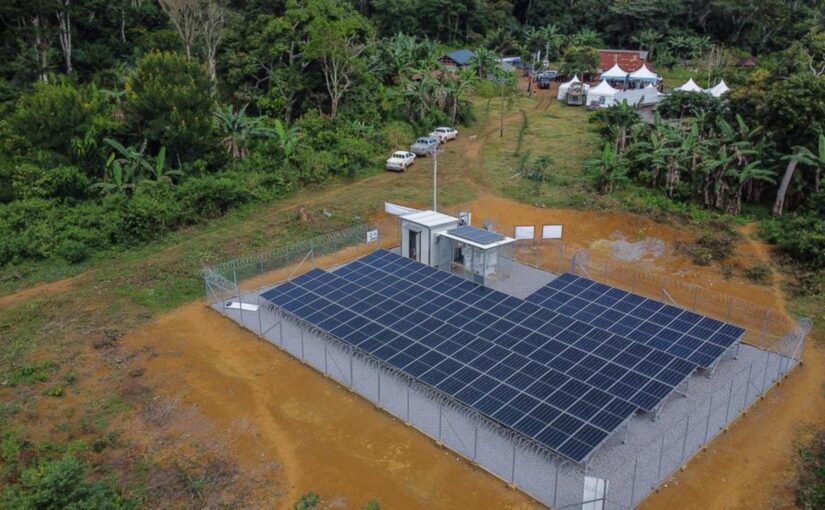
Africa’s solar installations rose by a record 54 percent in 2025, and 15 major African markets imported more than $400 million worth of solar panels in the first quarter of 2026 alone – more than two-thirds of the total for the whole of the previous year. In this article, Carlos Martinez looks at what lies behind those numbers.
The projects driving the continent’s green transition are overwhelmingly built and financed by China, from the Benban Solar Park in Egypt and the Adama wind farms in Ethiopia to De Aar in South Africa and a solar plant with battery storage in every one of Zambia’s 156 constituencies. What has made them viable is two decades of sustained Chinese public investment, which has driven the global cost of renewable energy down to a fraction of what it was 15 years ago.
Carlos also takes on the charge, increasingly fashionable in parts of the Western left, that this amounts to a new “green imperialism”. Market share, he argues, describes a trade relationship, not domination and coercion – and the function of the accusation, whatever the intention behind it, is to manufacture consent for the New Cold War.
A report in the South China Morning Post on 7 September highlights the contrast in energy policy between the United States, where, particularly under the present administration, the watchword is “drill, baby, drill”, and China, where the national strategy is to “walk towards the light”. Two energy behemoths, two approaches to the future of the planet, and the resulting choice facing the people of Africa.
The SCMP article observes that, for African governments seeking to expand access to electricity, the principal deciding factor is cost. And on cost, the argument is now over.
Africa’s solar installations rose a record 54 percent in 2025, adding 4.5 gigawatts of new photovoltaic capacity, and that record is likely to be broken again this year. The International Energy Agency reports that 15 major African markets imported more than $400 million worth of solar panels in the first quarter of 2026 alone – against $600 million for the whole of 2025.
“Africa’s solar revolution is here,” says Sonia Dunlop, chief executive of the Global Solar Council. “Growth is spreading to new markets across the continent, and rooftop and distributed systems are putting power directly into the hands of households and businesses.”
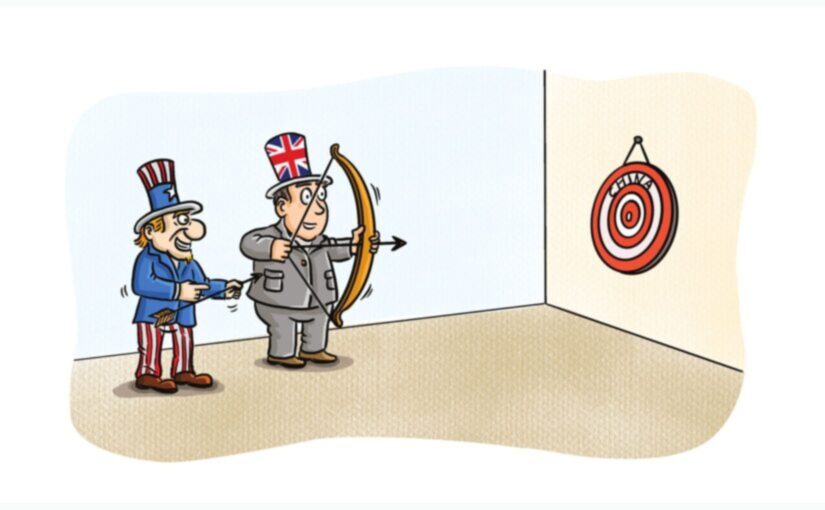
In the following article, Carlos Martinez surveys a burst of anti-China stories in the British right-wing press – the Telegraph’s warning that Chinese chips in GPS-guided tractors could be used to spy on farmers and fitted with kill switches; the Times’ claim that Chinese-made wind turbines could be used to shut down Britain’s electricity supply; and the Telegraph’s discovery of a hotel near RAF Akrotiri in Cyprus with a good view of the runway.
In each case, he notes, the evidence is absent and the motive is never explained. Meanwhile every documented instance of weaponised supply-chain hardware – Stuxnet, the NSA’s intercepted routers, Nord Stream, the booby-trapped pagers in Lebanon – belongs to Britain’s Western allies rather than to China.
He also points to an instructive contradiction: in the same week that Chinese industrial policy was being described as a threat to national survival, both the Guardian and the Financial Times carried pieces arguing that Britain should be learning from it. The purpose of the hysteria, Carlos argues, is not to inform economic policy but to build support for the US-led New Cold War.
If the right-wing media is to be believed, Britain is facing a systematic attack by the Communist Party of China.
On 4 September, it emerged that the perennial evil-doers in Beijing are hacking our tractors. The Coalition on Secure Technology, headed by the Labour MP Graeme Downie, warns that Chinese-made chips are standard in GPS-guided tractors, farming drones and irrigation systems, and that around 70 percent of the world’s cellular internet-of-things modules are made in China.
Beijing, we are told, could use this fearsome capability to harvest data on crop yields, production forecasts and livestock populations. All of this information is, of course, published by the Department for Environment, Food and Rural Affairs (Defra), but it’s understandable that the Chinese would rather spend their time compromising combine harvesters in Lincolnshire.
We are further informed that the Chinese will likely have fitted kill switches to these tractors, albeit without any evidence or indeed any suggestion of a possible motive.
There is, as it happens, a documented case of a tractor manufacturer installing software locks: the US firm John Deere builds them into its machines, chiefly to stop farmers repairing their own equipment. That threat comes not from Beijing but from Moline, Illinois.
Just days earlier, the Times warned that those same sneaky Chinese communists may have inserted spying devices in our wind turbines.
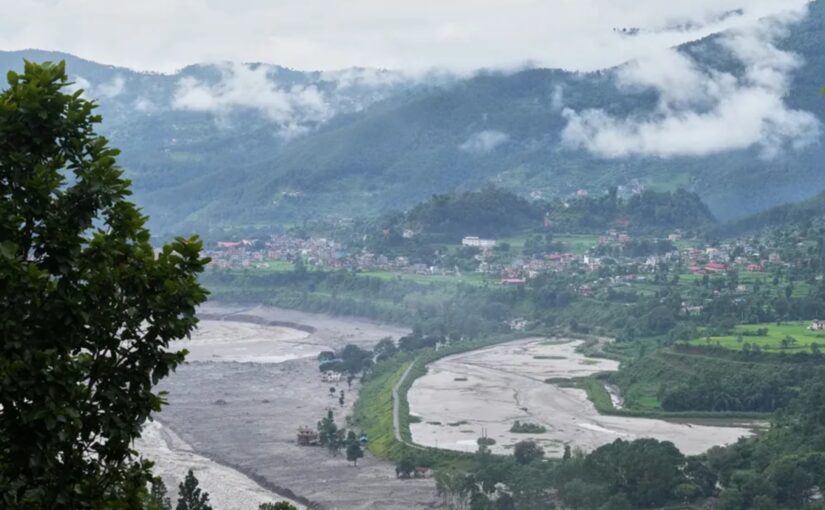
The following article by Carlos Martinez examines the BBC’s coverage of the catastrophic glacier collapse of 26 August, which sent a wall of ice, rock, mud and water down the river valleys straddling the border between Nepal and China’s Tibet (Xizang) Autonomous Region, killing well over a thousand people.
Rather than report on the disaster itself, or on its underlying cause in the accelerating warming of the world’s highest mountain range, the BBC’s China correspondent chose to run a story alleging that Beijing was suppressing footage of the event – footage which, as Carlos points out, had been released by the Chinese port authorities at Gyirong and was circulating widely on Chinese platforms. A massive rescue operation, with the direct involvement of China’s top leadership, becomes a “muted response”; Communist Party members being asked to assist their neighbours becomes evidence of authoritarian anxiety.
The article also takes apart the BBC’s assertion that Tibet was “annexed” by Beijing in the 1950s – a formulation at odds even with the declared position of the British government, which abandoned the colonial-era doctrine of “suzerainty” in 2008.
On August 26, a glacier collapsed high on the Nepali side of the Himalayan range, sending a wall of ice, rock, mud and water down the river valleys straddling the border between Nepal and China’s Tibet (Xizang) autonomous region. Some 42 kilometres of road were wiped out, leaving helicopters as the only means of reaching survivors. At the time of writing, Nepal’s death toll has since passed 900, with more than 4,000 people missing; on the Chinese side, 16 have been confirmed dead, and 546 are reported missing.
This is the disaster that Laura Bicker, the BBC’s China correspondent, chose to report as follows: “Shocking footage isn’t being shown in China – and we know little about victims there.”
Numerous people in China immediately pointed out that the footage is, in fact, all over Chinese platforms. Indeed, the very video used in the BBC’s own report was released by the Chinese port authorities at Gyirong. So the sequence runs: the Chinese state published the clip; the BBC ran the clip; the BBC then published a story about how the Chinese state is suppressing the clip.
Several commentators have made another significant point: Chinese media does not operate on the principle of “if it bleeds, it leads.” You will not see grieving relatives and footage of bodies looped for 24 hours. The BBC treats the absence of disaster pornography as evidence of a cover-up rather than a different editorial culture.
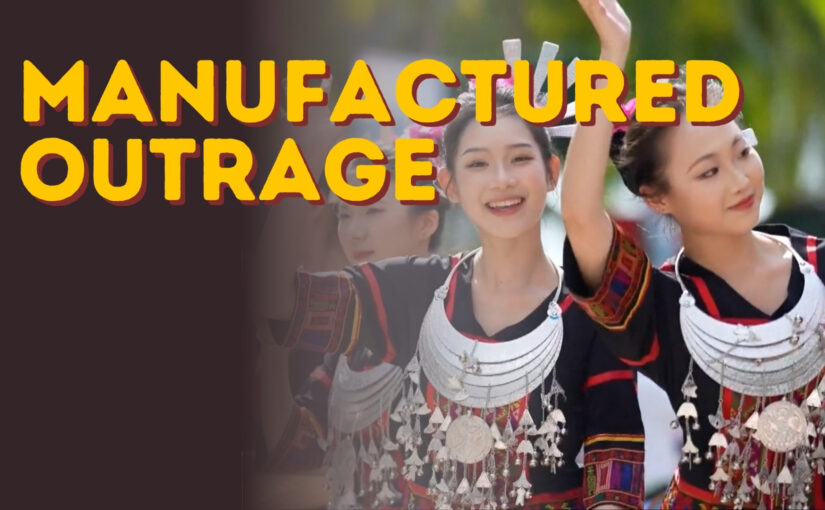
On 1 July, China’s Law on Promoting Ethnic Unity and Progress came into force – the country’s first comprehensive national law on ethnic affairs. Within days came denunciations from Washington and Brussels, a European Parliament resolution, and a wave of headlines announcing that China had ordered its minority peoples to “assimilate”. CNN’s version: “China tells its ethnic minorities to integrate or face consequences.”
In this contribution to the international webinar China’s National Unity vs US Social Hierarchy, Carlos Martinez looks at the distance between what the law actually says and what we have been told it says. The law prohibits discrimination against any ethnic group, explicitly reaffirms the right of all peoples to use and develop their own languages, and requires the state to direct infrastructure, industry and public services towards minority regions. It continues a framework that in the West would be called affirmative action – preferential university admissions, bilingual education, protected minority-language broadcasting, autonomy arrangements, and exemption from the one-child policy throughout its existence.
“Assimilation”, meanwhile, is not a neutral word. It names specific and well-documented crimes: the residential schools of Canada and the United States, the stolen generations in Australia, forced adoption and conversion, languages beaten out of colonised peoples – including generations of Welsh schoolchildren punished for speaking their own. Applying that word to China takes an association rooted in Western colonial history and lets it do the work that evidence cannot.
The video also goes through the record the coverage leaves out – life expectancy in Xinjiang rising from around 30 in 1949 to 77 today, Uyghur population growth of 16 percent between 2010 and 2020 against 2 percent for the Han population, 420 poverty-stricken counties in ethnic autonomous areas lifted out of absolute poverty, minority-language publishing and schooling, and central government transfers flowing towards the periphery rather than away from it – along with the documented history of CIA and National Endowment for Democracy sponsorship of separatism, the strategic reasons Xinjiang and Xizang matter, and the warning of Yugoslavia.
The webinar was organised by Friends of Socialist China, the United National Antiwar Coalition and the International Manifesto Group, with contributions from Chen Weihua, Jason Smith, Jacqueline Luqman, Arnold August and Sara Flounders.
Transcript
Comrades, thank you very much for inviting me, and thanks to the organisers for putting this event together.