In a result that defied the pre-election polls, Flávio Bolsonaro took first place in the first round of Brazil’s presidential election on 4 October, edging out President Luiz Inácio Lula da Silva ahead of a runoff on 25 October. In the following article, Carlos Martinez and Sara Vivacqua examine why the far right did so well – a ruling class in crisis, the politics of fear and faith – and what is at stake in the second round.
They argue that a Bolsonaro victory would threaten the 1988 Constitution itself, hand Washington its biggest prize yet under the so-called Donroe Doctrine, and do enormous damage to the multipolar project and to the Amazon. Yet they also show why the material basis of China–Latin America cooperation is too strong to be disrupted on purely ideological grounds.
This article was first published in the Morning Star.
In a surprise result that defied pre-election polls, the far right had a very good night in Brazil last Sunday. Flávio Bolsonaro – son of the former president Jair Bolsonaro, who is currently serving a 27-year sentence for plotting a coup – took first place in the presidential election with 47 percent of the vote, against 45.2 percent for the incumbent Luiz Inácio Lula da Silva. With neither candidate passing the 50 percent threshold, the two will meet again in a runoff on 25 October.
The bad news does not end with the presidential elections. Of the 54 Senate seats contested, 34 went to the right or far right, among them Michelle Bolsonaro and Carlos Bolsonaro, the former president’s wife and second son. Jair Bolsonaro’s Liberal Party (PL) is now the largest party in the Chamber of Deputies, with 121 seats to the Workers’ Party’s (PT) 70. The PT held on to its traditional strongholds in the north-east (the poorest region, with the highest proportion of Afro-Brazilians), but the overall picture is of a significant shift to the right.
A ruling class in crisis
Capital quickly delivered a favourable verdict: the Financial Times reports that the Brazilian real rose 4.2 percent against the dollar and the São Paulo stock exchange jumped almost 8 percent to a record high, as investors bet on a Bolsonaro government that would “mount rapid spending cuts” and dismantle environmental regulations. That should surprise nobody: always hostile to Lula and the PT, Brazil’s ruling class and its media stenographers have led a frenzied demonisation campaign against the left, portraying the PT as corrupt and incompetent.
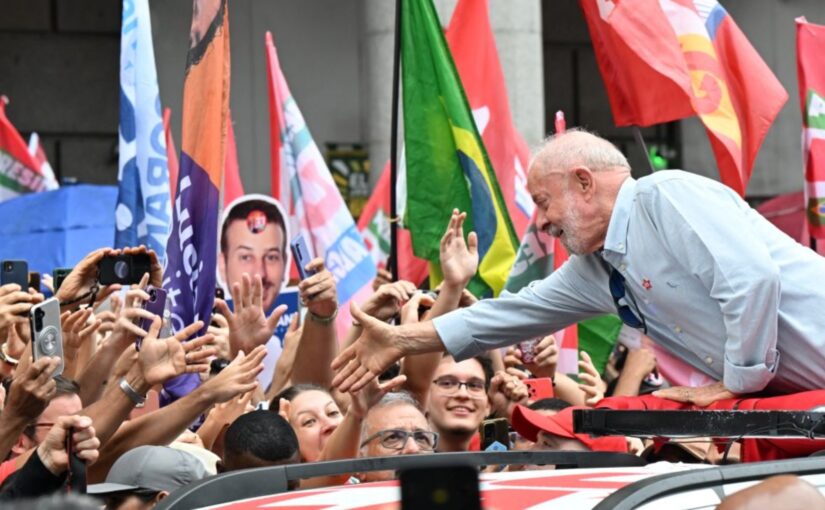
The country is running a budget deficit of close to a tenth of GDP, with some of the highest interest rates in the world, and Lula has governed since 2023 alongside an obstructive, conservative-dominated Congress. In spite of these severe economic and political constraints, the PT government has taken Brazil off the UN Hunger Map, restored and expanded Bolsa Família, made bold commitments on environmental protection, and refused to subordinate the country’s foreign policy to Washington.
These policies have been popular with the Brazilian working classes, but they have enraged the country’s oligarchs and financiers. Lula’s basic agenda – social welfare, a dignified existence for the poor, workers’ rights, environmental protection – is no longer acceptable to a Brazilian ruling class facing a crisis of profitability. The markets’ euphoria confirms that class’s preference for a Bolsonaro government that would deliver austerity, deregulation, and conformity to global Trumpism.
There is a material difference between the Lula of 2003 and the Lula of 2026. Between 2003 and 2010, a commodity super-cycle driven in large part by Chinese demand filled the state’s coffers, making it possible to pursue a thoroughgoing redistributive programme – including Bolsa Família, a vastly increased minimum wage, and mass expansion of higher education – without directly confronting the interests of the rich. In the PT’s first decade in office, 31.5 million Brazilians were lifted out of poverty.
The economic breathing space is now much tighter, and the ruling class has been able to construct a “popular” case against Lula.
Fear and faith
The far right has tapped into real grievances. Organised crime, much of it linked to drug trafficking, has grown in power across the continent; in the words of a Crisis Group report, “never has it spread so wide, and rarely has it penetrated so deeply into states and communities”.
Despite his own links to Rio’s militias, Flávio Bolsonaro has made a crackdown on the gangs the centrepiece of his campaign, promising to “give the streets back to the Brazilian people”, with Nayib Bukele’s mass incarceration in El Salvador held up as the model. The left’s answers – education, jobs, community policing, and going after the crime boss “who lives in a penthouse”, as Lula put it – are sensible, but they take longer to deliver than an iron fist takes to promise.
The far right has also expanded enormously through evangelical networks, with church groups, WhatsApp chains and viral videos carrying a massive misinformation campaign into working-class communities that the left’s organisations struggle to reach. Flávio, himself an evangelical, pledged to “declare that Brazil belongs to the Lord Jesus Christ” – a remark some Catholics took as a threat to the country’s patron saint, Our Lady of Aparecida, sparking a row that has reached the supreme and electoral courts. Religion, security and the traditional family have been fused into a single story, in which Lula is the threat and Bolsonaro the protection.
A constitutional coup from within
Winning and losing elections is, of course, part of the democratic process. But what is at stake in Brazil goes far beyond the presidency or control of Congress. It is the future of the 1988 Constitution, which marked the country’s return to democracy after 21 years of military dictatorship and established not merely formal democratic institutions, but enforceable social, labour and political rights.
Flávio Bolsonaro has already made his intentions clear. In a recent interview, he announced plans to amend the Constitution, overhaul the judiciary and reshape Brazil’s political system, presenting these measures as an effort to “re-democratise” the country. What this means in practice was spelled out by his father during the 2022 campaign against Lula: a constitution under military supervision, the impeachment of non-aligned Supreme Court justices and the imprisonment of political enemies.
The Supreme Federal Court (STF) is central to this struggle. It was the STF that convicted Jair Bolsonaro and senior military officers over the attempted coup following his 2022 electoral defeat – an unprecedented reckoning with military involvement in an attack on Brazilian democracy, and a step the US judiciary did not dare to take with Trump. The demands for military intervention voiced by Bolsonaro supporters camped outside army headquarters after that election culminated in the storming of Brazil’s democratic institutions on 8 January 2023.
The campaign to discredit the Supreme Court is not incidental to Bolsonarism; it has been integral to its confrontation with the constitutional order. According to the Guardian, the US State Department has earmarked a $1 million grant from its human rights fund for a project titled “Countering Lawfare and Censorship in Brazil”, supporting groups that campaign against the court; Brazil’s attorney general has called for an investigation. Trump’s administration has repeatedly targeted Brazil’s Supreme Court, while revelations about the US conservative investment network Rockbridge, associated with political circles around Vice-President JD Vance, have raised questions about foreign involvement in Flávio Bolsonaro’s campaign. These allegations of campaign financing and political interference demand investigation. They also place the attacks on Brazil’s judiciary within a wider struggle over the country’s sovereignty.
The next president will nominate at least four of the Supreme Court’s 11 justices, with the potential to reshape the constitutional order for decades to come. It is no rhetorical exaggeration to call this a counter-revolution in the making: a constitutional coup from within is taking shape before our very eyes. As one social media post put it: “I went to sleep in 2026 and woke up in 1964.”
The biggest prize
A Bolsonaro victory would be a major step forward for the so-called Donroe Doctrine. The 2025 National Security Strategy promised to “reward and encourage the region’s governments, political parties, and movements broadly aligned with our principles and strategy”, and Washington has been as good as its word: bailing out Milei in Argentina, backing de la Espriella in Colombia, kidnapping Venezuela’s president and besieging Cuba. Over the past 18 months, seven right-wing or far-right candidates have won presidential elections in Latin America. “Lots of people that I got elected”, Trump boasted last month.
Brazil is the biggest prize of all. It is the largest economy in Latin America, a founder of BRICS, and one of the handful of countries in the region that have refused to join Trump’s Shield of the Americas – a coalition of right-wing governments that, in Trump’s words, is committed to “using lethal military force to destroy cartels and their terrorist networks”. Flávio Bolsonaro has made clear that he would sign up, and has promised to designate Brazil’s criminal gangs as terrorist organisations – providing a legal fig leaf for US military operations on Brazilian soil.
The strategic importance reaches beyond the borders of Latin America. Washington’s long-term strategy rests on consolidating the Western Hemisphere as a secure rear base for a confrontation with China. This is a crucial front in Trump’s war on multipolarity.
What Washington can’t buy
China has been Brazil’s largest trading partner since 2009, buys almost 30 percent of its exports, and invested more than $6 billion in the country last year. Jair Bolsonaro campaigned in 2018 on a platform of hostility to Beijing, then went to China within a year of taking office; trade between the two countries grew throughout his presidency.
Javier Milei has followed a similar path. Having called China’s leaders “assassins” and pulled the plug on Argentina’s entry into BRICS, Milei has since thanked Xi Jinping for helping to stabilise Argentina’s economy, and in August renewed Argentina’s 130 billion yuan currency swap with China for another five years. “Geopolitics is one thing, commerce is another,” as Milei put it earlier this year. Most memorably, the day after Washington’s $20 billion bailout of Argentina last year, US Agriculture Secretary Brooke Rollins complained bitterly that the country had “sold a bunch of soybeans to China”.
The material basis of China–Latin America cooperation is too strong to be meaningfully disrupted on purely ideological grounds. China offers the region markets, investment, infrastructure and affordable technology – on a scale and at a price that the US simply cannot compete with.
What Brazil stands to lose
Nonetheless, a Bolsonaro government would do enormous damage. Under Lula, Brazil has been one of the most consistent voices for a multipolar world: a driving force in BRICS and the G20; a defender of the UN Charter and international law; a supporter of peace; an opponent of genocide. It would downgrade its commitment to every one of these. As Denis Staunton noted in the Irish Times, it “would weaken the international resistance to Trump’s coercive diplomacy and his rapacious appetite for the oil, gas, minerals and other natural resources of his neighbours and allies”.
The consequences for the planet would also be severe. Under Lula, annual deforestation in the Amazon has more than halved, from 11,594 square kilometres in 2022 to 5,731 in 2025; Carbon Brief estimates that at least 20,000 square kilometres of forest are still standing thanks to the current PT administration. Flávio Bolsonaro is a climate sceptic who has promised to favour agribusiness and mining. The ecologist David Lapola warns that a Bolsonaro government could “destroy what has been constructed over decades of environmental policy and activism in Brazil” in a matter of months.
The road to 25 October
The Brazilian left is now going all out to turn the tide and secure a second-round win for Lula. Three recent national polls put Flávio Bolsonaro around five percentage points ahead, while one favours Lula. Speaking to the Morning Star, Isabel Anjos, PT campaign coordinator in Minas Gerais, acknowledged that the first-round result came as a surprise to the party, but stressed that the election remains an open contest.
According to Anjos, a potentially decisive factor will be mobilising the 33.4 million Brazilians (21.1 percent of the electorate) who abstained in the first round – the second-highest abstention rate in Brazil’s democratic history. Abstention was particularly high in São Paulo, Rio de Janeiro and Minas Gerais, three states where Bolsonaro performed strongly.
Capitalism in crisis has always reached into its political toolbox and pulled out fascism, and that is what is happening across Latin America today. The governments of Argentina, Chile, Colombia, Peru and Honduras are pro-Trump, pro-war, pro-genocide, neoliberal, anti-poor and anti-democratic. Brazil has until 25 October to decide whether to join them. We must stand with the Brazilian working classes and oppressed communities in their struggle for a Lula second-round victory.