
Responding to left criticisms of China’s foreign policy

In this discussion with Radhika Desai, Carlos Martinez confronts the charge, common even on parts of the left, that Beijing does far too little for Palestine, Iran, Cuba and Venezuela.

The conversation traces China’s foreign policy from the internationalism of Bandung and the Non-Aligned Movement, through its rapprochement with Washington and entry into the world economy, to its pursuit of a Global Community of Shared Future.

Transcript

Radhika Desai: Hello, viewers and listeners. Welcome to the Geopolitical Economy interview, a series in which I speak with prominent intellectuals, scholars, politicians, journalists, activists and public figures to illuminate the fast-changing political economy and geopolitical economy of our times.

I’m Radhika Desai and you’re watching Radhika Desai, Geopolitical Economist. Today’s topic is China’s foreign policy towards the United States and the West on the one hand, and the oppressed — and I should say oppressed and embattled — nations such as Palestine, Cuba, Venezuela and Iran on the other, in the broader context of rising multipolarity. How should the left make sense of it, particularly given that sections of the left have criticised China for not doing enough for precisely these countries?

I can think of few people better qualified to address this question than Carlos Martinez, who joins me today. Welcome, Carlos.

Carlos Martinez: Hi, Radhika. Lovely to see you. Good to be with you.

Radhika Desai: It’s really great to have you today, Carlos. Let me tell our audience that you are an independent scholar and researcher, co-editor of the increasingly important and influential Friends of Socialist China website, and author and editor of many books on China and on socialism — including the one on China, which is called The East Is Still Red, and the wonderfully titled book on the demise of the USSR, The End of the Beginning. You meant, of course, that this was just the end of the beginning of world socialism.

Carlos, can you begin by addressing the criticisms of China’s foreign policy that are quite widespread in some sections of the left — in a sort of overall, summary fashion — before we go on to investigate its particular aspects, and China’s foreign policy towards particular countries?

Carlos Martinez: Sure. I think there are a couple of broad strands of criticism of China’s foreign policy on the left. One of them is more or less hostile; one of them is more or less friendly and sympathetic. The hostile one is that China is an imperialist country, that it’s a state-capitalist country, that its companies pursue private profit as their central motive, and that China’s foreign policy reflects that. This is essentially the United States State Department position, adopted by parts of the left.

So there’s lots of talk about debt traps. There’s lots of talk about expansionism. There’s lots of talk about China being an imperialist power and engaging in inter-imperialist rivalry with the US, with the West. That’s the position of the Greek Communist Party. That’s the position you’ll typically find in Jacobin and other elements of what might be referred to as the compatible left. Then you’ve got a sort of sympathetic critique.

Radhika Desai: And sorry, just to clarify — compatible with what?

Carlos Martinez: Compatible with capitalism.

Radhika Desai: Continue, please.

Carlos Martinez: I mean, I’m painting in very broad strokes there, and perhaps being a little bit unfair, but we can get into that later if you want. And then there’s a sympathetic critique, which comes a lot of the time from people who are pretty close to us politically, who accept China’s socialist foundation, but who express a disappointment that China’s foreign policy isn’t good enough — that China’s not aggressive enough in pursuit of justice, that it’s not doing enough for oppressed nations, that it’s not doing enough for countries under attack.

And they compare it unfavourably with the Soviet Union in the ’50s, ’60s and ’70s. They compare it unfavourably with, for example, Cuba’s intervention in Southern Africa in the 1970s and 1980s. In terms of this first strand — that China is an imperialist country — I think we don’t need to dwell on it too much here. That’s quite an easy question to deal with, and it’s dealt with at some length in a chapter in a forthcoming book on China’s foreign policy that Keith Bennett and I have put together, and that you very kindly wrote an endorsement for. That should be out in August.

Continue reading Responding to left criticisms of China’s foreign policy

‘But at what cost?’: the Yangtze edition

The Economist has reported a striking piece of good news: fish biomass in the Yangtze has risen by more than 200 percent since 2021, reversing seven decades of decline, with a rare sturgeon spawning in the wild for the first time in two decades and finless porpoise numbers climbing again. The turnaround – confirmed by a peer-reviewed study – followed the largest freshwater fishing moratorium ever attempted, the closure of thousands of chemical factories, mass reforestation, and the compensation and retraining of some 200,000 fishermen.

Yet, as the following article argues, the magazine could not resist straining to make an ecological triumph sound sinister – branding China’s approach “eco-authoritarian”. It is the “but at what cost” genre in its purest form: the reflex of a worldview that cannot survive the admission that a socialist country is surpassing the West on both ecological and economic performance.

This article was first published by Friends of Socialist China.

The Economist has reported a remarkable and very welcome piece of news. Fish biomass in the Yangtze has risen by more than 200 percent since 2021, reversing seven decades of decline. A rare sturgeon has been observed spawning in the wild for the first time in twenty years. Finless porpoise numbers are up from a low of around 1,000 in 2017 to more than 1,400. And this is not Chinese state media talking: it comes from a study, published in the journal Science, by researchers in China, Canada, the United States and France.

How was it done? Through a ten-year commercial fishing ban across the river, its major tributaries and the lakes of its basin – the largest freshwater fishing moratorium ever attempted. Thousands of chemical factories were closed or relocated. Forests were planted on the upper reaches to hold the soil. Cities were “spongified” with artificial wetlands and permeable surfaces to absorb rainfall and filter stormwater. And some 200,000 fishermen were taken off the water, compensated and retrained for other work. A river that was being killed is coming back to life.

The Yangtze programme is one component of China’s ecological civilisation strategy – written into the country’s constitution in 2018 and pursued through the same instruments that have sustained China’s economy: long-term planning, massive public investment, and a state with the capacity to override short-term private interest in the name of a collective good. It is the same capacity that has made China the world’s undisputed leader in renewable energy, reforestation and electric transport.

But at what cost?

Having reported all this, the good people of the Economist search desperately for a way to make it sound sinister. “The Chinese Communist Party, once famous for pillaging from the natural world, has set to protecting parts of it”, the magazine concedes – before warning that the country’s “eco-authoritarian” approach, “top-down and intolerant of resistance”, “deserves scrutiny before being imitated”. This absurd framing drew an immediate backlash.

China is condemned for not listening to the fishermen – who wanted to carry on fishing – and to environmentalists – who want fewer dams. The complaint about dams is telling: hydropower is not only low-carbon but dispatchable, able to be ramped up on demand and, through pumped storage, to balance the wind and solar that cannot – which is precisely why it does work that would otherwise fall to coal. To oppose it in the abstract, without saying what should generate the electricity instead, is to lean in practice towards fossil-fuelled generation. So are we to understand the Economist would be happier with the status quo of a dying river, a collapsing fishery, a species on the brink of extinction, and a climate crisis that is accelerating because of the failure to decarbonise?

Such a line of reasoning brings to mind Michael Parenti’s observation, in Blackshirts and Reds, about the absurdity of Cold War propaganda:

During the cold war, the anticommunist ideological framework could transform any data about existing communist societies into hostile evidence. If the Soviets refused to negotiate a point, they were intransigent and belligerent; if they appeared willing to make concessions, this was but a skilful ploy to put us off our guard. By opposing arms limitations, they would have demonstrated their aggressive intent; but when in fact they supported most armament treaties, it was because they were mendacious and manipulative.

If the churches in the USSR were empty, this demonstrated that religion was suppressed; but if the churches were full, this meant the people were rejecting the regime’s atheistic ideology. If the workers went on strike, this was evidence of their alienation from the collectivist system; if they didn’t go on strike, this was because they were intimidated and lacked freedom. A scarcity of consumer goods demonstrated the failure of the economic system; an improvement in consumer supplies meant only that the leaders were attempting to placate a restive population and so maintain a firmer hold over them.

The article notes, almost in passing, that the fishermen who lost their livelihoods were given compensation and retraining. It does not mention that this is an awful lot better than what Britain’s coal miners got in the 1980s, or what the cod fishermen of Newfoundland got in the 1990s – communities that their own governments simply abandoned to their fate once they had ceased to be useful.

This is the “but at what cost” genre in its purest form. China eliminates extreme poverty; but at what cost. China builds the world’s largest high-speed rail network; but at what cost. China brings its greatest river back from ecological death; but at what cost. The real cost, evidently, is to Western hegemony – and to a worldview that cannot survive the admission that a socialist country is surpassing the West in both ecological and economic performance.

China has billionaires and stock markets. Is it still socialist?

After nearly half a century of market reforms – with billionaires, stock exchanges and world-famous private brands – can China seriously still be described as a socialist country? This video examines the case against, the record any serious analysis must explain, and above all the political question the sceptics too rarely ask: which class holds state power?

It is based on the notes for a talk Carlos Martinez gave on 23 July 2026 to the Croydon Morning Star Readers and Supporters Group at Ruskin House. A report of the meeting is available on the Croydon Communists site.

Transcript

Hello and welcome.

In 1989, Deng Xiaoping met with Julius Nyerere, the Tanzanian president, and told him: “So long as socialism does not collapse in China, it will always hold its ground in the world.”

The implication was that the fate of socialism as a global project – the project of a world without exploitation, poverty or imperialism – was bound up with the fate of socialism in China. The reverse is also true. If socialism has collapsed in China – if the world’s largest socialist experiment has quietly dissolved itself into just another capitalist power – then the implications for the left everywhere are pretty bleak.

The question, then, is whether China is still socialist? After nearly half a century of market reforms, of billionaires and stock exchanges and branches of McDonald’s in every major city – can the People’s Republic seriously still be described as a socialist country?

It is a serious question, asked in good faith by many people on the left. Any convincing answer has to acknowledge what the sceptics get right, identify what they miss, and establish what actually determines whether a country is socialist.

The case against

If you’re a socialist in Britain, the United States, or the West in general, there’s a lot about modern China that doesn’t feel like the world we’re trying to build.

China has been carrying out market-oriented reforms since 1978 – that’s coming up on half a century. It has several hundred billionaires and significant inequality – between rich and poor, between the coastal cities and the inland countryside. It has globally famous private brands: Huawei, Alibaba, Tencent, BYD. It has stock exchanges in Shanghai and Shenzhen. It has a market economy in which private capital operates, in which the profit motive operates, and in which – let’s say it plainly – the exploitation of labour takes place. Wage workers in private enterprises produce surplus value, and a portion of that surplus value is appropriated by capitalists.

None of that sounds like the socialism we signed up for. The world we’re fighting for is a world without exploitation, without poverty, without billionaires: a world based on planning, public ownership, solidarity and the common good. And when we reach for real-world reference points, we tend to think of the Soviet Union – a society that essentially did away with private capital altogether.

Continue reading China has billionaires and stock markets. Is it still socialist?

Should China “lessen the role of the state”?

In the latest of the Financial Times’ periodic lectures to Beijing on how to run its economy, the Brookings Institution’s Eswar Prasad urges China to reduce its reliance on public investment, move away from manufacturing and – above all – “lessen the role of the state”. In the following article, Carlos Martinez takes the prescriptions in turn.

He finds them to be not a serious diagnosis but an invitation to dismantle the socialist foundations of the most successful economic development in human history, in favour of a model that is visibly failing the countries that practise it.

This article was first published by Friends of Socialist China.

Every so often the Financial Times publishes its periodic instruction to China on how to run its economy. The latest comes from Eswar Prasad of the Brookings Institution, and it follows the established template: concede the achievements in a subordinate clause, then explain that catastrophe looms unless Beijing adopts the policy mix of the countries currently growing at a third of its rate.

China, we learn, is “in serious trouble” – while growing at about 4.3 percent, a figure no G7 economy has come close to in years, and roughly double the US rate. Inflation has turned positive after a deflationary spell; industrial profits are rebounding. In any other country this would be reported as a soft landing. For China it is presented as calm concealing catastrophe.

Let us take the prescriptions in turn.

First, China must “reduce reliance on public investment and exports”.

But since around 78 percent of China’s growth derives from capital inputs, cutting investment means cutting growth. This is simply the United States inviting China to engage in economic self-harm. Public investment is the key mechanism through which China has built its infrastructure, energy, transport and industrial base. It is also the mechanism through which it has lifted hundreds of millions out of poverty. And it is the mechanism through which it has built a high-tech economy that now competes with, and even out strips, the West across the board.

As the Marxist economist Michael Roberts has repeatedly shown, it is high levels of productive investment, not the debt-fuelled consumption favoured in the West, that drive sustained growth and rising living standards over time – exactly the relationship mainstream commentary is determined to invert.

Continue reading Should China “lessen the role of the state”?

A reply to Greg Godels on China’s road to socialism

Greg Godels has published a thoughtful response in ML Today to Carlos Martinez’s recent reply to Jacobin on China and exploitation. Godels argues that the exploitation of the many by the few remains a central driving force of the Chinese economy, and questions whether China’s market reforms and its billionaire class can be squared with a socialist trajectory.

In the article below, Carlos argues that the decisive Marxist question is not simply whether wage labour and surplus value exist, but which class holds state power and in whose interest the economic surplus is directed. On that test – the class nature of the state – China’s billionaires answer to the state rather than command it; its reforms were a conscious strategy to develop the productive forces and build the material basis for a more advanced socialism; and China provably does not participate in imperialist super-exploitation.

This article was first published by Friends of Socialist China.

Greg Godels has written a considered response in ML Today to my recent reply to Jacobin on China and exploitation. Unlike much of what passes for left commentary on China, Godels writes as a comrade, not a Cold Warrior. He admires the Chinese revolution, insists that China’s fate must be decided by the Chinese people, and closes by affirming that, whatever its difficulties, “it is China’s road”. On all of that we agree. Where we part company is over a question that Godels, for all his fidelity to the classics of Marxism, never quite poses: which class holds state power?

State and revolution

Godels’s central charge is that the debate over China too rarely invokes “the exploitation of the many by the few”, and that when I ask for exploitation to be “contextualised”, I am really relativising and rationalising it. He is right that exploitation belongs at the centre of any Marxist analysis. But there is a second important category that is missing from his account entirely: the class nature of the state.

For Marx and Lenin alike, the question of whether a society is advancing towards socialism was never settled simply by cataloguing the presence or absence of wage labour and surplus value at the point of production. It was settled principally by asking which class holds power, and in whose interest the state directs the economic surplus. This is the whole point of the concept of the dictatorship of the proletariat, and of Lenin’s insistence, throughout the period of the New Economic Policy, that market mechanisms within a workers’ state are something categorically different from capitalism under a bourgeois state.

Under the NEP in the Soviet state, private capital, wage labour, rich peasants and market relations all flourished. Lenin did not conclude that the October Revolution had thereby been cancelled. He concluded that the proletarian state would make use of capitalist forms, on its own terms and under its own control, in order to build the material foundations of socialism.

Continue reading A reply to Greg Godels on China’s road to socialism

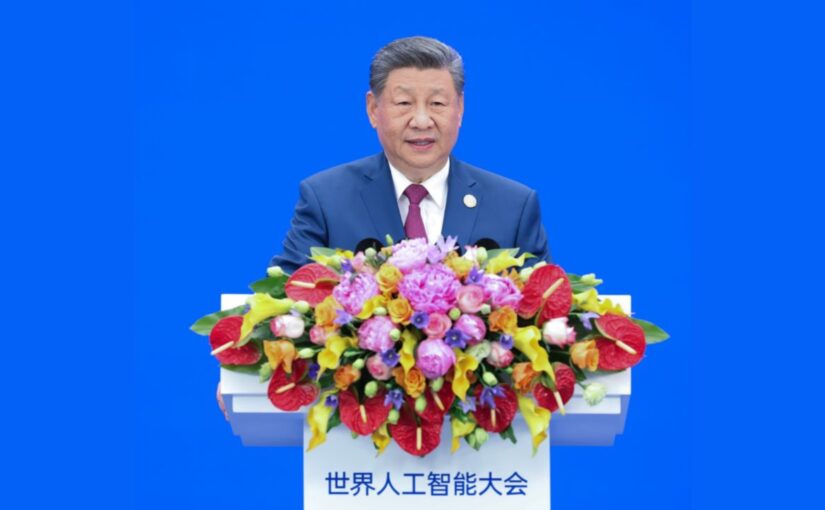
Xi Jinping outlines China’s vision for the future of artificial intelligence

On 17 July, Xi Jinping delivered the keynote address at the opening of the 2026 World AI Conference in Shanghai – his first in-person appearance at the conference since it began in 2018, and coming a day after 29 countries signed the agreement establishing the World Artificial Intelligence Cooperation Organisation (WAICO), a new intergovernmental body headquartered in Shanghai. The event was attended by President Kassym-Jomart Tokayev of the Republic of Kazakhstan, Prime Minister Hun Manet of the Kingdom of Cambodia, Prime Minister Anutin Charnvirakul of the Kingdom of Thailand, Secretary General of the United Nations António Guterres, and official representatives, business leaders, scholars and researchers from more than 100 countries and international organisations.

In the following analysis for Friends of Socialist China, Carlos Martinez examines the significance of Xi’s speech and the launch of WAICO. He argues that they represent a direct alternative to Washington’s approach – encapsulated in the Trump administration’s “Winning the Race” AI action plan, with its export controls, model restrictions and pressure on allies to join a technological blockade of China.

Where the United States treats artificial intelligence as a weapon in a zero-sum contest for supremacy, Xi calls for “open source, openness, collaboration and sharing”, and for AI to be developed as a common asset of humanity, with its benefits extended to the Global South. It is, Carlos writes, a democratic, multipolar and socialist vision: technology as a public good, serving people before profit.

This article was first published by Friends of Socialist China.

Should artificial intelligence – perhaps the most consequential technology of our era – be the exclusive property of a handful of corporations and one increasingly belligerent superpower, or should it be developed as a common asset of humanity? That is the question Xi Jinping posed, implicitly but unmistakably, in his keynote speech at the opening of the 2026 World AI Conference in Shanghai on 17 July – his first in-person address to the conference since its launch in 2018, and delivered a day after 29 countries signed the agreement establishing the World Artificial Intelligence Cooperation Organisation (WAICO), a new intergovernmental body headquartered in Shanghai.

Citing an old Chinese saying, Xi observed that “a single string cannot make music, and a single tree does not make a forest”, insisting that AI development “should not be a solo performance by a single country, but a symphony of international cooperation”. The metaphor is well chosen, because a solo performance is precisely what Washington has in mind.

Winning the race, or sharing the prize?

The United States announced its own AI strategy a year ago. Its title – Winning the Race: America’s AI Action Plan – tells us much of what we need to know about the underlying philosophy. AI is conceived not as a tool for human development but as a weapon in a zero-sum contest for global supremacy; the plan is built around tightening export controls on advanced semiconductors, restricting access to leading US models, and pressuring allies – under threat of secondary tariffs – to join a technological blockade of China. The Trump administration has since extended export controls to cutting-edge US AI models, forcing even European businesses to confront the risks of depending on US technology.

Xi’s speech reads as a point-by-point repudiation of this approach. Where Washington seeks to hoard the technology, China calls for “open source, openness, collaboration and sharing”. Where Washington weaponises “national security” to justify its chip war, Xi calls on the international community to “jointly oppose overstretching the national security concept in the field of AI and placing one country’s security over that of others”. Where Washington demands that the world adopt “American values” along with the American AI stack, Xi insists that AI “should not erode or undermine the diversity of world civilisations or the uniqueness of cultures of different countries”.

The West’s framing of AI as a civilisational contest is far from subtle. At the Paris AI summit last year, JD Vance warned darkly of “authoritarian regimes” using AI to control their citizens, while Britain’s technology secretary Peter Kyle declared that the AI race must be led by “western, liberal, democratic” countries. China’s response at the time – that it is “against drawing lines along ideological difference, overstretching the concept of national security, or politicising trade and tech issues” – is precisely the position Xi has now elevated to the level of a global governance programme. And as legal scholar Angela Zhang observed in the Financial Times, China does not think in terms of an “AI race”; its priority is not supremacy but self-sufficiency, diffusion and application – making the technology useful, cheap and universal.

People before profit

The contrast between China and the West’s approaches reflects two different social systems, with two different logics. In the US, AI development is driven by the profit expectations of a handful of tech giants and the war-planning of the Pentagon. In China, a socialist market economy directs the technology towards social ends: Xi spoke of smart devices that “truly improve people’s livelihood”, of coordinated upgrading across traditional and emerging industries “so that all sectors and businesses can benefit from AI”, and of keeping AI “always under human control”.

The difference shows up in practice. While Silicon Valley promises mass layoffs as a selling point to investors, China’s AI Plus programme – now fully integrated into state industrial policy – is oriented towards job creation and job quality, popularising AI as a social good while regulating its disruptions.

In Chinese hospitals, an AI screening tool called PANDA is detecting pancreatic cancer from routine CT scans before symptoms appear – catching early, at population scale, one of the deadliest cancers. And while Wall Street inflates an AI investment bubble of historic proportions, the CPC’s top theoretical journal has been urging the cultivation of “patient capital” – long-term, mission-oriented investment in place of speculative frenzy.

The DeepSeek phenomenon exemplifies the whole approach: a world-class model, developed at a fraction of the cost of its US competitors, requiring far less energy and computing power, released free and open source to the entire world. One model treats intelligence as a commodity to be enclosed; the other treats it as a public good to be shared.

Answering the call of the Global South

Some of the most striking passages of Xi’s speech concern the developing world. Xi warned against allowing the AI revolution to create a “new historical injustice” – a digital reprise of the colonial division of the world – and committed China to “help Global South countries with capacity building to bridge the AI and digital divides”. This was backed with concrete pledges: 5,000 AI training opportunities for developing countries over the next five years; international AI application cooperation centres with ASEAN, the Arab League, the African Union, CELAC, the SCO and BRICS; and the extension of MAZU, China’s AI-powered meteorological early warning system, to 30 countries.

WAICO itself is, in Xi’s words, “a major move by China to answer the call of the Global South”. Its founding membership – including Cuba, Ethiopia, Kenya, Laos, Pakistan, Brazil, Indonesia and Venezuela – speaks for itself, as does the attendance of UN Secretary-General António Guterres at the signing ceremony. Even the South China Morning Post acknowledges that Beijing is positioning itself as the advocate of openness “at a time when access to advanced technologies is increasingly constrained by export controls and corporate blacklists”.

Four initiatives, one vision

WAICO is the institutional expression of the Global AI Governance Initiative Xi proposed in 2023, and it takes its place within the broader framework of China’s four global initiatives: the Global Development Initiative (2021), the Global Security Initiative (2022), the Global Civilisation Initiative (2023) and the Global Governance Initiative (2025) – the operational programme of the community with a shared future for humanity. Indeed, the GGI concept paper explicitly identified the governance vacuum in artificial intelligence, alongside the underrepresentation of the Global South, as among the central failures of the existing international system. WAICO is the answer to that diagnosis: international rules on AI jointly formulated rather than imposed.

The speech maps directly onto the four initiatives: AI as “an important driver for shared prosperity” (development); AI as a contributor to “common security” rather than an arms race (security); AI in the service of “mutual learning between civilisations” (civilisation); and a “consensus-based global governance framework” built on “true multilateralism” and the central role of the United Nations (governance).

Beneath the mapping lies a single question, posed in every domain the initiatives touch: is the world a jungle in which the strong prey on the weak, or a family with a single shared home? Applied to AI, the first logic – the logic of capitalism and imperialism – produces export controls, corporate enclosure and an arms race; the second – the logic of socialism – produces open source, capacity building and cooperation.

What WAICO embodies is a fundamentally democratic vision of technological development: decisions about humanity’s future made not in the boardrooms of Silicon Valley or the war rooms of Washington, but through “extensive consultation and joint contribution for shared benefit” among sovereign equals. It is, equally, a socialist vision: technology as a public good, serving people before profit, with its benefits extended deliberately to those the capitalist world system has always excluded.

The United States offers the world an AI race with one permitted winner. China offers a symphony in which every country has an instrument.

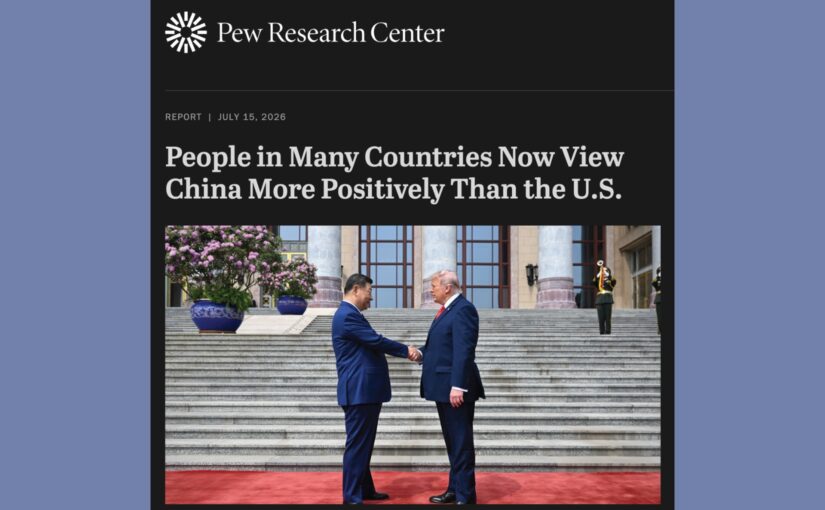
Around the world, China is viewed more positively than the United States

A newly published survey by the Pew Research Center – covering more than 42,000 people across 36 countries – has found that China is now viewed more positively than the United States in most of the countries polled, with more people worldwide expressing confidence in Xi Jinping than in Donald Trump. It is a striking measure of how far Washington’s global standing has fallen.

In the following article, Carlos Martinez examines what lies behind this historic shift. He argues that the single most important factor is the war on Gaza – a genocide watched in real time by a global public that has also seen the governments of North America and Western Europe arm, finance and shield it, all while lecturing the world about a “rules-based order”. The same collapse of credibility, he notes, has quietly buried the “Uyghur genocide” narrative, and has been compounded by the US-Israeli war of aggression against Iran.

Set against this, the article points to what China offers the world: the greatest poverty alleviation in history, a global clean-energy transition, and cooperation on terms of sovereign equality – together with a new visibility that is allowing hundreds of millions of people to see Chinese life for themselves, bypassing the distorting filter of the Western press.

This article was first published by Friends of Socialist China.

For decades, Washington has been able to console itself with the notion that, whatever the world thought of its never-ending criminal wars, it could always rely on its vast apparatus of cultural hegemony to win hearts and minds around the world. At some level, it has always remained the land of the free and the home of the brave. But nothing lasts forever.

According to a new Pew Research Center survey of 42,151 people across 36 countries, China is now viewed more positively than the United States in most of the countries surveyed – and more people worldwide express confidence in Xi Jinping than in Donald Trump.

Even Canadians view China more favourably. In 2023, 57 percent of Canadians had a positive view of the US and just 14 percent viewed China positively; today China leads by 44 percent to 33.

Continue reading Around the world, China is viewed more positively than the United States

Interview: Fighting spirit has allowed the CPC to survive and adapt over a century

The following is the full text of an interview given by Carlos Martinez to the Global Times, marking the 105th anniversary of the founding of the Communist Party of China (CPC). An abridged version was published by the Global Times on 12 July 2026 as part of a special series of interviews with international scholars reflecting on the party’s century-long journey.

In the interview, conducted by GT reporter Xia Wenxin, Carlos explores the meaning of the CPC’s “fighting spirit”, or “spirit of struggle” – a concept he argues is routinely misread in the West as blind confrontation or factional intrigue, but which in fact flows directly from the dialectical core of Marxism. Struggle, in this sense, is not a mood but a method: the recognition that development happens through contradiction, and that a serious revolutionary party must identify the principal contradiction of each period and mobilise the masses to resolve it.

Tracing this thread from Mao Zedong’s 1945 parable of the Foolish Old Man who removed the mountains through to the present day, Carlos discusses how the same method has allowed the party to survive and adapt across a century that saw so many other revolutionary projects defeated. He examines the CPC’s practice of self-revolution and its unrelenting campaign against corruption; the targeted poverty alleviation drive that lifted hundreds of millions out of poverty; and the fundamental difference between the Chinese dialectical understanding of struggle as productive and the Western view of conflict as terminal.

Finally, he considers how this fighting spirit will be tested on the new battlefields of the 15th Five-Year Plan – high-tech self-reliance under conditions of US containment, the green transition, and the assorted domestic challenges on the road to the Second Centenary Goal of 2049. As he concludes, “on the record of the last 105 years, I would not bet against the CPC and the Chinese people surmounting these new challenges.”

The abridged version of this interview first appeared in the Global Times. The full version was first published on Friends of Socialist China.

As the CPC marks its 105th anniversary, it stands as one of the longest-governing political parties in modern history. Looking back at this journey, how do you evaluate the role of the “fighting spirit” in helping the party navigate historical crises and constantly adapt to changing eras?

I think that, for the CPC, “fighting spirit” is closely related to the dialectical core of Marxism: the recognition that development happens through contradiction, that nothing valuable arrives without meaningful effort, and that a serious revolutionary party has to identify the principal contradiction of each period and work to resolve it. Struggle, in this sense, is not a mood; it is a method.

This is not a recent slogan grafted onto the Party; it runs right through its tradition. One of the clearest statements of it is Mao’s closing speech to the Seventh Party Congress in June 1945, “The Foolish Old Man Who Removed the Mountains”, in which he retold an old fable. A foolish old man sets out to dig away two great mountains that block the way to his house; when a wise old man mocks the folly of it, he replies, “When I die, my sons will carry on; when they die, there will be my grandsons, and then their sons and grandsons, and so on to infinity. High as they are, the mountains cannot grow any higher and with every bit we dig, they will be that much lower. Why can’t we clear them away?” The two mountains, Mao said, were imperialism and feudalism, and the task of the Chinese people was to dig them out. What turns the parable into a statement of strategy is its ending: “Our God is none other than the masses of the Chinese people. If they stand up and dig together with us, why can’t these two mountains be cleared away?”

Fighting spirit, in this conception, is not so much heroic individual will as the conviction that an apparently immovable obstacle yields to patient, collective, intergenerational effort, once the masses are mobilised to do the digging.

That method is exactly what has allowed the Party to survive and adapt across a century in which so many of the other revolutionary projects of its generation were defeated. Consider the sheer range of conditions it has had to navigate: a semi-colonial, semi-feudal country torn apart by foreign invasion and civil war; the construction of an entire industrial and social base from near-zero after 1949; the turn to reform and opening up; and then the collapse of the Soviet Union and the Eastern European states in 1989–91, when counter-revolution triumphed almost everywhere – but was resolutely defeated in China. As Deng Xiaoping told Julius Nyerere in 1989, “so long as socialism does not collapse in China, it will always hold its ground in the world”.

That the People’s Republic did not collapse was not luck. It was the product of a party willing to struggle on every level: against foreign domination, against feudalism, against poverty, against underdevelopment, against corruption, and against ideological ossification.

Continue reading Interview: Fighting spirit has allowed the CPC to survive and adapt over a century

Manufactured outrage: the truth about China’s ethnic unity law

The following article by Carlos Martinez responds to the coordinated storm of condemnation that greeted the entry into force on 1 July of China’s Law on Promoting Ethnic Unity and Progress – a campaign that seeks to revive the discredited “Xinjiang genocide” narrative and extend it to Xizang (Tibet) and beyond.

Carlos examines what the law actually says, and contrasts China’s record on minority rights – rising life expectancy, the elimination of absolute poverty, and the protection and flourishing of minority languages – with the treatment of minority communities in the West.

He traces the long history of Western sponsorship of separatism in China, from the CIA’s two-decade Tibetan programme to the National Endowment for Democracy’s funding of exile groups today, and locates the current hysteria in the failure of the propaganda war: as polling shows steadily warming attitudes towards China, particularly among the young, the ideologues of the New Cold War are increasingly desperate to re-toxify China’s image. What China is building is strength through unity in diversity; what its adversaries want to see is disunity and disintegration.

This article was first published by Friends of Socialist China.

On 1 July, China’s Law on Promoting Ethnic Unity and Progress came into force – the country’s first comprehensive national law on ethnic affairs, adopted by the National People’s Congress in March.

Within days, a remarkably well-coordinated storm of condemnation had been whipped up: denunciations from Washington and Brussels, a resolution in the European Parliament, and a wave of media coverage announcing that China had ordered its minorities to “assimilate”. The thoroughly discredited “Xinjiang genocide” narrative is being dusted off and relaunched – this time with Xizang (Tibet) added to the charge sheet for good measure.

Continue reading Manufactured outrage: the truth about China’s ethnic unity law

The role of China in bringing down the empire

In the video embedded below, Carlos Martinez speaks on the role of China in the global project of bringing down the empire, at the Workers World Party hybrid forum “The World is Bringing Down the Empire!” (9 July 2026).

The single biggest factor in overcoming imperialism in the present epoch is the emergence of a multipolar world – and the single biggest factor in that process is the rise of People’s China. This talk traces how China’s role has evolved from the overt anti-imperialism of the 1950s, through the “hide your strength and bide your time” period of Reform and Opening Up, to the leading role it takes in world affairs today: the Belt and Road Initiative, the Community of Shared Future for Humanity, and the Global Development, Security, Civilisation and Governance Initiatives.

Along the way, Carlos addresses war and peace, China’s engagement with Africa, the recent war on Iran, and the argument – associated with Samir Amin – that a multipolar world provides the framework for the necessary overcoming of capitalism.

Transcript

Comrades, thank you very much for inviting me.

I’ve been asked to speak on the role of China in the global project of bringing down the empire. I want to start with a simple claim, which is that the single biggest factor in overcoming imperialism in the present historical epoch is the emergence of a multipolar world. And the single biggest factor in that process is the rise of People’s China.

So let me talk about what China’s role actually is, how it’s changed over the decades, and why it matters so much for everyone who wants to see a different world; a world of peace, equality, prosperity, friendship and solidarity.

Continue reading The role of China in bringing down the empire