
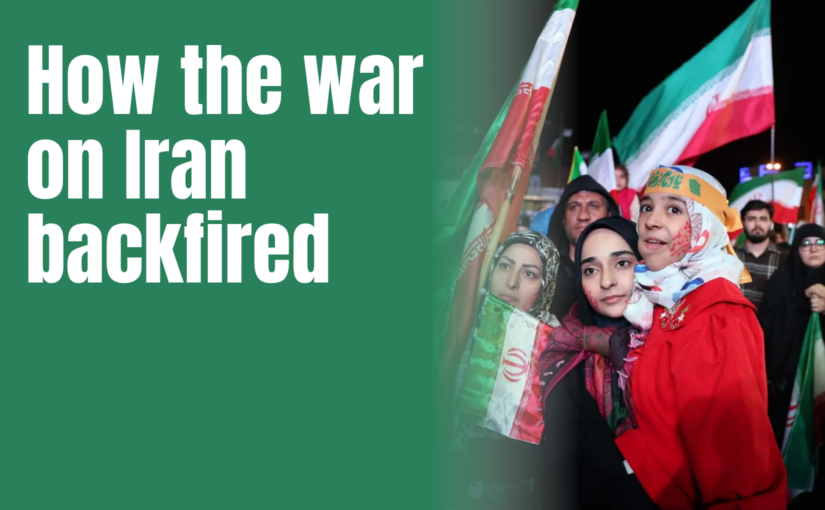
The US-Israeli war on Iran was meant to halt the world’s drift towards multipolarity. Instead it accelerated it.
In this talk from the webinar “Imperialism vs Multipolarity: US and China’s clashing visions” (organised by Friends of Socialist China and the International Manifesto Group), Carlos Martinez argues that the war on Iran is the sharpest illustration we have of two clashing visions of world order – a declining empire that rules through sanctions, blockades and bombing, and an emerging multipolar order based on sovereignty, development and peace.
The presentation covers:
- What the war was really about: Iran, Palestine, the Belt and Road, and the containment of China
- Why Iran survived in 2026 what Mossadegh’s Iran could not in 1953
- China’s role: buying Iranian oil in defiance of sanctions, the UN Security Council veto, economic and diplomatic support
- How the outcome has strengthened Iran, weakened the US, isolated Israel, and accelerated the rise of the multipolar world
Watch the full webinar: Imperialism vs Multipolarity: US and China’s clashing visions.
Transcript
I’m going to make Iran – rather than China or the US directly – the main focus of my remarks, because the war there is the sharpest illustration we have of the two clashing visions we’re discussing today.
First I’ll talk about how the Iran war relates to the overall global struggle between imperialism and multipolarity.
Second, how the emerging multipolar reality has shaped the outcomes of that war.
And third, how those outcomes are, in turn, reshaping the trajectory of the multipolar project.
What the war was really about – the last throw of the dice
Why did the US and Israel launch this war in the first place? The official story was Iran’s nuclear programme – the same threadbare tale Netanyahu has been telling since 1992. The real motivations are geopolitical, and they go to the heart of our theme.
Iran is the last major state in West Asia standing firmly as a beacon of resistance to US imperialism and Zionist expansionism.
The nearby North African state of Libya was destroyed in 2011 in a NATO war of regime change. Syria was dismembered from 2011 in a proxy war, waged by al-Qaeda elements facilitated, financed and armed by the West, the Israeli regime, the Gulf states and Türkiye.
Iran was the ‘last domino’ – so its defeat, the dismantling of the Islamic Republic, and quite possibly the dismemberment of this multinational state on ethnic lines, became essential to the US and Israel securing their dominance of the region.
But there is an even bigger target in all of this, and that is the multipolar project in general and the People’s Republic of China in particular.
Iran sits at the very heart of the China-initiated Belt and Road Initiative – geopolitically crucial for China’s access to wider West Asia, the Mediterranean and beyond – and the two countries are bound by a 25-year strategic partnership signed in 2021.
Over the last couple of months it has become near-universally understood that whoever controls the energy flows of the Gulf – not just Iran’s oil and gas, but Saudi Arabia’s, Iraq’s, Qatar’s, the UAE’s – holds a knife to the throat of the world’s energy markets, and above all to China, the world’s largest oil importer.
The ability to throttle that supply in the event of a hot war, for example over China’s Taiwan, is a prize Washington has long coveted.
So this war was, to a significant degree, also a move against China: an attempt to disrupt the Belt and Road, to weaken a key BRICS and Shanghai Cooperation Organisation partner, and to seize a strategic chokepoint – just as the kidnapping of President Nicolás Maduro was about seizing control of Venezuela’s energy flows in order to leverage them against Beijing. And indeed just as the US’s threats against Greenland are essentially about controlling the mineral wealth and energy flows of the North Atlantic and the Arctic Ocean, the Far North as it is increasingly known, and being able to throttle them in a confrontation with China and/or Russia.
I would put it like this: the war was a last throw of the dice in terms of the Project for a New American Century.
It’s increasingly apparent that the trajectory towards a multipolar world is essentially irreversible – and the war on Iran was a desperate attempt by a declining hegemon to disrupt that trajectory while it still believes it has the military means to do so.
And it backfired spectacularly on its own terms.
The US burned through something like 30 percent of its Tomahawk cruise missiles and half of its THAAD interceptors fighting Iran – the very weapons it had stockpiled for a confrontation with China.
A war meant to strengthen Washington’s hand against Beijing has left it substantially weaker. It has left the US diplomatically isolated, regarded around the world as a rogue state. Even the Financial Times conceded that recent US actions “in the Caribbean, Venezuela and especially Iran help Beijing make the case that America is a force for global instability”.
How the multipolar reality shaped the outcome
Why did Iran in 2026 survive what Mossadegh’s Iran could not?
In 1953, Britain and the US could overthrow Mossadegh’s government with a handful of agents and a pile of bribes, and install a compliant dictatorship that was blissfully free from unorthodox ideas about nationalising the country’s energy resources.
More recently, NATO was able to destroy Libya through a combination of air power, proxy forces and years of economic sanctions.
After 13 gruelling years of proxy war, Syria was subjugated.
And yet in 2026, the combined military might of the US and Israel could not break Iran. What’s different?
Clearly, an extremely important factor is Iran’s own unity, strategic brilliance, its level of preparedness and its extraordinary resilience. The Iranian people have been in the streets in their millions since 28 February, defending the country’s sovereignty, standing by their government and military, standing up for their constitution and the gains of their revolution.
Partly it is that Iran held a card no amount of firepower could neutralise: the ability to disrupt a fifth of the world’s energy trade that transits the Strait of Hormuz. Arguably this is a more effective deterrent than any nuclear weapon would be.
But it is also that Iran is now woven into a changing, more multipolar world that increasingly is willing to stand up for itself.
China took a very active diplomatic role from the beginning. Clearly the days of “hide our strength and bide our time” are over: China is willing to use its economic and diplomatic weight to defend the multipolar project, and to defend its partners in this historical transformation.
China condemned the war from day one as a flagrant violation of the UN Charter and the basic norms of international relations.
It continued buying Iranian oil throughout – an economic lifeline – and when Washington sanctioned Chinese refineries for doing so, China’s Ministry of Commerce ordered its companies and banks to disregard the sanctions outright, on the grounds that they violate both international and domestic Chinese law. That is the world’s largest trading nation formally and openly refusing to comply with US secondary sanctions for the first time and indeed making it illegal to do so.
While it’s obviously not possible for China or Russia to directly intervene militarily in Iran, and Iran itself has never suggested that such intervention was necessary or even desired, both have provided economic support and it’s been widely reported that both countries have provided intelligence and geospatial support to the Iranian military.
At the UN Security Council, China and Russia jointly vetoed a resolution dressed up as “shipping protection” that would have legitimised the war and prepared global public opinion for an escalation.
Both countries had learned the lesson of 2011. Back then they abstained on Resolution 1973, which authorised a no-fly zone over Libya on putatively humanitarian grounds – and watched NATO immediately stretch and twist that mandate into a regime-change war that ended with the destruction of the Libyan state and the murder of Muammar Gaddafi.
Beijing and Moscow took that betrayal as a permanent lesson: never again would they allow a narrow, humanitarian-sounding resolution to be turned into a licence for war.
Then there is Pakistan, which – drawing on its close ties to both Tehran and Beijing – brokered the ceasefire and the Memorandum of Understanding signed last week, with China backing it every step of the way. It was the China–Pakistan five-point peace proposal at the end of March that produced the 7 April ceasefire.
Meanwhile, there was no “coalition of the willing” in the case of Iran. Unlike 2003, Washington could not even assemble its closest allies around it. Britain, the most reliable stooge when it comes to such matters, confined itself to providing base access – Diego Garcia, Cyprus – with Keir Starmer’s government hedging that the war was “not sufficiently anchored in international law”.
And even the Gulf monarchies have been playing an increasingly ambiguous game: having watched the United States defend its own “unsinkable aircraft carrier” – ie Israel – rather than them, and then seeing which way the wind was blowing, in the main they began hedging towards accommodation with Iran. That this sort of hedging was possible at all is a sign of broader shifts, first and foremost the growing economic partnership between China and the Gulf states, combined with the growing awareness that the US is no longer a reliable guarantor of their security.
How the outcome has reshaped the multipolar reality
What if things had worked out differently?
Had the US achieved its maximal aims, the Islamic Republic of Iran would no longer exist; Reza Pahlavi would be installed as a Washington-subservient “democratic” monarch, despised as much if not more than his father was; Iran would leave BRICS, leave the Shanghai Cooperation Organisation, leave the Belt and Road, recognise Israel and abandon the Palestinians. Probably, ironically, Reza Pahlavi would have US support in developing nuclear weapons, just as his father was moving towards in the 1970s.
What we have instead is a very different outcome, and it has accelerated the multipolar trajectory rather than slowing it.
First, Iran emerges strengthened and decisively oriented eastward. For decades a debate has raged inside Iran – crudely, reformists leaning West, principalists leaning East – about the country’s direction. The war has settled this question decisively.
To advocate a “pro-US” position in Iran today is to isolate yourself completely from a people who have heroically defended their sovereignty in the streets for months.
The clearest sign came just a few days ago: Iran’s parliament speaker Mohammad Baqer Qalibaf – also now Iran’s special representative for China – called Iran a “full-fledged, reliable and long-term partner” of China, and said, “in any bloc that emerges, there are two definitive and irreplaceable countries: China and Iran”.
Iran’s foreign minister, Abbas Araghchi, having met with his Chinese counterpart Wang Yi in May, reported that “our Chinese friends believe that Iran is different after the war and has improved its international status and proven its capability and authority, and a new era of China’s cooperation with Iran and other countries is ahead.”
So Iran is, more firmly than ever, aligning itself with multipolar and anti-imperialist forces.
Incidentally, none of this betrays Khomeini’s famous dictum “neither East nor West”: that slogan never rejected close cooperation and strong relations with any other country; rather, it rejected domination by any country. Cooperation with China comes on terms of sovereignty, non-interference and mutual respect.
Second, the war has been a profound inspiration to empire-resistant states and movements everywhere – living proof that the world’s foremost military power can be faced down and defeated.
Third, it is a serious blow to the old imperial strategy of stoking Shia–Sunni conflict. Far from lining up against Iran, four majority-Sunni states – Pakistan, Saudi Arabia, Türkiye and Egypt – convened to try to bring about an end to the war. This longstanding and powerful weapon of divide and rule is at last being neutralised. Not to mention the fact that Iran’s resilience, its support for Palestine and for Lebanon and its strikes against Israel have won it massive support throughout the Arab world.
And fourth, the war has dealt a devastating blow to the military and diplomatic reputation of the United States – which could not win, and saw its regional infrastructure of power projection torn to shreds – and it has deepened Israel’s isolation as a rogue and increasingly genocidal and fascist state, especially with its “Gaza 2.0” assault on Lebanon. Israel is more isolated than ever, and the Abraham Accords are dead. That whole project of normalising Israel and gathering Arab states around it in order to build a “Middle East NATO” is dead.
Conclusion – a war that accelerated what it meant to stop
This war was supposed to arrest the journey towards a multipolar world: to take out a key BRICS partner, sever a node of the Belt and Road, and remind the Global South that resistance is futile.
It has achieved the opposite.
Iran is more deeply embedded at the heart of the multipolar project than ever. The Belt and Road now clearly runs not only by sea but overland, through round-the-clock Iran–Pakistan border crossings and Chinese-built rail from Xinjiang.
The sanctions weapon has been openly defied. And the world has watched the US method of coercion fail in the face of the Chinese method of patient diplomacy oriented to peace and sovereign equality.
There is a choice now in front of every country, including Britain: cling to the coat-tails of a declining empire and its Project for a New American Century, or join the rising majority of humanity building a world based on sovereignty, development and peace.
As a result of this criminal US-Israeli war on Iran and Lebanon, more countries will be drawn into the multipolar orbit, and the unipolar moment will be remembered as a brief and violent interlude in the long march of human history towards emancipation.