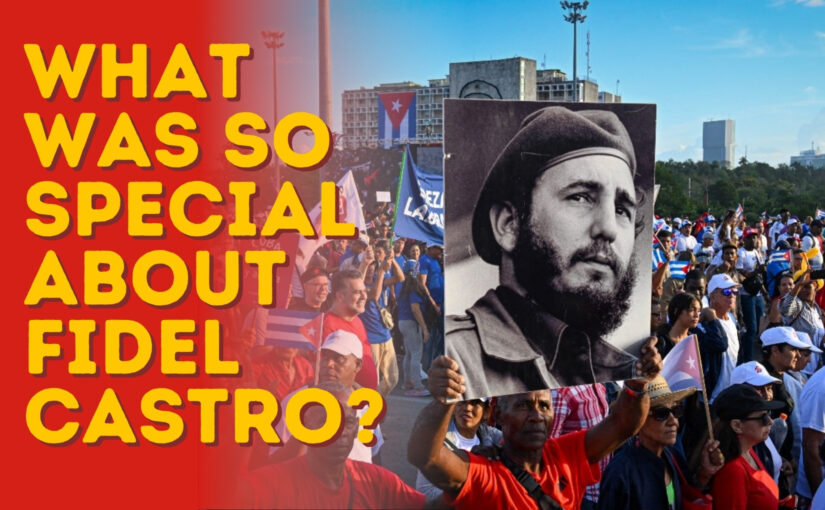
Fidel Castro was born on 13 August 1926. On the centenary of his birth, Carlos Martinez asks: what was actually so special about Fidel? Not the myth, but what he concretely did and understood that so few others did.
This video looks at four aspects: the unswerving revolutionary, who saw the possibility of overthrowing a US puppet dictatorship, defeated a CIA invasion in 72 hours, and then refused to follow Gorbachev when 85 percent of Cuba’s trade vanished overnight. The principled and undogmatic Marxist, who insisted that Marxism could not be conceived of as a church with its Rome and its Pope, who backed Allende’s peaceful road and the Bolivarian governments alike, and whose 1993 assessment of Chinese socialism put him decades ahead of most of the Western left. The consummate internationalist, who sent 375,000 troops to help defeat apartheid South Africa in Angola and took nothing in return, and whose “army of white coats” has now put more than 600,000 Cuban health workers into 165 countries. And the man of the people – the literacy campaign, the confrontation with racism, the early warning at Rio in 1992.
Then the video turns to why this centenary matters so urgently. Cuba is facing the gravest threat since 1959: a Trump administration reportedly working to bring the government down by the end of the year, a fuel blockade that has produced six national grid collapses in 2026 alone, a reported plan for a naval blockade, and an assault on the Cuban medical missions. Honouring Fidel means giving Cuba our firm solidarity.
Sources and further reading:
To honour Fidel Castro means to continue his work of fighting imperialism and building socialism
Fidel Castro on Chinese socialism (1993) – the full text of the remarks quoted in this video
Cuba: siege socialism or barbarism – earlier video
Cuba is not a failed state – it is a besieged state (Morning Star)
Transcript
Hello and welcome.
This Thursday, 13 August, Fidel Castro would have been a hundred years old. Cuba has designated this the Year of the Centenary of the Commander-in-Chief Fidel Castro Ruz, and there are events taking place all over the world to mark the event.
So, what was so special about Fidel? What, concretely, did he do and understand that so few others did?
The question matters particularly now, when Cuba faces its gravest threat since 1959.
When Engels stood at Marx’s graveside in Highgate Cemetery in 1883, he said that Marx was “before all else a revolutionist”, whose real mission in life was to contribute to the overthrow of capitalist society and to the liberation of the modern proletariat. And that description fits Fidel just about as well as it has ever fitted anybody.
What he attempted was extraordinary. In the 1950s, Cuba was ninety miles from the United States — economically dominated by it, politically supervised by it, culturally saturated by it, and ruled by Washington’s man, Fulgencio Batista. This was the height of McCarthyism. There was no model of revolution to copy. There was no collapsing empire leaving a power vacuum, no Red Army arriving over the border.
Cuba’s existing communist party, the Popular Socialist Party, was a serious organisation with real roots in the working class, but it didn’t believe that the moment had come. Its leader, Blas Roca, was honest about this afterwards. For a long time, he admitted, the party “failed to take any practical steps” towards armed struggle, because it assumed that the struggles it was leading would culminate in insurrection more or less spontaneously. Fidel recognised the potentially revolutionary situation and then did the practical work: preparing, training and assembling people who were prepared to fight.
This revolutionary sense continued throughout his life. In April 1961, the CIA landed a force of exiles and mercenaries at the Bay of Pigs, with US air and naval support behind them. The Cuban response was to arm the population, with Fidel personally directing the defence from the field. The invasion was crushed in under seventy-two hours — one of the very few occasions in the twentieth century in which a small country decisively defeated an invasion sponsored by the United States.
In 1991, the Soviet Union disappeared, and with it eighty-five percent of Cuba’s foreign trade, essentially overnight. The fuel stopped coming. Industry and transport seized up. Every analyst in Washington expected that Cuba would fall within months.
Fidel’s answer was not to follow the path of Mikhail Gorbachev. He had set out his position two years earlier. In December 1989, with the socialist camp seeming to collapse around him, he stood at El Cacahual over the graves of Cuban internationalists killed in Africa and told the Cuban people what he thought was going wrong in the Soviet Union. No revolution, he said, and no genuine socialist rectification is possible without a strong, disciplined and respected party. And you can’t carry out such a process by slandering socialism, by destroying its values, by discrediting the party. Cuban communists, he said, would know how to defend this bastion to the last drop of our blood.
And they did. Cuba imported a million bicycles from China. It turned Havana’s vacant lots into organic gardens. It built a tourism industry from nothing. And it came through the Special Period without mass starvation, without IMF shock therapy. Of all the countries in the old Comecon, only Cuba and Vietnam are still standing.
At Fidel’s funeral, Raúl Castro listed it all — the Granma, the overthrow of Batista, the Bay of Pigs, declaring socialism ninety miles from the United States, surviving the missile crisis, helping to defeat apartheid South Africa. And he drew from it a single lesson. Fidel’s enduring lesson, he said, is that extraordinary things become possible when the people are united and determined to defeat injustice and to build a better world.
Fidel was also a serious Marxist, and it’s worth reiterating this, because the standard Western account of him has him as a sort of romantic nationalist who was pushed into the Soviet camp by US hostility — as though socialism was something that just happened to him rather than something he chose.
But he was explicit about it. He writes in his autobiography:
Marxism taught me what society was. I was like a blindfolded man in a forest, who didn’t even know where north or south is. If you don’t eventually come to truly understand the history of the class struggle, or at least have a clear idea that society is divided between the rich and the poor, and that some people subjugate and exploit other people, you’re lost in a forest, not knowing anything.
And by his final years at university, he’d read all the Marx, Engels and Lenin he could get his hands on.
Now, Fidel didn’t proclaim the socialist character of the revolution until April 1961 — on the eve of the Bay of Pigs — and didn’t describe himself publicly as a Marxist-Leninist until December that year. And he explained why with complete candour. He said: if we put the policies of socialism to the Cuban people, they agree with all of them; but if we apply the word “socialism”, after these decades of US anti-communist propaganda, they recoil. So he let the revolution prove itself in practice first. And that’s not opportunism. It is, rather, a question of political practice: allowing people to learn through direct experience what they couldn’t accept on the basis of abstract theory.
And once he said it, he said it with relish. In October 1965, at the founding of the Communist Party of Cuba, he declared that the word “communist” was for them not an offence but an honour.
Within a hundred years, there will be no greater glory, nothing more natural and rational, than to be called a communist. We are on the road towards a communist society. And if the imperialists don’t like it, they can lump it. Understand, gentlemen, that when you call us “communists”, you are giving us the greatest compliment that you can give.
For Marxism to actually be Marxist, it must reject dogmatism. And in that same speech, Fidel warned that Marxism couldn’t be conceived of as something like a church, a religious doctrine with its Rome, its Pope and its Ecumenical Council. It was, he said, a revolutionary and dialectical doctrine, a guide to revolutionary action and not a dogma.
Cuba strongly backed Salvador Allende’s attempt to reach socialism in Chile through the ballot box, and Fidel toured that country for twenty-five days in 1971, saying afterwards that Cuba had given the Chilean process its support despite having made its own revolution by very different means. Decades later, Fidel embraced Hugo Chávez, Lula, Evo Morales, Rafael Correa and Daniel Ortega as a continuation of the same project under changed conditions, rather than as a betrayal of some kind of sacred principles.
Ricardo Alarcón, who led Cuba’s National Assembly for twenty years, put the underlying idea very well. The fundamental error, he said, is the belief that there exists a socialist model. We should speak of socialisms, in the plural — socialism being, in José Carlos Mariátegui’s phrase, a heroic creation.
Which brings us to what Fidel had to say about China.
By the 1990s, a great deal of the Western left had written China off entirely. Market reforms, foreign investment, special economic zones — the whole thing filed away as capitalist restoration, and the Chinese Revolution treated as something that ended in 1976. Fidel’s assessment was the opposite. In November 1993, presenting Cuba’s highest honour, the Order of José Martí, to Jiang Zemin, he said this:
China is no longer the China of the feudal lords, nor the constant victim of the aggressions of colonial and imperial powers. This is the new China that emerges from the victorious national liberation struggle and the socialist revolution, exploits unsurpassed in human history. Everything was carried out under the immortal ideas of Marxism-Leninism and their wise application to China’s conditions. The path China has had to travel following liberation has been long, difficult, and risky in a world where imperialism exercised and still exercises power and hegemonic influence. Colossal successes have been attained. The era of disasters and famines has been left behind. Only socialism could have been capable of the miracle of feeding; clothing; providing with jobs, education, and healthcare; raising life expectancy to 70; and providing decorous shelter for more than 1 billion human beings in a minute portion of the planet’s arable land. Thanks to such a feat at this difficult time for the world’s peoples, over one-fifth of humanity remains under the banner of socialism.
And this reasoning is profoundly materialist. Fidel’s question is not “does China resemble the socialism I have in my head?” It is: what has this system actually delivered to the people living under it, and what would have been possible without it? And it’s the same question he asked of Cuba, and the same question he would want asked of Cuba now.
Another crucially important aspect of Fidel’s legacy is his internationalism.
Cuba is a relatively poor country of eleven million people. And yet, between 1975 and 1991, it sent 375,000 troops to Angola, to defend Angolan independence against invasion by apartheid South Africa. More than two thousand Cubans died on African soil. Cuba took no oil, no minerals, no bases, no territory, no compensation. When the South African forces were finally halted at Cuito Cuanavale, it changed the course of southern African history: Namibia won its independence, and the apartheid regime began to fall.
Nelson Mandela understood the significance of this very well. The Cuban internationalists, he said, made a contribution to African independence, freedom and justice unparalleled for its principled and selfless character. It is unparalleled in African history, he added, to have another people rise to the defence of one of us like this.
And it wasn’t only Angola. Cuba supported liberation struggles in Guinea-Bissau, Algeria, Congo, Ethiopia, Western Sahara, South Yemen, Mozambique, Zimbabwe and Namibia. Cuban tank crews fought on the Golan front after the 1973 war with Israel. Fidel was the only foreign head of state to visit the liberated zone of South Vietnam during the war. And Havana gave refuge to revolutionaries the US wanted in prison, among them Robert F. Williams and Assata Shakur.
Then there’s what Fidel called the army of white coats. Since the first mission went to newly independent Algeria in 1963, more than 600,000 Cuban health workers have served in 165 countries. Around 24,000 are serving right now, in more than fifty countries, staffing the clinics that nobody else will staff. The Latin American School of Medicine in Havana trains doctors from across Africa, Latin America and the Caribbean — and indeed from poor communities in the US — for free, on the understanding that they go home and serve their own people.
Fidel explained the principle simply, in a speech in 1988. Being internationalists, he said, is paying our own debt to humanity. And whoever is not capable of fighting for others will never be sufficiently capable of fighting for himself.
No country has contributed more, in proportion to its size and resources, to the liberation of other peoples.
Fidel was, of course, deeply committed to the wellbeing of the Cuban masses.
In 1961, the government sent a quarter of a million volunteers — including a hundred thousand teenage brigadistas — into the countryside to teach the peasantry how to read. In a single year, illiteracy fell from around twenty-four percent to under four percent. And literacy today stands above ninety-nine percent — higher than Britain, higher than the United States.
Fidel took on racism directly. In March 1959, within weeks of taking power, he told Cubans that discrimination was not only practised by the aristocracy, but that very humble people discriminated too. And he asked why the problem should not be tackled radically, and with love, by educating people out of the inherited prejudice of centuries of slavery. And Isaac Saney’s judgement is that Cuba has done more than any other country to dismantle institutionalised racism and generate racial harmony.
Fidel was also decades ahead with regard to the climate crisis, telling the Rio Summit in 1992 that an important biological species was in danger of disappearing through the rapid destruction of its natural conditions. He was talking about human beings, of course — and putting the responsibility squarely on the consumer societies of the rich world, and particularly the imperialist powers.
He could also admit error. In 2010 he publicly accepted personal responsibility for the persecution of gay Cubans in the early decades of the revolution. He said: if someone is responsible, it’s me. And that’s not a small thing for a head of state to say.
What does honouring Fidel mean now? Fidel’s centenary is not simply an occasion for historical reflection. It comes at a time when Cuba is under the most severe attack it’s faced since the revolution.
Washington is reported to be working to bring the Cuban government down by the end of this year, and Trump says its fall is “a question of time”. In January, Trump declared a national emergency and authorised tariffs against any country selling oil to the island, directly or indirectly — essentially, the imposition of a total fuel blockade. And there have been several national grid collapses this year alone.
Marco Rubio has toured the Caribbean, threatening governments with visa bans if they keep employing Cuban doctors — attacking the medical missions, which are at once Cuba’s largest source of foreign earnings and the clearest proof of what a small socialist country can offer the world. The State Department has published a hundred-page document recasting essentially the entire US left as a Cuban front operation. And just last week, the US sanctioned Cuba’s military attaché in Beijing for the putative crime of buying defensive equipment from a willing supplier.
Each one of these measures is, in its way, a tribute. You don’t spend sixty-four years, inflict more than a hundred and seventy billion dollars of damage, organise hundreds of assassination plots, and endure an unbroken record of defeat at the United Nations — where last October the vote against the blockade was 165 to 7 — trying to destroy a country that doesn’t matter, that isn’t an ideological threat. Cuba is attacked because of what Fidel built there: the threat of a good example.
Cuba is resisting. Cuba will continue to resist. Cuba has tripled its solar generation in a single year, with Chinese financing behind a programme of ninety-two solar parks aimed at ending the fuel dependency that Washington has been exploiting. China has also sent emergency aid and tens of thousands of tonnes of rice. Russia has sent shipments of oil. The economic reforms passed this summer are an attempt to renew the economy under siege.
Many countries, and in particular the socialist countries, are doing what they can to help Cuba survive.
But Cuba also needs solidarity from people around the world. That’s what honouring Fidel actually means today. It means demanding an end to the blockade. It means joining and building the solidarity organisations. It means refusing the propaganda, including the version of the propaganda that circulates on the left about Cuba not being a socialist country.
Closing the World Meeting of Solidarity with Cuba in November 1994, Fidel put the stakes very plainly. He said:
We understand what it would mean for all the progressive forces, for all the revolutionary forces, for all the lovers of peace and justice in the world, if the United States succeeded in crushing the Cuban Revolution. And because of this we consider defending the revolution along with you to be our most sacred duty, even at the cost of death.
A hundred years after his birth, that’s the question in front of us.
In October 1953, on trial for the attack on the Moncada barracks, a twenty-seven-year-old lawyer told the court that it could condemn him, that it did not matter, because history would absolve him. And history has indeed absolved Fidel Castro. The verdict came in a long time ago — in the literacy brigades, in Cuito Cuanavale, in every clinic in the world with a Cuban doctor in it.
The Nicaraguan revolutionary Tomás Borge once said of his fallen comrade Carlos Fonseca that he was among the dead who never die. And Fidel is also very much among that number.
Thank you very much for watching. See you next time.