
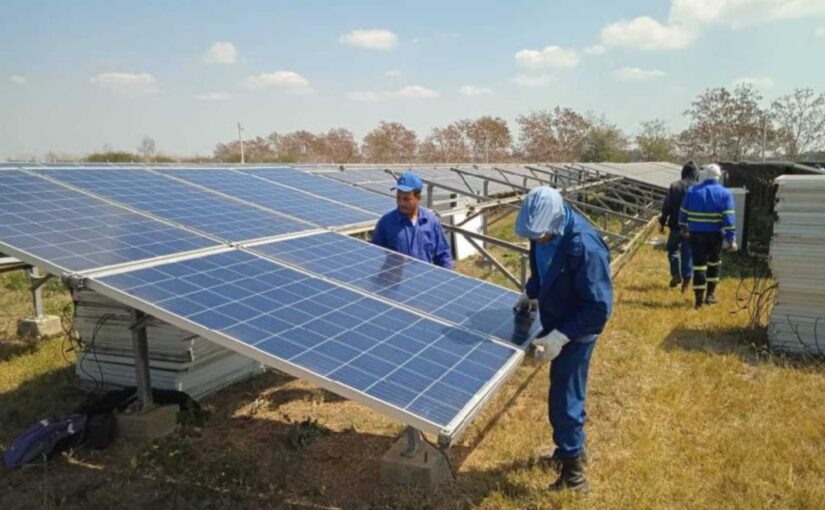
China has delivered a second consignment of 5,000 photovoltaic systems to Cuba, destined for rural communities, health centres, day nurseries and bank branches – the latest instalment in what has become one of the fastest energy transitions anywhere in the world. With Chinese equipment, finance and technical support, Cuba has installed around 1,000 MW of new solar capacity in two years, with 92 medium-sized parks due for completion by 2028, while Chinese solar exports to the island have risen from $3 million to $117 million in as many years. All of this is taking place against a grid pushed towards collapse by Washington’s energy siege, with available capacity at times barely a third of peak demand.
The following article by Carlos Martinez sets out why this amounts to considerably more than an infrastructure project: oil tankers can be intercepted, suppliers threatened and banks sanctioned, but sunlight cannot be blockaded.
This article was first published by Friends of Socialist China.
China has delivered a second consignment of 5,000 photovoltaic systems to Cuba, destined for rural communities, health centres, day nurseries and bank branches. Receiving them, President Miguel Díaz-Canel said Cuba “deeply appreciates this gesture by the Chinese people and government, which adds to the efforts Cuba is making to change its energy mix, amid the genocidal blockade”.
The donation is a small part of what has become one of the fastest energy transitions anywhere in the world. Over the past two years, with Chinese equipment, financing and technical support, Cuba has installed around 1,000 MW of new photovoltaic capacity. This forms the first half of a programme to construct 92 medium-sized parks, each generating approximately 21.8 MW, with a combined capacity approaching 2,000 MW by 2028. Alongside this credit-financed programme, China is donating a further 120 MW through a network of smaller parks. Solar supplied roughly 10 percent of Cuba’s electricity over the course of 2025; during daylight hours its contribution is now considerably higher, at times approaching half of national generation around midday.
The scale of this expanding cooperation can be read in the trade figures. Chinese exports of solar equipment to Cuba came to $117 million in 2025, against just $3 million two years earlier. Havana furthermore has scrapped tariffs on photovoltaic systems, solar water heaters, wind turbines, biodigesters and renewable-powered air conditioning.
An emergency made in Washington
The context is a grid in crisis. Peak demand on the island runs at around 3,200 megawatts, while available capacity has at times fallen to 1,100 – barely a third of what is needed. The result has been rolling blackouts lasting many hours a day, repeated collapses of the national system, and knock-on failures elsewhere: some 225,000 people have recently faced difficulties getting water because the pumps have no power.
Cuba’s energy crisis cannot be understood apart from the blockade, still less presented as evidence of the inherent failure of socialist planning. It is a function of the Trump regime’s genocidal energy siege. Cuba’s thermoelectric plants are old and starved of spare parts; its imported fuel has been choked off. Washington has spent the past two years hunting down the tankers that supply the island, sanctioning the shippers and pressuring the suppliers, to the point where Cuba was reported to be weeks away from running out of oil. A blockade now in its seventh decade, condemned last year by 165 countries at the UN General Assembly with only a handful of votes against, is designed precisely to produce hunger and despair.
That is what makes the solar programme more than an infrastructure project. Every megawatt generated from Cuban sunlight is a megawatt that cannot be embargoed, intercepted or sanctioned. The programme constitutes an important step towards both energy sovereignty and environmental sustainability.
Solidarity, not charity
This is a joint programme rather than a turnkey gift: China supplies equipment, finance and technical support, while Cuba provides the sites, construction work, grid connections and trained personnel needed to bring the parks into operation.
China’s involvement in Cuba’s energy sector long predates the solar parks, and connects directly to the long history of solidarity between the two countries: Cuba’s consistent defence of the People’s Republic, China’s opposition to the blockade, and their shared commitment to socialist development.
In 2021, Cuba joined the China-led Belt and Road Initiative Energy Partnership in order to develop its renewable energy sources and to build energy sovereignty. Beijing has sent 70 tons of generator parts to restore thermoelectric capacity, approved $80 million in emergency aid, and shipped tens of thousands of tons of rice in order to help respond to the current siege. Ambassador Hua Xin has described the cooperation as having a strategic significance:
At the social level, it will provide the population with a clean, stable, and reliable electricity supply, thus improving their well-being. At the economic level, the savings in foreign currency will boost Cuba’s economic recovery. And at the environmental level, the annual reduction in carbon emissions will contribute to global climate governance.
Much of China’s support comes as outright donation or as financing structured in ways that reduce exposure to US sanctions – an approach unavailable to Western lenders, who will not touch Cuba for fear of secondary penalties.
China and the global energy transformation
That Cuba can undertake a solar transformation at this scale and pace is, to a considerable degree, a function of what China has built at home. Having invested on an unparalleled scale in manufacturing and innovation, China now manufactures over 80 percent of the world’s solar modules and much of the associated supply chain, and is constructing around two-thirds of the world’s wind and solar projects, driving the global cost of photovoltaic generation down to a fraction of what it was a decade ago. That collapse in price, achieved largely through long-term planning and public investment, is now making it viable for a blockaded island to re-engineer its grid.
Cuba is not the only beneficiary. The same cheap panels are powering an energy transformation across Africa, where hundreds of millions still lack reliable electricity. Where the imperialist powers offer privatisation, deregulation, structural adjustment, political pressure and lectures, China provides infrastructure, finance, technological knowhow and engineers.
The difficulties remain enormous: storage is insufficient, the thermoelectric plants require extensive repair, and Washington continues tightening the siege. But Cuba is constructing, with socialist China, an energy system progressively less vulnerable to imperial coercion. Oil tankers can be intercepted, suppliers threatened and banks sanctioned; but sunlight cannot be blockaded.