
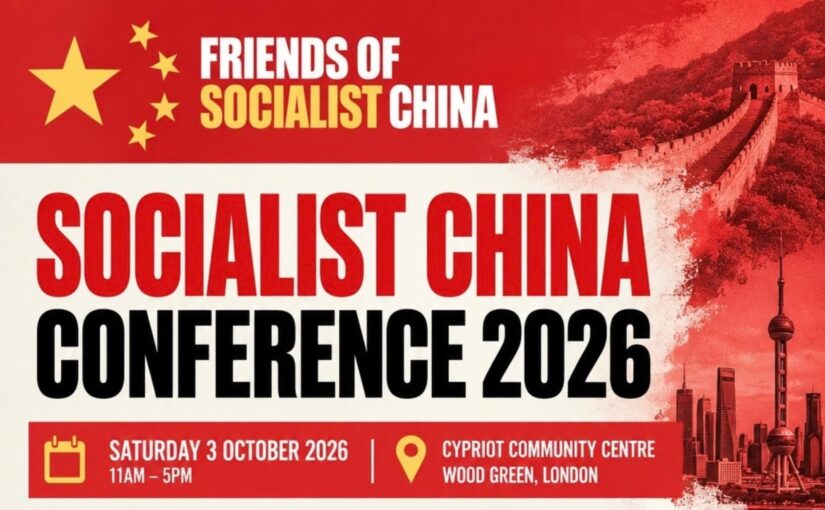
In the following article, Friends of Socialist China co-editor Carlos Martinez sets out the agenda for the third annual Socialist China Conference, taking place in London on Saturday 3 October.
Carlos notes that the British ruling class – the security state and its media representatives above all – talks about China constantly, from Chinese “kill switches” in wind turbines to Beijing supposedly funding the Palestine marches. The conference is a chance for the left to get a word in: on the drive to war in the Asia-Pacific, on what China’s achievements in poverty eradication, infrastructure and renewable energy mean for workers in Britain, on the shifting of global opinion in China’s favour, and on turning the “Chinamaxxing” mood among young people into political understanding.
This article first appeared in the Morning Star.
If the right-wing press is to be believed, Britain is under systematic attack by the cunning Chinese communists.
Over the past couple of months, we have been warned that Beijing is funding the Palestine marches; that these perennial evil-doers are hacking our tractors; that Chinese-made wind turbines may be fitted with kill switches; and that a Chinese-owned hotel in Cyprus has a suspiciously good view of RAF Akrotiri.
Former MI6 chief Sir Richard Dearlove has claimed that China “could switch off our power grid at any second.”
The British ruling class – and particularly the security state and its media representatives – talks about China constantly, so it is probably a good idea for us to get a word in. That is what the third annual Socialist China Conference, in London this Saturday, is for.
War and peace
China’s unprecedented rise took the West by surprise. Washington’s strategists expected the country to remain at or near the bottom of the global economic hierarchy for decades or centuries, but today’s China is the world’s second-largest economy and is growing at more than twice the rate of the US economy; it is also the world’s largest trading nation and manufacturer.
It is a world leader in renewable energy, high-speed rail, space exploration, telecommunications and advanced manufacturing, and is catching up quickly in cutting-edge digital technologies.
The response to this in the West has been increasingly militarised. Washington’s National Security Strategy calls on US allies to help “deter adversaries and protect the First Island Chain,” and they are obliging.
Britain is locked into Aukus with Australia and the US. Japan is further down the road of remilitarisation than at any point since 1945, and its Prime Minister, Sanae Takaichi, has pointedly declined to reaffirm the country’s three non-nuclear principles.
Whether this century sees a catastrophic war depends to a significant degree on managing the relationship between the West and China — on stopping the drive to war and promoting cooperation on the existential issues facing humanity.
The art of the possible
China is increasingly answering some of the questions British workers are asking about their own lives.
In 2021, China eliminated absolute poverty: every person in the country now has guaranteed access to food, clothing, housing, healthcare, education, clean water and modern energy.
Life expectancy has overtaken that of the US. China has built around 48,000km of high-speed rail while Britain has been dithering over HS2 (140 miles/230km).
In July, China’s installed solar capacity overtook coal for the first time, reaching 1,286 GW — around 10 times Britain’s entire generating capacity from all sources.
Even sections of the Establishment are starting to notice. In a recent op-ed for the Financial Times, Ravi Gurumurthy, chief executive of Nesta (UK Innovation Agency), argues that Britain should learn from Chinese industrial policy, going so far as to suggest that “full state ownership may serve us better.”
China’s remarkable progress has its foundations in Marxist political economy: the commanding heights of the economy are publicly owned; that economy is essentially planned; and, while there are capitalists in China, they do not constitute the ruling class. That is why the country’s national priorities are poverty eradication, decarbonisation and public infrastructure rather than profit maximisation.
The world is watching
A Pew survey published in July found that “China is now seen more positively than the US in most of 36 countries surveyed.” Even Canadians now view China more favourably than the US, by 44 per cent to 33.
The contrast between the world’s two largest economies is so stark as to be unmissable.
While the US and Israel bombed Iran, China condemned the aggression, kept buying Iranian oil in defiance of US sanctions, and vetoed security council resolutions designed to legitimise the war.
While Washington strangles Cuba with an energy blockade, China is helping the socialist island carry out the fastest solar transition anywhere in the world.
As Radhika Desai put it at last year’s conference, China has “subtracted a sixth of humanity from the ravages of capitalism and its imperialism.”
From memes to politics
Opinion in Britain is shifting too, especially among the young. The “Chinamaxxing” phenomenon would have been unthinkable a few years ago. Gaza has played a part in this.
As Keith Bennett put it at last week’s online launch of the book China’s Foreign Policy and the Making of a Multipolar World: “A few years ago, refuting the wholly invented tale of a supposed genocide in Xinjiang could seem like an uphill struggle. Today, the difference between an actual and a fictional genocide is there for all with eyes to see.”
But the meme, while fostering a friendly attitude towards China, is for the most part devoid of political analysis. Our conference will examine the politics behind China’s achievements, and the politics behind the West’s hostility to them.
Mao Zedong observed that to make a revolution, it is always necessary first of all to create public opinion — and the same goes for counter-revolution. The other side has been creating public opinion about China for years. It is time we answered.
Join us on Saturday. The conference takes place on Saturday October 3, from 11am to 5pm, at the Cypriot Community Centre, Earlham Grove, Wood Green, London N22 5HJ.
In-person speakers include Mick Wallace, Vijay Prashad, Kate Hudson, John Ross, Radhika Desai, Jenny Clegg, Francisco Dominguez, Alex Gordon, Alfredo Saad Filho, Nandita Lal, Nuvpreet Kalra, Nupur Paliwal, Keith Bennett, Carlos Martinez and more, alongside representatives of the Chinese, Cuban and Laotian embassies, and video messages from Zhang Weiwei, Li Jingjing and George Galloway.
It is supported by the Morning Star, the Communist Party of Britain, the Workers Party of Britain, the Communist Party of Ireland, Caribbean Labour Solidarity, No Cold War Britain, CODEPINK, AKEL in Britain, Student Federation of India UK, the Portuguese Communist Party (UK), the International Manifesto Group, the Black Liberation Alliance and others.
Tickets are available on Eventbrite: bit.ly/chinaconf2026.