
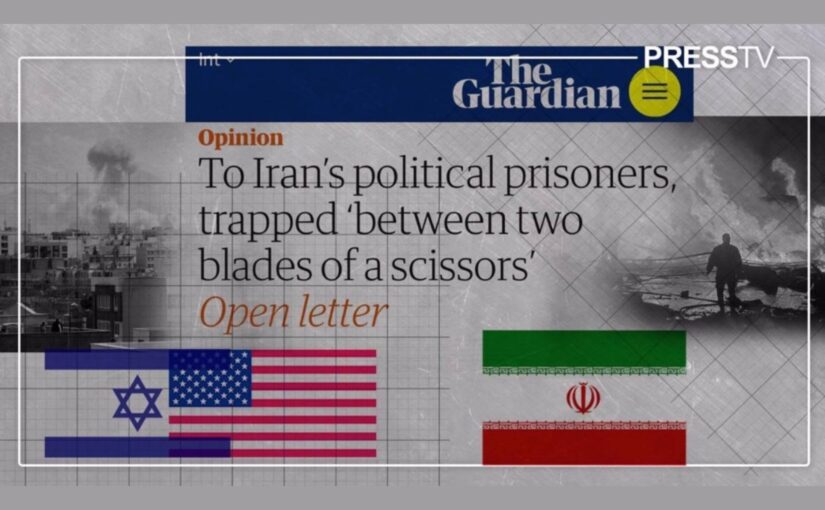
The Guardian has published an open letter to Iran’s “political prisoners”, signed by Angela Davis, Judith Butler, Rashid Khalidi, Ruth Wilson Gilmore, Walden Bello and others, which presents the Islamic Republic on one side and the United States and Israel on the other as “the two blades of a scissors”, with the Iranian people crushed between them.
In the following article, Carlos Martinez argues that this manufactured symmetry between the perpetrators of an ongoing war of aggression and its victim erases both Iran’s four-decade record of anti-imperialist solidarity – from the Palestinian resistance to apartheid South Africa, Cuba and Venezuela – and the achievements of the Iranian people since 1979. In a war of aggression, he writes, the absolute priority must be to show solidarity with the country under attack.
This article was first published by Press TV.
The Guardian has published an open letter to Iran’s “political prisoners,” signed by Angela Davis, Mumia Abu-Jamal, Rashid Khalidi, Robin DG Kelley, Ruth Wilson Gilmore, Judith Butler, and Walden Bello, among others (although Kelley has since withdrawn his signature, and there is considerable doubt that Mumia Abu-Jamal knowingly lent his name to the venture).
These are not people to be dismissed lightly. Many have made important contributions to the anti-imperialist and Black liberation movements, and one of them is currently writing from within a US prison. Nevertheless, the letter is wrong and serves an objectively harmful purpose.
The central metaphor employed is that of “the two blades of a scissors”: the Islamic Republic on one side, and the United States and Israel on the other, with the Iranian people being crushed between them. Such an image manufactures symmetry between the perpetrators of an ongoing criminal war of aggression and the victim of that war; between the warmongering Epstein coalition and an independent country with no record of invading anyone.
The signatories justify their position by “rejecting the false binary of imperialism and hollow anti-imperialism”. But how hollow, exactly, is Tehran’s anti-imperialism?
Iran: an anti-imperialist state
For four decades, while almost every Arab government made its accommodation with Washington and Tel Aviv, Iran armed, funded and provided diplomatic support to the Palestinian resistance. When the Abraham Accords put enormous inducements on the table – security guarantees, investment, technology, the lifting of pressure – Iran refused normalisation. As a matter of principle, it has consistently declined to recognise the legitimacy of an entity built on apartheid and ethnic cleansing.
Iran has paid a significant price for that principled stance: four decades of sanctions designed to strangle its development; the assassination of its scientists; the sabotage of its infrastructure; endless covert operations; and now a full-scale war in which an estimated 3,500 Iranian civilians have lost their lives, and schools, hospitals, apartment blocks, bridges, ports and oil depots have been bombed.
Tehran’s stance against the Empire has not been limited to Palestine. For example, under the West-backed Pahlavi dictatorship, Iran was a close ally of apartheid South Africa and a reliable supplier of its oil. After 1979, the Islamic Republic severed those relations and backed the liberation struggle, at a time when Washington and London still classified the African National Congress as a terrorist organisation.
In 1992, two years after his release from prison, Nelson Mandela travelled to Tehran to thank Iran for its support, referring to Ayatollah Seyyed Ali Khamenei as “my leader”. Apparently, Mandela did not find Iran’s anti-imperialism hollow.
Today Iran stands with Cuba as it faces a genocidal energy siege. It stands with Venezuela, which has suffered the kidnapping of its president and the theft of its oil resources. It stands with Yemen and with the resistance forces of Lebanon and Iraq – the only regional actors working systematically to block US hegemonism and Israeli expansionism.
Iran is a member of BRICS and the Shanghai Cooperation Organisation (SCO), and a crucial link in the Belt and Road Initiative – which is to say, Iran is part of the emerging multipolar trajectory that constitutes the actually existing opposition to the unipolar world order dominated by Washington and its allies.
“Hollow anti-imperialism” – as the open letter refers to – is a communiqué and a hashtag – or perhaps an open letter. Iran’s anti-imperialism has been measured in blood.
Propaganda war
The letter published by The Guardian sadly parrots tired tropes about an “evil regime” which “from its inception enforced absolute social and political control based on an exclusionary ideology”. No mention of the fact that this “exclusionary ideology” received the support of over 98 percent of the Iranian electorate in a referendum held in 1979, following a revolution against the absolute social and political control of the US-aligned Pahlavi regime.
No mention of the fact that many of the leaders of the revolution had themselves been imprisoned and tortured by the Shah’s machinery of repression. And no mention of the Iranian people’s impressive achievements since 1979.
Before 1979, roughly half of Iranians could not read or write; literacy now exceeds 90 percent and is near universal among the young. Women, once largely excluded from education, now make up the majority of students in Iranian higher education.
A country under one of the harshest sanctions regimes in history has built itself into a scientific, technological and military power capable of absorbing the combined weight of the United States and Israel and emerging with its sovereignty intact.
By painting the Islamic Republic as an “evil regime”, the letter erases the reality of the Iranian people’s achievements and the popular support for their government. Such a narrative undermines solidarity with a country under attack; it legitimises imperialism and delegitimises resistance. This is the real hollow anti-imperialism.
Where do we stand?
One can disagree with various aspects of Iran’s domestic politics. The question at hand is different: where do we stand in the global struggle against imperialism? Which side of the barricade are we on? Do we support a criminal war of aggression, or the resistance to it? Do we support the genocide in Gaza, or the country that has been the Palestinian resistance’s most consistent state ally for nearly half a century?
The letter dissolves the distinction. It asks us to refuse the choice. But in a war of aggression there is no third position available, because only one party benefits from your neutrality, and it is not the party being bombed.
The timing is also significant. The letter appears in a British newspaper, six months into a US-Israeli war, at the precise moment when Washington cannot win militarily and needs the political terrain softened.
It recycles a familiar vocabulary – sham trials, systematic torture, the targeting of minorities – largely without sourcing, in the genre that has preceded and accompanied every “regime-change” war of the past three decades, from Yugoslavia to Syria. Whatever the signatories intended, that is the function it will serve.
The lesson they taught us
Angela Davis was imprisoned by a state that told the world she was a terrorist. Mumia Abu-Jamal is imprisoned by that same state today – a state which, incidentally, holds more people in prison than any other country on earth.
These are people who know precisely what happens when an empire manufactures the moral case for crushing its enemies, because it manufactured the case against them.
They would not have signed, half a century ago, a letter denouncing both blades of a scissors – COINTELPRO on one side and the Black Panther Party on the other.
They would have recognised what such a letter was for.
The duty of progressive and anti-war forces is not complicated. It is to oppose the war, the sanctions, the assassinations and the “regime-change” operation, and to assert that a country defending its sovereignty against the most powerful military on earth deserves our solidarity.
Matters concerning Iran’s domestic politics can be settled afterwards, by Iranians themselves, in an Iran that has preserved its independence.
Thank you!