
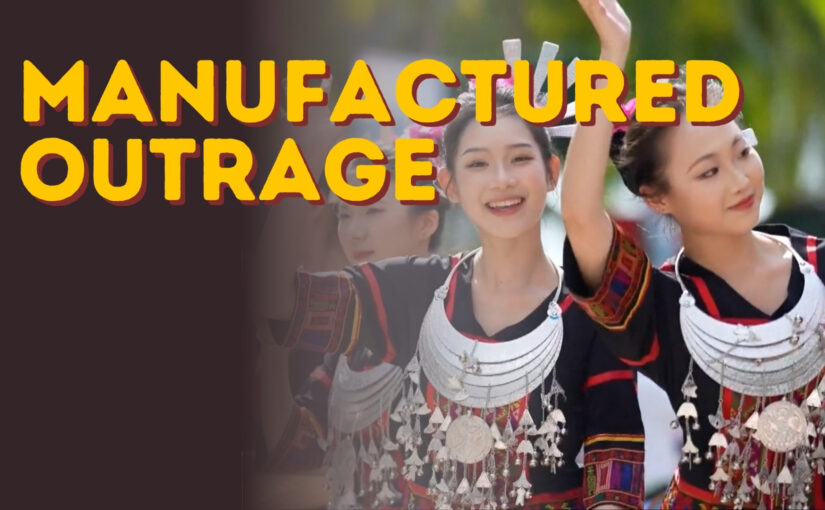
On 1 July, China’s Law on Promoting Ethnic Unity and Progress came into force – the country’s first comprehensive national law on ethnic affairs. Within days came denunciations from Washington and Brussels, a European Parliament resolution, and a wave of headlines announcing that China had ordered its minority peoples to “assimilate”. CNN’s version: “China tells its ethnic minorities to integrate or face consequences.”
In this contribution to the international webinar China’s National Unity vs US Social Hierarchy, Carlos Martinez looks at the distance between what the law actually says and what we have been told it says. The law prohibits discrimination against any ethnic group, explicitly reaffirms the right of all peoples to use and develop their own languages, and requires the state to direct infrastructure, industry and public services towards minority regions. It continues a framework that in the West would be called affirmative action – preferential university admissions, bilingual education, protected minority-language broadcasting, autonomy arrangements, and exemption from the one-child policy throughout its existence.
“Assimilation”, meanwhile, is not a neutral word. It names specific and well-documented crimes: the residential schools of Canada and the United States, the stolen generations in Australia, forced adoption and conversion, languages beaten out of colonised peoples – including generations of Welsh schoolchildren punished for speaking their own. Applying that word to China takes an association rooted in Western colonial history and lets it do the work that evidence cannot.
The video also goes through the record the coverage leaves out – life expectancy in Xinjiang rising from around 30 in 1949 to 77 today, Uyghur population growth of 16 percent between 2010 and 2020 against 2 percent for the Han population, 420 poverty-stricken counties in ethnic autonomous areas lifted out of absolute poverty, minority-language publishing and schooling, and central government transfers flowing towards the periphery rather than away from it – along with the documented history of CIA and National Endowment for Democracy sponsorship of separatism, the strategic reasons Xinjiang and Xizang matter, and the warning of Yugoslavia.
The article this contribution is based on: Manufactured outrage: the truth about China’s ethnic unity law (Friends of Socialist China).
The webinar was organised by Friends of Socialist China, the United National Antiwar Coalition and the International Manifesto Group, with contributions from Chen Weihua, Jason Smith, Jacqueline Luqman, Arnold August and Sara Flounders.
Transcript
Comrades, thank you very much for inviting me, and thanks to the organisers for putting this event together.
I’ve been asked to talk about the distortions in Western media coverage of China’s new ethnic unity law. The most revealing feature of that coverage is the distance between what the law says and what we have been told it says.
China’s Law on Promoting Ethnic Unity and Progress came into force on 1 July. It’s the country’s first comprehensive national law on ethnic affairs. Within days there were denunciations from Washington and Brussels, a resolution in the European Parliament, and a wave of headlines announcing that China had ordered its minority peoples to assimilate.
CNN put the argument most bluntly: “China tells its ethnic minorities to integrate or face consequences.”
The law itself makes national unity and ethnic solidarity the responsibility of all Chinese citizens. It prohibits discrimination and suppression against any ethnic group. It explicitly reaffirms the right of all peoples to use and develop their own spoken and written languages. And it requires the government to strengthen infrastructure, industry, public services and environmental protection in minority regions, so that no ethnic group is left behind in China’s modernisation.
This continues a long-standing framework that in the West would be called affirmative action: preferential university admissions for minority students; bilingual education; protected minority-language broadcasting; autonomy arrangements; and substantial transfers of resources from the central government. China’s minority nationalities were also exempt from the one-child policy throughout its existence.
These are very strange foundations indeed for a programme of forced assimilation.
But “assimilation” is not a neutral word. It evokes specific and well-documented crimes: the residential schools of Canada and the United States; the stolen generations in Australia; forced adoption, forced conversion, and languages beaten out of colonised peoples. Generations of Welsh schoolchildren were punished and humiliated for speaking their own language.
This is the framework that the Western media coverage is being neatly slotted into. It takes a word rooted in the historical experience of Western colonialism, attaches it to China, and allows that association to do the work that evidence cannot.
The law’s language of exchanges, interaction and integration among ethnic groups – which is just ordinary language for a multiethnic society seeking to build cohesion – becomes a kind of ultimatum or threat. A common national identity becomes cultural destruction.
China’s actual record points in a very different direction.
In Xinjiang, average life expectancy has risen from around 30 years in 1949 to 77 today. Between 2010 and 2020, the Uyghur population grew by 16 percent, compared with 2 percent for Xinjiang’s Han population. All 420 poverty-stricken counties in China’s ethnic autonomous areas were lifted out of absolute poverty during the targeted campaign that concluded in 2021.
Young people in Xinjiang and Xizang (Tibet) receive 15 years of publicly funded education. Xinjiang publishes newspapers, books, radio and television in six languages. Inner Mongolia maintains some 1,900 minority-language schools. Documents of the National People’s Congress are published in seven minority languages.
In Xizang, the illiteracy rate stood at 95 percent at the time of liberation in 1951. Today, 98 percent of children complete nine-year compulsory education, with Tibetan taught as a core subject and widely used as a medium of instruction.
Children also learn Standard Chinese, because fluency in the common national language expands access to universities, public institutions and employment throughout the country. The relevant choice is not between a common language and minority languages. China teaches both.
The economic relationship is equally important. Under colonialism, resources flow from the oppressed periphery to the imperial centre. In China, Xinjiang and Xizang are among the largest per capita recipients of central government transfers, with Xizang receiving more than twice as much per person as any other province or autonomous region. The clear objective is shared prosperity and the narrowing of regional inequality.
I’ll leave the domestic record of China’s principal accuser – the US – to other speakers. But a country that operated indigenous boarding schools under the slogan “Kill the Indian, and save the man” – well into the 1970s – is in no position to define forced assimilation for the rest of the world.
One other aspect of China’s ethnic unity law has received particular attention: its provision for action against organisations and individuals outside China engaged in separatism. This has been presented as uniquely sinister by a US government that applies extraterritorial sanctions around the world, and that claims jurisdiction over any transaction conducted in dollars.
More importantly, foreign-sponsored separatism in China is not hypothetical. From the late 1950s, the CIA armed and trained Tibetan insurgents and subsidised the Dalai Lama’s operation. Today the National Endowment for Democracy openly funds organisations fomenting separatism in Xinjiang and Xizang and hurling slanders at China. China’s concern with externally supported separatism is not paranoia. It is based on documented history and current practice.
The strategic logic is not difficult to identify. Xinjiang is a key gateway for the Belt and Road Initiative and a centre of China’s world-leading solar and cotton industries. Xizang contains the source of many of Asia’s great rivers. Those seeking to contain China understand that its strength rests in part on its unity.
Yugoslavia offers a terrible warning in this regard. A socialist federation of many nationalities was recast as a prison of oppressed peoples; ethnic grievances were encouraged and armed from outside; and the country was broken along the fault lines its enemies had spent years widening. The result was not liberation, but war, ethnic hatred and economic ruin.
China’s answer is unity in diversity: equal political status, protection for minority languages and cultures, preferential support for historically disadvantaged regions, and participation in a common national project. Like any set of policies, this no doubt has its implementation flaws and can be assessed critically, but it should be assessed on the basis of what China is actually doing – not through colonial history projected onto China and repackaged as human-rights concern.
Malcolm X warned that, if we are not careful, the newspapers will have us “hating the people who are being oppressed, and loving the people who are doing the oppressing”. Sixty years on, his words remain an apt description of the outrage manufactured over China’s ethnic unity law.
Thank you.
Whenever someone starts talking about “the oppression of the Uyghurs”, I think we need to take about five steps backwards before we start passing judgement.
What exactly was Beijing dealing with? Xinjiang has a long history of separatism, ethnic conflict and Islamist militancy. There were serious outbreaks of violence, including the 2009 Ürümqi riots and later terrorist attacks. So when the Chinese state talks about terrorism, separatism and extremism, it’s not talking about something it simply invented out of thin air.
Then look at what Beijing actually says it is trying to do. Xi talks repeatedly about development, employment, poverty reduction, stability, ethnic unity and bringing the different nationalities into a common Chinese national community. And look at the material investment in Xinjiang: infrastructure, transport, industry, urban development and poverty reduction. That doesn’t prove every policy was justified, and it certainly doesn’t disprove allegations of arbitrary detention or coercion. But it does tell you something about the nature of the state project.
So ask the obvious questions. Who was detained? For what? What was the security situation? What was Beijing trying to achieve? Which policies were directed at actual violence and which went beyond that? What happened to the region economically and socially as a result?
That’s a much more useful discussion than simply saying “China suppresses the Uyghurs”.
And then, if we’re going to make this a discussion about states mistreating ethnic minorities, let’s apply the same historical standard to the people doing the lecturing.
We’re talking about societies with histories of slavery, Jim Crow, Indigenous dispossession and forced assimilation, colonial wars, anti-communist coups and death squads, mass bombing, torture, rendition, black sites and decades of Cold War intervention. The United States itself has now documented the forced removal and assimilation of Indigenous children. The CIA’s own detention programme involved torture and rendition. And US policy in Afghanistan helped create the wider geopolitical environment in which transnational jihadist networks developed.
None of that means “America did bad things, therefore China can do whatever it likes.” That’s childish.
It means that if you want to understand Xinjiang, you should apply the same standard to China that you apply to everyone else: history, material interests, security concerns, state objectives, methods and consequences.
Don’t give me the moral conclusion first and then tell me the history doesn’t matter.
Explain what happened, why it happened, what the Chinese state was trying to accomplish, and then let’s argue about whether the methods were justified.
That’s a serious discussion. “China is oppressing the Uyghurs” is just a conclusion.