
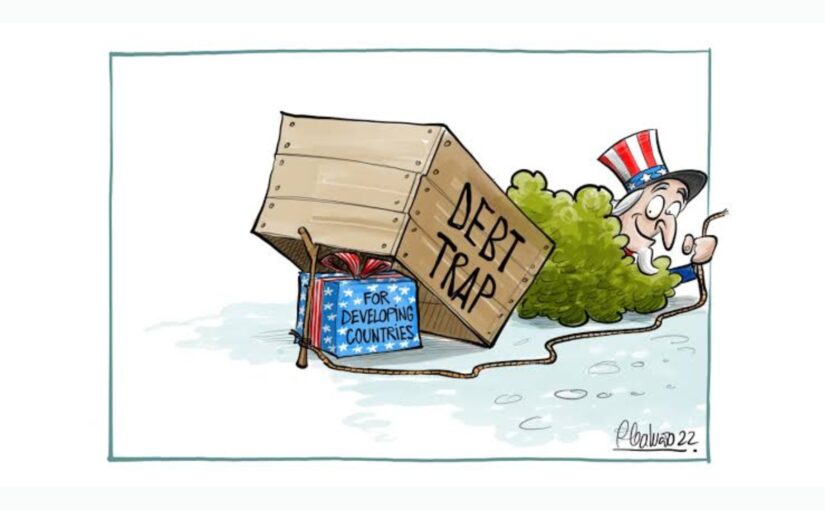
China is routinely accused of lending recklessly to poor countries, waiting for them to default, and then seizing strategic assets. A major new study of the Belt and Road Initiative finds the opposite: infrastructure construction is associated with falling debt risk, stronger state capacity and improved governance.
This video examines that research alongside the independent evidence. It revisits Hambantota – the Sri Lankan port that China supposedly “seized”, although Sri Lanka retained ownership and received 1.12 billion dollars for the lease – as well as the false claims concerning Entebbe airport and Mombasa port.
It also looks at how Chinese lending actually works – lower interest rates, longer maturities and grace periods, and none of the “structural adjustment” conditionality attached to IMF and World Bank programmes. And it asks the question largely absent from Western coverage: who actually receives the bulk of debt payments from lower-income countries, and what has the neoliberal debt system done to sovereignty, public services and development across the Global South?
Sources and further reading:
Mao Weizhun and Zeng Qingming, “Measuring the Political Effects of Belt and Road Infrastructure (2013–2023)”, Quarterly Journal of International Politics, vol. 11 no. 2, 2026, pp. 1–40 (in Chinese) – link
Nearly 200-country study shows China’s Belt and Road Initiative cuts debt and corruption (South China Morning Post)
Lee Jones and Shahar Hameiri, Debunking the Myth of “Debt-trap Diplomacy” (Chatham House)
Deborah Bräutigam and Meg Rithmire, “The Chinese ‘Debt Trap’ Is a Myth”
Rhodium Group, “New Data on the ‘Debt Trap’ Question”
Boston University Global Development Policy Center, China–Africa Lending in 2024: Concentration and Retooling
Debt Justice, “Debt payments to private lenders three times higher than to China”
Why Chinese “debt trap diplomacy” is a lie (Friends of Socialist China)
Transcript
Hello and welcome.
A new study of the Belt and Road Initiative has found that, far from driving participating countries into debt distress, Chinese-financed infrastructure actually tends to reduce their debt burden.
That cuts directly across one of the most successful anti-China narratives of the last decade — the claim that Beijing deliberately pushes poor countries into unsustainable debt, waits for them to default, and then takes control of their ports, their railways, their power stations and other strategic assets.
The phrase “debt-trap diplomacy” has been repeated by Western politicians, think tanks and media organisations so often that it’s now widely treated as a matter of record. But the specific claim is rarely even defined, never mind backed up with evidence.
The claim is not simply that Chinese banks have made loans that went wrong. Every large creditor has obviously done that. It’s not that some Belt and Road projects have been badly planned or overpriced or tainted by corruption. Some, of course, have. And it’s not that Chinese banks are charitable institutions unconcerned with getting their money back. They’re not.
But the debt-trap thesis makes a much more serious allegation: that China knowingly creates unpayable debts in order to seize assets or extract strategic concessions. If that’s true, there ought by now to be a visible pattern — of reckless lending, of engineered defaults, of confiscated infrastructure, of political submission.
But no such pattern can be found. And the Belt and Road has now been running for 13 years, with debt trap slanders circulating for pretty much the entire time.
The new study, by Mao Weizhun and Zeng Qingming of Nanjing University’s Centre for Asia-Pacific Development Studies, was published in July in the peer-reviewed journal Quarterly Journal of International Politics.
The researchers examined 197 countries and regions over the period between 2000 and 2023. Their data included 146 countries that had signed Belt and Road cooperation agreements and 135 in which projects had been launched or completed.
Importantly, they didn’t treat participation itself as a simple yes-or-no question. They distinguished between signing a cooperation agreement, starting construction, and actually bringing infrastructure into operation. This allowed them to examine what happened as countries moved through the different stages.
If the standard debt trap narrative were correct, then financial vulnerability should rise as the borrowing begins and the projects are built. But the researchers actually found the reverse. Signing a Belt and Road agreement had no significant effect on debt risk. Once construction was under way, the effect became negative — that is, debt reduced. And once the infrastructure was operating, it became strongly negative.
In other words, greater involvement in Belt and Road infrastructure was associated with lower debt burden. The study also found improvements in government effectiveness, political stability and control of corruption.
The mechanism for that is pretty straightforward. A railway, a port, a power station or a communications network is a productive asset. It can lower transport costs. It can overcome energy shortages. It can connect neglected regions to markets. It can attract investment. It can expand production. It can enlarge the tax base. And that strengthens a country’s capacity to service its debts from its own resources.
Borrowing to build productive capacity is not the same as borrowing simply to meet last year’s repayments. But much of the discussion of debt treats those two things as if they were identical.
This is of course just one study, by Chinese academics, published in a Chinese journal. But its findings are entirely consistent with a substantial body of research produced outside China — including by researchers who are highly critical of aspects of Chinese lending.
The expression “debt-trap diplomacy” was coined in 2017 by the Indian strategic analyst Brahma Chellaney. Washington immediately adopted it. In a major speech the following year, US vice-president Mike Pence said that Sri Lanka had been unable to repay the cost of Hambantota port and had therefore been pressured to deliver the port “directly into Chinese hands”.
And Hambantota became the central exhibit in the case against the Belt and Road. And it’s still invoked in order to describe China’s relations with the Global South as some sort of new form of colonialism.
The problem is that almost every important element of that story is false.
The Hambantota project was not conceived by China. Sri Lankan politicians had been promoting a deep-water port for decades, and Canadian firms, Danish firms had carried out feasibility studies. Sri Lanka sought foreign finance. China stepped in after other prospective lenders declined.
The project definitely had problems. Chatham House’s detailed study describes poor planning, inflated expectations and serious failures of governance on the Sri Lankan side. None of that, however, is evidence that China designed a trap.
Nor did Hambantota cause Sri Lanka’s debt crisis. By 2016, all Chinese loans combined accounted for around 9 percent of Sri Lanka’s government external debt. The Hambantota loans accounted for 4.8 percent. Sri Lanka’s much larger vulnerability arose from borrowing on international capital markets: short-maturity, high-interest sovereign bonds whose cost was shaped, actually, by decisions taken in Western financial centres.
Most importantly, China did not seize the port in exchange for cancelling the debt. In 2017, China Merchants Port Holdings paid Sri Lanka 1.12 billion dollars for a long-term lease. The Chinese loans remained on Sri Lanka’s books and continued to be repaid. The money from the lease was used to strengthen Sri Lanka’s foreign-exchange reserves and meet other obligations, including payments to Western creditors.
That’s not a debt-for-asset swap. Sri Lanka asked for an investor and was paid for a lease. It remained the legal owner of the port.
The accompanying claim that Hambantota became a Chinese naval base has fared no better. Security remains under Sri Lankan control. The country’s southern naval command is stationed there. US and Indian naval vessels have visited, and the port is subject to US Coast Guard inspections. There’s no record of China using Hambantota as some kind of military base.
Whether the port ultimately proves a commercial success is a separate question — although its traffic, its employment and its investment have actually grown substantially in recent years. The debt-trap argument doesn’t depend on the port being a poor investment. It depends on China having engineered Sri Lanka’s distress and confiscated the asset. Those things absolutely did not happen.
And we find the same pattern elsewhere. In 2021, reports spread around the world that Uganda was about to lose Entebbe International Airport to China. When AidData obtained the full contract, it found that the airport was not collateral and that China Eximbank had no legal basis to seize it.
Claims that Kenya had pledged Mombasa port as security for its Chinese-financed railway were also based on a complete and presumably deliberate misreading of the agreements. Researchers at the China Africa Research Initiative found that the ports authority was the railway’s principal customer, not collateral waiting to be seized.
The Rhodium Group examined 40 cases of Chinese debt renegotiation in 24 countries, covering around 50 billion dollars. It found that the normal outcomes were extensions, refinancing, deferment and debt forgiveness. Asset seizure was exceptionally rare. It also found that borrowers were often able to negotiate favourable outcomes.
So there are genuine problems in several Belt and Road countries, but there is no pattern of China creating those problems or leveraging them to confiscate strategic assets.
None of this makes the Belt and Road a charity, as I said at the outset. But the loans are generally made at interest rates substantially lower than their Western commercial equivalents, with longer maturities and grace periods, and with repayment schedules linked to the cash flow the project itself generates.
And Chinese lending doesn’t require governments to privatise public services, cut food and fuel subsidies, abolish capital controls, deregulate labour markets or open strategic sectors to foreign ownership. There’s none of the conditionality, the so-called “structural adjustment”, that’s been a feature of IMF and World Bank lending for decades.
Where is the real debt trap?
The World Bank’s International Debt Report 2025 found that low- and middle-income countries paid 741 billion dollars more in principal and interest between 2022 and 2024 than they received in new financing. It was the largest net outflow in more than half a century. Interest payments alone reached 415 billion dollars in 2024.
UN Trade and Development estimates that 3.4 billion people live in countries spending more on interest than on health or education.
China is a significant creditor and, in some countries, it’s a major one. But the latest Debt Justice UK calculations show that, across lower-income countries, 39 percent of external debt payments between 2020 and 2025 went to private lenders, 34 percent to multilateral institutions, 14 percent to governments other than China, and 13 percent to Chinese lenders.
The political fixation on the 13 percent diverts attention from the structure as a whole — and especially from Western banks, asset managers and bondholders charging high interest rates and imposing onerous conditions on their borrowers.
This is where the language of a trap is entirely appropriate. Many developing countries borrow in currencies they do not control. A rise in interest rates by the US Federal Reserve can send their borrowing costs and exchange rates into crisis, regardless of the policies they’ve chosen.
Falling commodity prices or a pandemic can destroy their export earnings. They then borrow again, not to build infrastructure or expand production, but to repay old debts.
When the crisis arrives, an IMF programme provides enough money to keep the creditors happy while the debtor country is instructed to cut public spending, remove subsidies, privatise assets and suppress domestic demand. Resources flow outwards; sovereignty contracts; poverty deepens; and the underlying dependence remains intact.
That system has operated across Africa, Latin America, Asia and the Caribbean for the entire neocolonial period. It’s resulted in the vast transfer of wealth from poor countries to rich ones while preventing the public investment required for sovereign development — which is the exact opposite of what Belt and Road finance does.
And that’s why so many governments of the Global South continue to seek Chinese cooperation. They’re not naïve victims incapable of understanding their own interests. In a lot of cases, China has been willing to finance projects that Western governments and private capital had rejected as insufficiently profitable.
Imperialism is not simply a large country trading with, investing in or lending to a smaller one. It’s a system of domination — the subordination of weaker economies to the strategic and economic needs of the imperial centre.
For centuries, the colonial and neocolonial powers have organised the economies of the Global South around extraction: minerals, crops and energy flowing outwards, manufactured goods and debt flowing in. Infrastructure was built where it served that pattern — from mine to port, not to integrate national economies or to meet social need.
The Belt and Road runs in the opposite direction. Power grids, transport networks, industrial parks and digital infrastructure can give countries the material basis to process their own resources, develop manufacturing, increase regional trade and reduce dependence on the old centres of capital — that is, to break out of underdevelopment.
And that’s why this new Nanjing study matters. Its finding is not that debt has ceased to be a problem, or that every Chinese project is inherently good. It’s that Belt and Road infrastructure is associated with stronger development capacity and lower debt risk — precisely the reverse of the relationship that’s alleged by the debt-trap narrative.
That narrative survives because it performs a political function. It projects the established practices of imperial finance onto China. It obscures the creditors actually extracting the greatest payments. And it presents the construction of productive capacity in the Global South as a threat.
There is a debt trap. It’s the global financial architecture that makes poor countries pay more to borrow, drains their budgets into the accounts of bondholders, and uses crisis to impose neoliberal restructuring.
The Belt and Road is not a trap. For all its limitations and its contradictions, it offers countries part of the material basis for escape from that trap.