
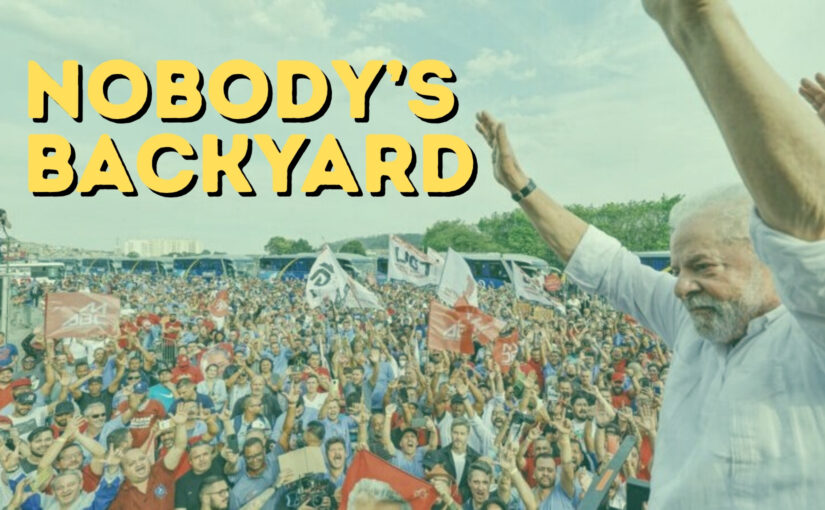
Brazil goes to the polls on 25 October in a presidential runoff between Luiz Inácio Lula da Silva and Flávio Bolsonaro, son of the jailed former president Jair Bolsonaro. In this contribution to an International Manifesto Group webinar on the Brazilian elections, Carlos Martinez argues that the outcome matters far beyond Brazil’s borders: the election is a front line in the struggle between a declining US-led imperialist system and a rising multipolar world.
The talk sets out the “Trump Corollary” to the Monroe Doctrine and Washington’s campaign of tariffs, sanctions, terrorist designations and alleged foreign financing against Lula’s Brazil; contrasts it with China’s partnership in trade, investment and industrial development; and looks at what a Bolsonaro government would mean for BRICS, for Palestine and Iran, and for the Global South.
Sources and further reading:
Carlos Martinez and Sara Vivacqua, “Brazil hangs in the balance” (Morning Star)
Carlos Martinez and Sara Vivacqua, “What is at stake in Brazil’s election” (Morning Star)
Tings Chak, “How Brazil’s election could reshape relations with China” (BreakThrough News)
The White House, National Security Strategy of the United States of America (2025)
China’s Policy Paper on Latin America and the Caribbean (Xinhua, full text)
Transcript
Other speakers know far more than I do about Brazil’s domestic dynamics, so I’ll focus on what this election means for the wider Latin American region, for China, for BRICS, and for this overall, historic struggle between a declining US-led imperialist system and a rising multipolar world.
It’s my view that, of all the elections in the Americas this year, this is the one whose outcome matters most to the Trump regime, which is why it has been so flagrantly interfering, as we’ve been hearing. And the election is of critical importance to the Global South as well, essentially for the same reasons: Brazil is currently on the front line in this war between imperialism and multipolarity.
The Donroe Doctrine
The US National Security Strategy, published last December, promises to “assert and enforce a ‘Trump Corollary’ to the Monroe Doctrine”, and to “reward and encourage the region’s governments, political parties, and movements broadly aligned with our principles and strategy”.
A few analysts interpreted this document as a sort of retreat into the US’s traditional backyard. But the criminal war on Iran, launched a couple of months later, in February this year, shows that the US is not retreating from anywhere. The document is about consolidating the Americas as a secure rear base for a long campaign against China, against Russia, against Iran, and against the peoples of the Global South more generally.
We’ve already seen what this ‘Trump Corollary’ looks like in reality. Venezuelan President Nicolás Maduro has been kidnapped, along with First Combatant Cilia Flores. The US is attempting to impose control over Venezuela’s abundant oil resources.
Cuba faces a genocidal energy siege.
In the last 18 months, seven right-wing or far-right candidates have won presidential elections in Latin America – and in several of those contests the US has exerted undue influence. A 20 billion dollar bailout for Milei in Argentina, with Trump warning that “if he loses, we are not going to be generous”. A pardon for a convicted cocaine trafficker two days before the Honduran vote.
Trump himself describes this new wave of right-wing – including quasi-fascist – governments as: “Lots of people that I got elected.”
Brazil, as we’ve been hearing, has faced a broad array of interference tactics. Fifty percent tariffs, explicitly tied to the release of Jair Bolsonaro. Magnitsky sanctions on the Supreme Court justice who convicted him. Brazilian gangs designated as terrorist organisations – quite obviously creating a potential pretext for military intervention. And serious questions about money reaching Flávio Bolsonaro’s campaign through Rockbridge, a network created in the orbit of JD Vance. Brazil’s own intelligence agency rates US pressure on this election at a “critical level”.
Why Brazil? Because it’s the largest economy in Latin America, because it’s a founder of BRICS, because it’s one of the few countries in the region to have refused to join Trump’s so-called Shield of the Americas. Brazil under Lula has rejected US unilateral sanctions on Russia, and has actively promoted a negotiated settlement to the war in Ukraine. It has firmly defended its sovereignty and independence in the face of US pressure. It has excellent relations with China. All in all, it is an indispensable component of the multipolar world that the US is trying to prevent – or trying to destroy.
The issue of China
Five days after the National Security Strategy was published, China published its own policy paper on Latin America, calling for the region to be a “Zone of Peace”, built on sovereignty and non-interference. So you’ve got two documents reflecting two profoundly different visions.
China has been Brazil’s largest trading partner since 2009. It buys more than a quarter of Brazil’s exports, and bilateral trade reached a record 171 billion dollars last year. The Chinese manufacturer BYD is now building electric vehicles at Camaçari, in Bahia, on the very site Ford abandoned in 2021.
So the economic cooperation between these two countries has been expanding rapidly, not only in quantity but in quality; not only in trade, but in investment, technology transfer and industrial development. In 2025, China and Brazil signed a strategic partnership on critical minerals, with China agreeing to invest 10 billion dollars in Brazil’s lithium and rare earth sectors. The two countries are also cooperating on satellites, fertilisers, artificial intelligence and other high-tech areas.
Contrast this with the way Washington treats Brazil, imposing massive – and politically motivated – tariffs on manufactured goods, but exempting primary commodities like coffee, beef, orange juice and oil. The US wants Brazil to remain a raw materials supplier, while China wants to help Brazil develop its own industrial capacity and move up the value chain.
Which is another way of saying that the US seeks to uphold the imperialist division of labour, while China seeks to help Brazil escape it.
The National Security Strategy is, to a considerable degree, aimed at disrupting China’s symbiotic relationship with the countries of Latin America. It openly states that the US “will reassert and enforce the Monroe Doctrine to restore American preeminence in the Western Hemisphere”, and will “deny non-Hemispheric competitors the ability to position forces… or to own or control strategically vital assets, in our Hemisphere.”
And there’s no question that a Flávio Bolsonaro government would enthusiastically fit into this framework. For example, at CPAC in March, Flávio offered Brazil – which holds nearly a quarter of the world’s rare earth reserves – as the “solution” to US dependence on China for critical minerals.
Now, the reality is that Brazil won’t simply be able to cut off China. Chinese trade and Chinese investment are far too important to Brazil’s economy, whether anyone likes it or not. But very likely a Bolsonaro government would slow down the economic relationship and put a stop to the shared political project of pursuing peace, development and multipolarity.
There’s an interesting historical parallel here. In 1961, Vice-President João Goulart became the first senior Latin American official to visit People’s China, meeting Mao Zedong. A month later he became President, and three years later he was overthrown in a US-backed coup that ushered in 21 years of dictatorship.
BRICS and Russia
And then there’s BRICS. Brazil is, of course, a founding member; it hosted last year’s summit in Rio; former President Dilma Rousseff heads the New Development Bank, headquartered in Shanghai.
We’ve already seen what Washington’s preferred approach to BRICS is: Milei simply cancelled Argentina’s entry into the bloc. Saudi Arabia – almost certainly under pressure from the United States – has refused to confirm its membership. A Bolsonaro government could well withdraw from BRICS, or play the role of a Trojan horse, or simply have an ongoing, low-level disruptive influence.
Certainly Flávio Bolsonaro would have no truck with the global project of ending dollar hegemony. In July, his campaign reportedly sent proposals to US trade officials to stop Brazil’s Pix payment system from linking up with non-Western networks.
Iran and Palestine
The contrast between Lula and Bolsonaro is particularly sharp when it comes to West Asia.
Lula had the courage to call Israel’s assault on Gaza by its proper name: genocide. He recalled Brazil’s ambassador from Tel Aviv. He has condemned the US–Israeli war on Iran as a violation of sovereignty and a violation of international law.
Flávio Bolsonaro, on the other hand, launched his candidacy in Israel. He’s pledged to move Brazil’s embassy to Jerusalem, and he’s been endorsed by Benjamin Netanyahu. He called Lula’s position on Iran “unacceptable”, and has signalled his support for that criminal war of aggression against Iran and against Lebanon.
And incidentally there’s a very clear pattern emerging here. Every one of the Trump-aligned leaders in Latin America – Milei in Argentina, Kast in Chile, Noboa in Ecuador, Asfura in Honduras, de la Espriella in Colombia, Bukele in El Salvador, Peña in Paraguay, Paz in Bolivia, Fujimori in Peru – is strongly pro-Israel. A Trumpist–Zionist bloc is being assembled across the continent. The coalition bombing Iran and arming the genocide in Gaza is the same coalition backing Bolsonaro.
What’s at stake
So what’s at stake on 25 October?
If Lula wins, a country of 214 million people will have shown that tariffs, sanctions, terrorist designations and foreign money can be faced down.
If Flávio wins, it will be a major advance for the Donroe Doctrine, and a heavy blow to BRICS, to Palestine and to the Amazon, in a context where Brazil’s multipolar orientation is essentially no longer acceptable to a US imperialism in crisis.
Capitalism in crisis has always reached into its political toolbox and pulled out fascism. That is what we’re seeing across Latin America today.
Our task is solidarity with Brazil’s working class, solidarity with Brazil’s oppressed communities, exposing US interference, and continuing the work of building a global united front against imperialism.
I’ll leave the last word to President Lula, speaking at the UN General Assembly last month: “Brazil does not belong in anyone’s backyard.”
Thank you.