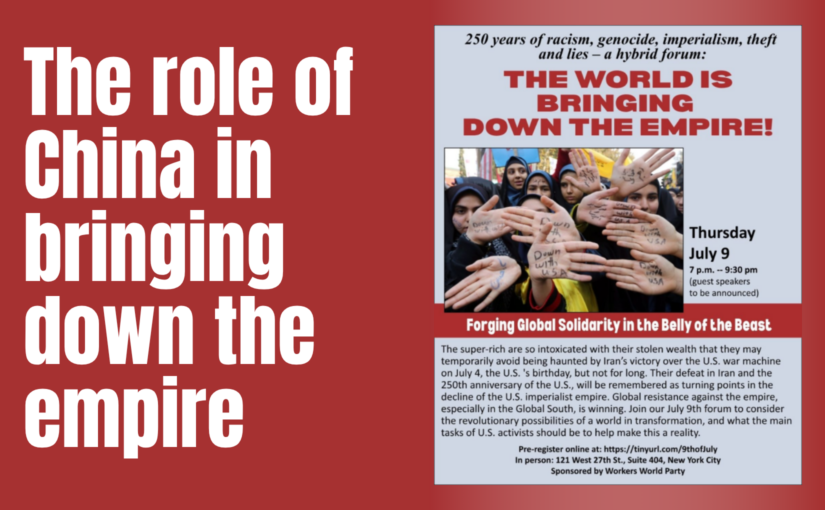
In the video embedded below, Carlos Martinez speaks on the role of China in the global project of bringing down the empire, at the Workers World Party hybrid forum “The World is Bringing Down the Empire!” (9 July 2026).
The single biggest factor in overcoming imperialism in the present epoch is the emergence of a multipolar world – and the single biggest factor in that process is the rise of People’s China. This talk traces how China’s role has evolved from the overt anti-imperialism of the 1950s, through the “hide your strength and bide your time” period of Reform and Opening Up, to the leading role it takes in world affairs today: the Belt and Road Initiative, the Community of Shared Future for Humanity, and the Global Development, Security, Civilisation and Governance Initiatives.
Along the way, Carlos addresses war and peace, China’s engagement with Africa, the recent war on Iran, and the argument – associated with Samir Amin – that a multipolar world provides the framework for the necessary overcoming of capitalism.
Transcript
Comrades, thank you very much for inviting me.
I’ve been asked to speak on the role of China in the global project of bringing down the empire. I want to start with a simple claim, which is that the single biggest factor in overcoming imperialism in the present historical epoch is the emergence of a multipolar world. And the single biggest factor in that process is the rise of People’s China.
So let me talk about what China’s role actually is, how it’s changed over the decades, and why it matters so much for everyone who wants to see a different world; a world of peace, equality, prosperity, friendship and solidarity.
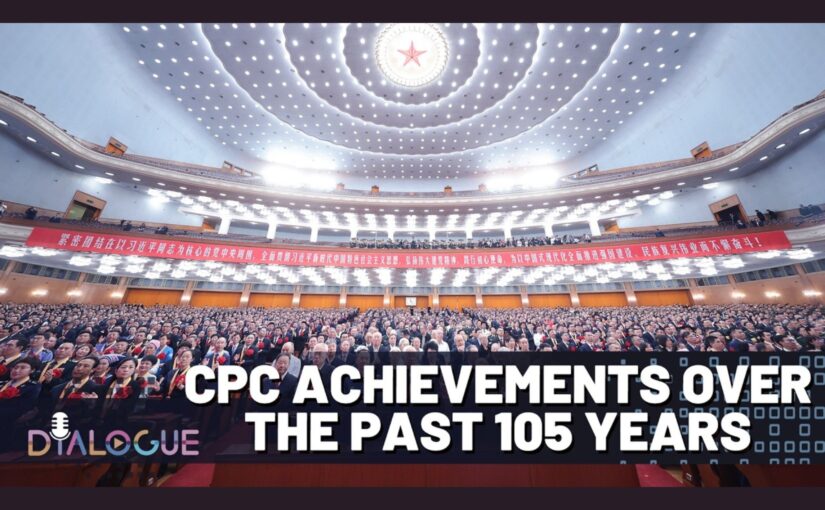
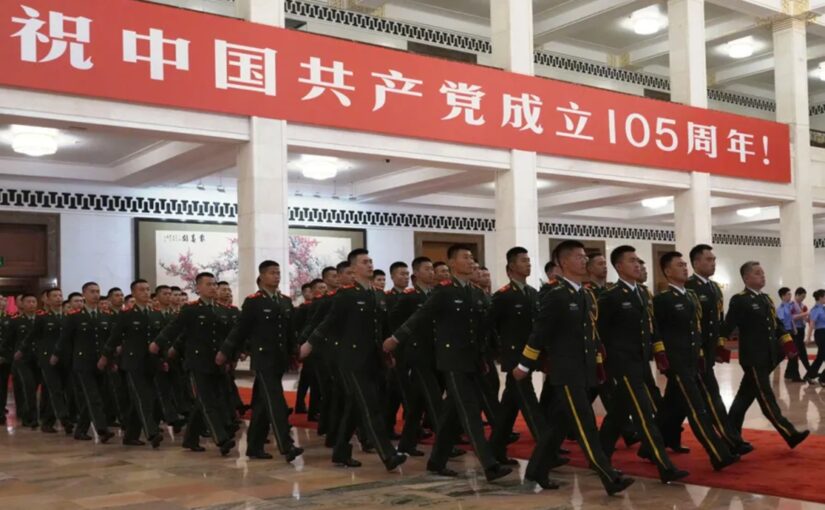
The following is a discussion from CGTN’s Dialogue programme marking the 105th anniversary of the founding of the Communist Party of China. Broadcast in the wake of Xi Jinping’s anniversary speech – in which he hailed the Party’s 105-year history as the “most magnificent epic” of the Chinese nation – it brings together Xia Lu, associate professor at the School of CPC History and Party Building at Renmin University of China; Carlos Martinez, co-editor of Friends of Socialist China; and Radhika Desai, convenor of the International Manifesto Group.
The panel discusses how to evaluate the CPC’s achievements and governing logic; the role of Marxism – seeking truth from facts, the mass line, and the Party’s capacity for self-renewal – in explaining its longevity and legitimacy; and the distinctiveness of Chinese modernisation. Radhika Desai argues that the Chinese revolution, following the Bolshevik revolution, set humanity on a path to socialism, and that amid a declining capitalism China has become an “ocean of stability”. Carlos Martinez stresses that China’s is a modernisation achieved without colonialism, slavery or war – shattering the Eurocentric assumption that to modernise is to Westernise. Xia Lu reads the Party’s six outstanding qualities through the lens of dialectical and historical materialism, and emphasises the mass line and the Party’s vigilance against detachment from the people.
This discussion was originally broadcast by CGTN’s Dialogue. The video and a transcript follow.
Transcript
Host: Hello and welcome to Dialogue. Addressing a gathering marking the 105th anniversary of the Communist Party of China, General Secretary of the CPC Central Committee Xi Jinping hailed the 105-year history of the Party as the “most magnificent epic” of the Chinese nation. He urged the Party to press ahead to build China into a modern socialist country on schedule. So how should we evaluate the Party’s achievements and governing logic over the past 105 years? What does the speech tell us about the Party’s discipline and capacity for self-renewal? And as China moves toward its long-term modernisation goals, what challenges lie ahead? Joining me today from Beijing are Xia Lu, associate professor from the School of CPC History and Party Building at Renmin University of China; Carlos Martinez, author of The East is Still Red: Chinese Socialism in the 21st Century and co-editor of Friends of Socialist China; and also Radhika Desai, convenor of the International Manifesto Group. Welcome to the show. Radhika, I’ll start with you: I’m sure you followed the speech, so I wonder what were your major takeaways?
Radhika Desai: Well, first of all, President Xi’s speech really grasps the fundamentals of the achievements of the Party. I would say that for this party to be more than a century old – 105 years old – while retaining its legitimacy among a billion-strong population, and having essentially transformed the people of China not only into an agent of their own history, giving the destiny of the people into the hands of the people of China, but into an agent of world history – that is a tremendous achievement. The second major event setting the world on a path to socialism after the Bolshevik revolution was the Chinese revolution. And the Bolshevik revolution is no longer; the Chinese revolution is still going. So it set humanity on a path to socialism, and it continues there – at this particular time in history when circumstances have become extremely dangerous, thanks to the decline of that very capitalism. In its decline, capitalism is unleashing chaos, destruction and economic disruption all over the world. In this context, the CPC not only holds great legitimacy among the people of China, but shows the way forward to the rest of the world, and has become a beacon, an oasis of stability, and a visionary path to the future.
Host: Carlos, President Xi said the Party’s endeavours over the past 105 years have fundamentally transformed the future of the Chinese people – as Radhika said, blazed the right path toward the rejuvenation of the Chinese nation, demonstrated the strong vitality of Marxism, had a profound influence on the course of world history, and made the CPC a powerful communist party. What do you make of such a statement?
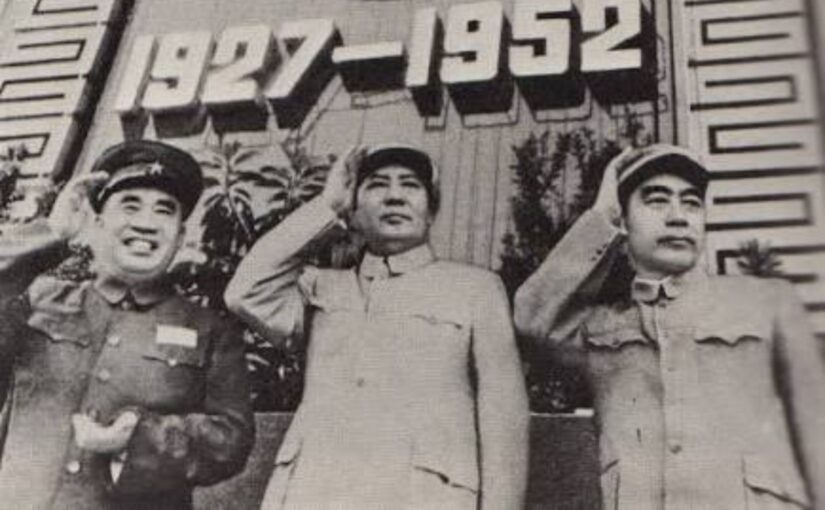
The following article by Carlos Martinez marks the 50th anniversary of the death of Zhu De – founder of the People’s Liberation Army and, with Mao Zedong, one of the leading architects of the Chinese Revolution’s victory.
Drawing on the classic accounts of Agnes Smedley, Edgar Snow and Evans Carlson, it traces Zhu De’s journey from a tenant’s hut in Sichuan, through to the founding of the Red Army and the rostrum at Tiananmen Square – and asks what his life still teaches, half a century on.
Fifty years ago, on 6 July 1976, Zhu De died in Beijing at the age of 89. It was a year of terrible losses for the Chinese people: Zhou Enlai had died in January; Mao Zedong would follow in September. Of the three, Zhu De is the least remembered in the West – and yet the army he built, the People’s Liberation Army, remains the guarantor of everything the Chinese Revolution has achieved, and his life traces the arc of that revolution more completely than almost any other.
Red Virtue: origins in Sichuan
Zhu De was born in December 1886 into a tenant family in Yilong county, Sichuan, on an estate whose landlord was known locally as the “King of Hell”. By what Edgar Snow called “a strange accident of language”, the two characters of his name mean “Red Virtue” – a fact his parents could hardly have foreseen, “or they would surely have changed it in terror”.
His mother bore 13 children; the last five were drowned at birth because the family could not feed them. She herself, he recalled, “was so humble that she had no name of her own”. The clan pooled its resources to educate a single son who could talk back to the tax collectors – and so Zhu De, almost by accident, became literate, passed through the old examination system in its dying days, and entered the Yunnan Military Academy, where he joined Sun Yat-sen’s revolutionary Tongmenghui (a radical secret society and precursor to the Kuomintang) and took part in the 1911 Revolution and the campaigns that destroyed Yuan Shikai’s attempted monarchy.
The hardest battle
By his mid-thirties Zhu De was a general in the warlord armies of the south-west: wealthy, decorated, and addicted to opium. The 1911 Revolution, he concluded, had been “aborted by republican compromise with foreign imperialism”; warlordism was a dead end, and he was part of it. So he walked away. He gave up his commands and his fortune, and broke his opium addiction alone – pacing the deck of a Yangtze steamer for a month, in what Snow called “the hardest battle of his life”, proof that “this man had more steel in his will than his acquaintances supposed”.
Then he asked to join the infant Communist Party. His reasoning was characteristically direct: if the foreign imperialists attacked this party with everything ugly in their vocabulary, “it was the party for Chu Teh” (Chu Teh being the older Western spelling of his name). Rejected in Shanghai by then CPC General Secretary Chen Duxiu – who could not believe a former warlord general capable of becoming a communist – he sailed for Europe, and in Berlin in late 1922 presented himself to a student organiser more than ten years his junior named Zhou Enlai. His old life, he said, “had turned to ashes beneath his feet”. He was admitted to the party he would serve for the remaining 54 years of his life.
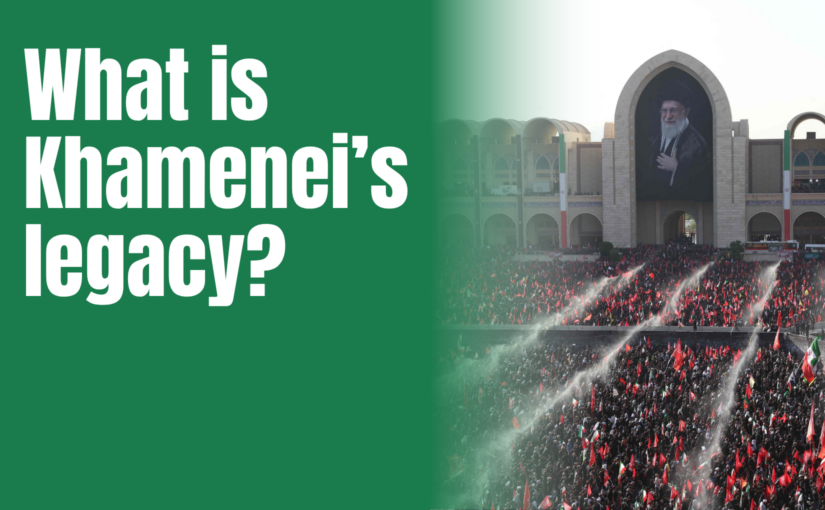
This week, millions of Iranians are filling the streets of Tehran, Qom and Mashhad for the funeral of Seyyed Ali Khamenei, assassinated by the US and Israel on 28 February along with members of his family. Delegations from around a hundred countries have come to pay their respects; not one Western leader is among them.
In this video, Carlos Martinez asks who Ali Khamenei actually was, and why the most powerful country on earth considered him so dangerous: his lifelong defence of Iranian sovereignty after a century of foreign domination; his unmatched support for the Palestinian struggle; the social transformation of Iran under sanctions; his orientation towards the multipolar world; and the austere scholar behind the Western caricature – the man Nelson Mandela called “my leader”.
Transcript
This week, millions of people – the authorities actually expect more than ten million by the end of the week – are filling the streets of Tehran, Qom and Mashhad for the funeral of Seyyed Ali Khamenei, who was assassinated by the US and Israel on the 28th of February, together with several members of his family – including his 14-month-old granddaughter.
The funeral had to be delayed for four months, because the country was under bombardment. And now that the ceasefire is holding – for the moment – the Iranian people are finally able to bury their leader. Delegations from around a hundred countries have come to pay their respects. Not a single Western leader is among them.
So in this video I want to ask a simple question: who was Ali Khamenei, and why are millions of people mourning him? Why did Nelson Mandela call him “my leader”? And why did the most powerful country on earth consider this eighty-six-year-old cleric, poet and scholar so dangerous that it carried out an extrajudicial assassination of him and his family?
Donald Trump called Khamenei “one of the most evil people in history” – this from a war criminal and close personal friend of Jeffrey Epstein, so make of that what you will. The BBC and CNN will tell you he was a dictator, a fanatic, a tyrant. What they don’t do is explain why his coffin is now surrounded by one of the largest crowds of mourners in human history.
Khamenei’s legacy is deeply entwined with the history of Iran, and the project of defending Iran’s sovereignty.
For most of the last century and a half, Iran was not allowed to govern itself. In 1907, Britain and Tsarist Russia simply divided the country between them into “spheres of influence” – without consulting a single Iranian.
In 1953, when the elected prime minister, Mohammad Mossadegh, committed the unforgivable crime of nationalising Iran’s oil, the CIA and MI6 organised a coup, overthrew him, and installed the Shah as a dependable guardian of Western energy interests. For the next quarter of a century, Iran’s oil flowed west, and the Shah’s secret police tortured anyone who objected.
One of the people they tortured, incidentally, was a young cleric named Ali Khamenei, who was imprisoned six times under the Shah’s dictatorship.
The Revolution of 1979 ended Iran’s century of humiliation. And whatever else you want to say about the Islamic Republic, it has stuck firmly to its promise of asserting its sovereignty. The Revolution ensured that Iran would never again be anyone’s client state.
Khamenei embodied that principle for over forty years – as president from 1981, and as Supreme Leader from 1989.
In February this year, when the bombs started falling on Tehran and his advisers begged him to move to a secure location, he refused. He said that since millions of ordinary people in Tehran had nowhere to go, he was staying put. He was in his own home, not a bunker, observing Ramadan, and that’s where he was killed.
On 1 July the Communist Party of China turned 105; three days later, on 4 July, the United States turned 250. In this article, Carlos Martinez asks what these two political projects – born of two very different revolutions – have contributed to the world.
This week features two anniversaries that, taken together, tell much of the story of our age. On 1 July, the Communist Party of China marked 105 years since its founding. On 4 July, the United States celebrates 250 years since the Declaration of Independence. The two milestones invite a comparison: what have these two political projects contributed to the world?
War and peace
The US was born in a revolution against empire and has spent much of its life building one. By one widely cited reckoning, the US has been at war for over 90 percent of its history – from the wars of continental conquest to Korea, Vietnam, Iraq, Afghanistan, Libya and Iran. It maintains around 800 military bases in 80 countries and spends over a trillion dollars a year on its armed forces.
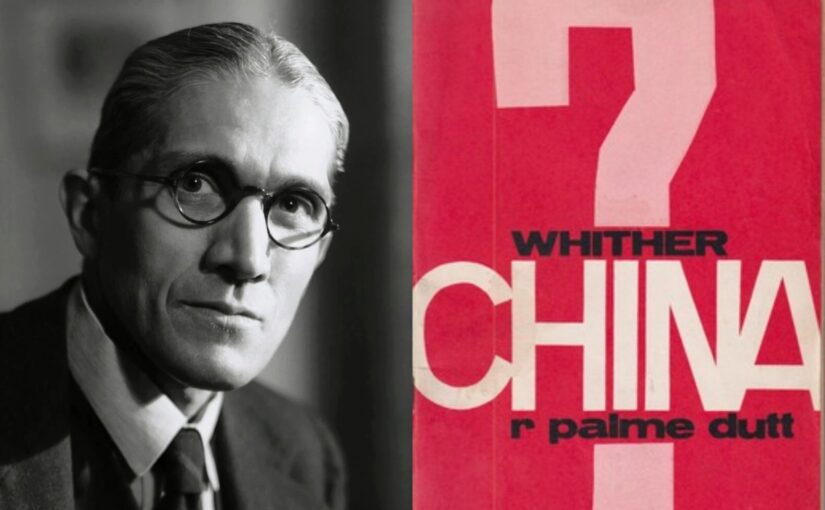
To mark the 130th anniversary of the birth of Rajani Palme Dutt – theoretician, organiser and, for half a century, one of the foremost Marxist minds in the British movement – Carlos Martinez asks what he would have made of contemporary China, testing his 1967 pamphlet Whither China? against the verdict of history.
This lecture was delivered on 27 June 2026 at the R. Palme Dutt Memorial Lecture 2026 at SOAS University of London, organised by the Students’ Federation of India UK and the Young Communist League.
Comrades and friends. Thank you to the Students’ Federation of India UK and the Young Communist League for organising this event, and for asking me to speak.
We gather to mark the 130th anniversary of the birth of Rajani Palme Dutt – theoretician, organiser, anti-imperialist, and for half a century one of the foremost Marxist minds in the British movement. A man whose very name – the Bengali ‘Rajani’ and ‘Dutt’ alongside the Swedish ‘Palme’ – embodied the internationalism he preached and practised.
I want to use my time to ask a particular question. Palme Dutt died in 1974. He did not live to see China’s reform and opening up, the collapse of the Soviet Union, China’s rise to becoming the second-largest economy on earth, or the New Cold War now being waged against the People’s Republic. So: what would Rajani Palme Dutt have made of contemporary China?
It might seem a strange or pointless question to pose. The most substantial thing Palme Dutt wrote about China was his 1967 pamphlet Whither China? – which is, on its surface, a sharp polemic against the Chinese leadership, written at the height of the Sino-Soviet split, a year into the Cultural Revolution.
Palme Dutt was of course very much on the Soviet side in that split. Nonetheless, his pamphlet was not a simple repetition of the Soviet line, but a careful and serious analysis from a fundamentally comradely perspective.
So the question is posed not as a parlour game, but as a way of asking what a great Marxist of the past would make of the present; of testing his analysis against the reality of history; and of separating enduring principles from contingent positions.
A pamphlet of its moment
The Sino-Soviet split was, of course, one of the greatest setbacks our global movement has ever suffered, and reading Palme Dutt’s pamphlet, you feel the weight of it on every page. He is clearly shocked and deeply saddened by the bitterness of the situation.
And with the hindsight of six decades, we can recognise that both sides were at fault and went too far. As Deng Xiaoping put it to Gorbachev in 1989, when the two parties finally normalised relations again, “there was a lot of empty talk on both sides”. Deng’s verdict – “we no longer think that everything we said at that time was right” – could stand as an epitaph for the whole dispute.
So let me look at the substance of a few elements of Palme Dutt’s critique, and subject it to the test of history.