
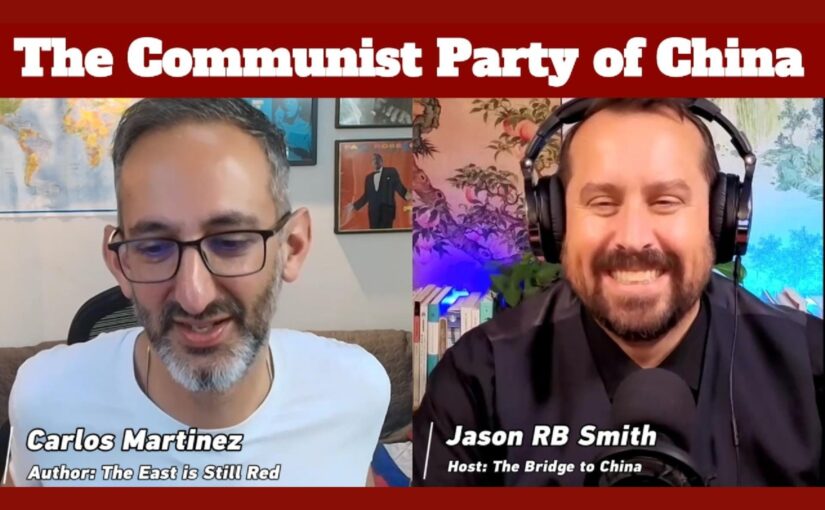
Carlos Martinez speaks to Jason Smith on The Bridge to China Podcast about the Communist Party of China’s anti-corruption drive and its capacity for self-revolution; why socialism with Chinese characteristics is still socialism; what China’s poverty alleviation campaign actually achieved; why so much of the Western left remains sceptical of China; and how China is helping the Global South break the chains of underdevelopment.
Carlos argues that the anti-corruption campaign is, above all, a campaign to prevent capital from buying political power – “the dividing line between a socialist and a capitalist state” – and that in China, “billionaires answer to the state, not the other way around”.
The interview was first published on The Bridge to China Podcast. Carlos’s new book, co-edited with Keith Bennett, is China’s Foreign Policy and the Making of a Multipolar World (Praxis Press).
Transcript
Jason Smith: In The East Is Still Red, you argue that the party’s priorities – living standards, poverty reduction, territorial integrity, environmental protection – line up with the will of the people, to use an old term. How do you see that relationship working in practice?
Carlos Martinez: Right. I think the core political point is around China’s political system, its system of democracy – which probably sounds strange to Westerners, because we’ve been told for so long that China isn’t a democracy, that it’s an authoritarian state, that it’s a dictatorship, et cetera, et cetera. But the main thing to understand about China as a state, as a political entity, is that the working class and its allies – the peasantry, the intellectuals and the patriotic elements of the capitalist class – constitute the ruling class. And they’ve got a system that brings them democracy. It’s very different to the West. It’s very different to what we in the West think of as democracy, which is basically the Westminster parliamentary system – which essentially comes down to what Marx referred to as working people getting to choose every four or five years which class enemy misrepresents them in Parliament.
The Chinese have what they call whole-process people’s democracy, which involves the ongoing, everyday participation of ordinary people in decision-making. That happens via the people’s congresses, at five levels – the national level, the provincial level, the city level, the town level, the village level – and the consultative committees, local congresses, village committees and so on. And all of this adds up to what I would say is an elaboration or formalisation of what was the CPC’s policy during the Mao Zedong period and the early revolutionary period: the mass line. You go to the people, understand their concerns, come back from the people, synthesise those concerns with Marxism, with Chinese traditional thought, and then take that back to the people. And the result is a system of priorities that I think still – after 105 years of the Communist Party of China, after 77 years of the People’s Republic of China – continues to meet people’s aspirations and priorities in the short term and the long term.
You can compare that with the West. In the United States, Pete Hegseth, Secretary of War, has recently announced that the next US budget is going to be 1.5 trillion dollars. So that’s what the West is prioritising. Britain, all the countries of the European Union, or nearly all of them, have agreed to Trump’s target that they reach 5 percent of GDP on defence spending, which is an unbelievable quantity of money. If you think in terms of percentage of fiscal revenue – of the money that the government has actually got to spend on things – it’s probably more like 25 or 30 percent. So we’re talking about diverting incredible resources into the military-industrial complex, into the merchandise of death and destruction. What a waste, in basic humanist terms. What a ridiculous waste.
So what’s prioritised in China? Poverty alleviation is prioritised. Improving people’s living standards is prioritised. Green energy is prioritised. Infrastructure development is prioritised – rolling infrastructure out across the whole country, across the centre of the country, across the west of the country, the traditionally less developed parts of the country. So it’s a democratic system based on the power of the working class and its allies that produces results which are far more consistent with the will of the people than what we have in the West.
Jason Smith: Sometimes when I’m online and I’m sharing stories of China’s poverty alleviation with Western people, they like to say that it’s propaganda. So what does your personal experience of travelling in China tell you about how the party organised that work, and who benefited? Did they eliminate poverty?
Carlos Martinez: Well, if poverty alleviation is propaganda, then frankly I wish the West would engage in more of that propaganda. I live in North London. I can walk outside my apartment and within a few seconds I’ll see someone living on the street. I’ll come across someone begging. I will see massive inequality. I will see desperate poverty in the course of my ordinary day. Unprecedented levels of unemployment; millions of people living from food banks; millions of people unemployed or underemployed or in very precarious work and experiencing very precarious living conditions. And the winter’s coming, and you’re going to have millions of pensioners, older people aged 70, 75 and up, who are literally having to choose between heating and eating every day for the next six months. So please, British government, let’s have some of this anti-poverty propaganda.
Now, my own experience of poverty alleviation in China is relatively limited. I’ve only been to a few places. I went to China for the first time in 2019. But what I can say is that what I’ve witnessed is a surprisingly high standard of living – for someone who lives in the West and goes to countries of the Global South. You go with certain expectations of what you’re going to see. I’ve been to India before; I’ve been to various countries in Asia and Africa, and that frames my expectations when I go to another country of the Global South. And China completely bucks those expectations. You go to Beijing, you go to Shanghai, you go to Guangzhou, you go to Xi’an, et cetera, and you don’t see homelessness. You don’t see people living on the streets. You don’t see people begging on the streets. You see extremely clean and well-maintained streets. You see parks everywhere, extremely well used – young people, older people playing, singing, dancing, doing tai chi, et cetera. And obviously there’s substantial inequality, and people experience very different levels of living standards, but on the surface at least, from what you can see, everyone experiences a basically dignified, reasonable standard of life.
Aside from the big cities, I’ve also been to some smaller cities, some villages – places like Jiayuguan and Dunhuang, Guiyang, Zunyi in Guizhou. And these are thriving smaller cities with really impressive infrastructure, lovely-looking schools, great hospitals, et cetera. I went to Dunhuang for the first time in 2020, and that was the first place I’d been in my life where they had a fully electric bus fleet. So on all of those sorts of things – public transport, green energy, electric vehicles, electric transport – China’s so far ahead of the West, even in small towns and villages.
As for what the record shows on poverty alleviation in China, I think hopefully most of that is reasonably well known by now: the World Bank figure of 800 million people lifted out of poverty since the 1980s, and the targeted poverty alleviation campaign since 2013, whereby they’ve actually eliminated absolute poverty. So in a country of 1.4 billion people, you’ve got no people below that level of extreme absolute poverty. In monetary terms that maybe doesn’t seem like much – you’re above that $2.10 a day, or whatever it is, of cash income, and $2.10 doesn’t get you much. But what comes with it is what they call the seven guarantees, which means that aside from your level of cash you’ve also got guaranteed housing – a roof over your head; guaranteed clothing – clothes on your back; guaranteed decent, dignified food; electricity piped into your home; water piped into your home; your children go to school for a minimum of ten years – mandatory, free, universal education; and if you get sick, you see a doctor. You’ve got access to healthcare. So on that basis, if you’re out of extreme poverty in China, in most places of the world you’d be doing pretty well.
And what that doesn’t capture is that you very likely – a 90 to 95 percent chance – own your own home. You are 100 percent not in intergenerational debt bondage, like your counterparts might be in India or Pakistan or many, many other places in Asia or Latin America. If you’re in the countryside, if you’re a rural worker, you have your own plot of land. So even if you’re in relative poverty, compared to your counterparts nearly everywhere else in the Global South, you’re doing very well. You’ll probably be classified as middle class if you’re in Bangladesh, et cetera.
And the other very interesting thing in relation to poverty alleviation that a lot of the time people don’t talk about – and it relates to your first question about priorities – is the level of priority this project has received, the incredible commitment of the government and of the Communist Party. Three million cadres, over the course of eight or nine years, were deployed to the countryside to work with villagers, with families, with individuals, with communities at a very concrete level, to figure out their problems, figure out what factors were keeping them in poverty, and figure out customised and sustainable solutions, so that they were lifted sustainably out of poverty – so that they went above that line and stayed above that line. And that’s an ongoing commitment. You still have people working at the village level to ensure that communities and families don’t fall back into poverty. And that could be fixing roofs on schools; it could be connecting farms to online digital markets on the eastern seaboard, et cetera. There’s a million different solutions to a million different problems. But it represented the most unbelievable level of commitment to meeting the needs of the poorest people in society. And if we could achieve that in the West, well, that would be a great day.
Jason Smith: Yeah. If we look at the exact poverty standard according to the World Bank, in the United States we have 1.25 percent of the population living below that poverty line – not the US poverty line, which is much higher, but the official international poverty line. And it’s close to zero in China, and I wish the United States would learn. Obviously a lot of people are hoping that the rest of the Global South – the underdeveloped world, or the over-exploited world, as Parenti called it – would learn from China’s example, but I think the developed West can also learn from some of the programmes and strategies that China deployed.
But I’ve also noticed there’s a change in the online zeitgeist. Over the last five years, people have gone from “China’s really poor” to accepting that that’s not really the case anymore, to now arguing: is China capitalist, or is it socialist, or is it communist? And you’ve said that socialism with Chinese characteristics is still socialism. What makes you say that?
Carlos Martinez: Well, for one thing, if it’s capitalism, you have to explain how it’s achieved all the things that other capitalist countries haven’t achieved. India is a capitalist country. Pakistan is a capitalist country. China is surrounded by capitalist countries. And you’ve got countries like India, which achieved their liberation at a very similar time to China, that are the same size in terms of population, and that were back in the late 1940s at a very similar level of development. India has made impressive progress in many ways, don’t get me wrong, but it doesn’t compare with where China’s reached. China’s life expectancy is 79 now, touching 80. It’s part of the 15th Five-Year Plan that average life expectancy will get to 80, which is going to put it in a very exclusive club, and it’s really quite incredible for a population of 1.4 billion. Its GDP per capita is around $13,000, and its literacy rate is essentially 100 percent. By comparison, India’s life expectancy is in the high 60s, its per capita GDP is more like $3,000, its literacy rate is under 80 percent, and it still has hundreds of millions of people who live in extreme poverty, whose children don’t go to school. Either they live in desperately poor conditions in the countryside, in intergenerational debt bondage, or they’re living in peri-urban slums on the outskirts of Mumbai, on the outskirts of Delhi, et cetera.
So why has China been able to achieve the things that it has achieved, and India hasn’t? For that matter, why has China been able to basically end homelessness and Britain hasn’t? Why is China the world leader in green energy and electric vehicles and the United States isn’t? Why has China got great infrastructure throughout the whole country, while it would take me probably four hours to get to Manchester – which is maybe the same distance as you going from Beijing to Tianjin? There’s no way of explaining that if China’s just another capitalist country – a country where the class of people that own and deploy capital is the ruling class.
And furthermore, people sort of object to this idea of China as a socialist country by saying: okay, the working class is the ruling class, but what does that actually mean if you’re someone who’s working in a factory? Well, I think it means a couple of things. In the short term, it means that your life is getting better. You can see over the years, and over the course of decades and generations, that life is getting better for ordinary working-class people. That means wages are going up, working conditions are improving, your social security coverage is expanding, your health insurance is expanding, your children are going to school for longer and getting a better education. The higher-education enrolment rate in China is extremely high – 60–70 percent, far higher than it is even in Britain. You can get medical treatment without going bankrupt. You’ve got trade union representation. And this is something people don’t realise: union membership covers 75 to 80 percent of workers in China, whereas in the US it’s barely touching 10 percent. The All-China Federation of Trade Unions’ penetration rate is among the highest in the world. So if you’ve got a problem with your boss, if you’re not getting paid enough, or you’re getting exploited, or you’ve got issues with your working conditions, you’ve got an organisation that will engage in collective bargaining on behalf of you and your comrades. You most probably own your own home, which is not something that working-class people can say in most capitalist countries. If you’re in a rural household, your home belongs to you. You’ve got access to clean water, to electricity, to the internet, to public transport. So these are lots of things that are quite enviable, certainly for working-class people in the Global South. And as I say, it’s all on a positive trajectory. It’s all going in the right direction. Whereas in most of the rest of the world, wages and conditions are going down in real terms. The working class in Britain, the working class in the United States, earn less than their forefathers did 50 years ago.
In the long term, what does it mean to be a member of the working class or the peasantry in a socialist country rather than a capitalist country? Well, you’re part of an epoch-defining and revolutionary process. You’re contributing to the building of socialism, which in historic terms is still a pretty novel and interesting project. You’re in the vanguard of figuring out what an advanced socialism of the future is going to look like. At a national level, you’re contributing to the process of Chinese modernisation, to the project of what they call the great rejuvenation of the Chinese nation. And at a global level, you’re contributing to – hopefully – the construction of a better, more peaceful, more equal, more prosperous and sustainable world. So I think there is a substantial difference between being a worker under socialism and being a worker under capitalism.
Jason Smith: Another issue is governance and corruption. There are a lot of charts that come out of Western think tanks and institutions that say China is a very corrupt government. But this is what I see. In the United States, the Epstein files come out; not one client on that list is prosecuted, and we know a lot of them are related to the political class. We have lobbying, which pays off our politicians to write laws in favour of the wealthiest people. And then we have wealthy oligarchs deciding what candidates are available at the state level, at the local level, at the national level. So we have the richest people in the United States determining how our government operates. That looks like corruption to me. I don’t know how it is in Great Britain, but when I look at China’s system, I don’t see corruption. I see a political class that is above the capitalist class, and punishes the capitalist class when it goes awry. Like the Evergrande CEO, who is now serving life imprisonment for his deceitful figures, which hid tens of billions of dollars from the public and invented tens of billions of dollars that his company wasn’t actually making. So in your opinion, when you look at the anti-corruption drive that has taken place since 2012–2013, how is it that the Communist Party of China has made rooting out graft a central priority, and what does that mean?
Carlos Martinez: I mean, the scale of this anti-corruption drive over the course of the last 15 years or so is really something to behold. Last year alone, there were over a million corruption cases opened, and nearly a million people punished. You had over 100 provincial- or ministerial-level officials investigated. And since 2012 you’ve had over 7 million people disciplined. And it reaches the very top: we’re talking about former Politburo members, top generals, financial regulators. Xi Jinping often talks about tigers and flies – the biggest and the strongest, and the smallest and the weakest. And actually, in terms of what matters to ordinary people living their everyday lives, the flies matter a lot. Last year you had nearly 150,000 township-level officials investigated.
I remember when I first came to China in 2019, speaking to a friend in Beijing who was born and raised there. He said that a few years previously he’d started to really worry about levels of corruption. It had got to a point where it was just so frustrating in the course of daily routine existence. If the boiler stopped working in your apartment, you’d have to bribe someone to get it fixed – things like that, just annoying things, where people were enriching themselves even in a very small-scale way and costing you time and costing you money. And the unfairness of it all was really impacting people’s confidence in the system as a whole. So he was quite concerned for China’s future.
So I think the CPC, and especially Xi Jinping and his administration, really understood this problem and decided to tackle it in an absolutely comprehensive and systematic way. Xi Jinping said right back in 2012 that corruption could doom the party and the state. At that time it was in danger of becoming uncontrollable. And it’s kind of inevitable that some level of corruption is going to appear in a market system, even if it’s a market socialist system. This is a side effect of the rapid growth of the market reforms that took place, particularly during the Jiang Zemin era, where there was incredibly rapid growth – well over 10 percent per year on average for those ten or so years. And at the end of that period, people were by and large living an awful lot better than they were at the beginning. So I don’t say we should just throw away all of that GDP growth and the increase in wealth, in cash income, in the commodities that people had available to them. However, it did come with some side effects. And controlling those side effects – controlling the uncontrolled expansion of capital, controlling corruption – was a basic demand of the people. It was consistently one of people’s top concerns. And the anti-corruption campaign was, and remains, hugely popular.
And I think there’s an element of learning the lessons of the Soviet Union as well. The CPC has made a very serious, very detailed, ongoing study of the collapse of the Soviet Union. And one of those lessons is that you had this fusion of money and power within the Communist Party of the Soviet Union. Officials became a sort of privileged layer with their own interests, and then they cashed in when the Soviet Union collapsed in 1991. But above all, this is a campaign about preventing capital from buying political power – preventing this correlation between money and power, which is essentially the dividing line between a socialist and a capitalist state. So in that sense the anti-corruption campaign is very much a socialist and anti-capitalist campaign.
And what does it tell us about the system? It tells us that the party is capable of – in fact, is very good at – self-revolution: disciplining itself, constantly reforming. And this is something that goes back to the very beginnings of the history of the CPC. It tells us there’s a highly capable, highly mobilised state apparatus able to tackle problems at an incredible scale. And it’s also interesting that this anti-corruption drive has become an institutionalised process. It’s like the reform process in China, which kicks off in 1978 and has now been in place for coming up to 50 years. Similarly, the anti-corruption campaign is a never-ending process. If you’re not vigilant about it, corruption will re-emerge. So it’s institutionalised, it’s not one-off, it’s continually evolving – for example, the eight-point regulation on frugality among leaders, the National Supervisory Commission that was introduced a few years ago, and so on. And all of this just reminds us that in China billionaires answer to the state – not the other way around, as is the case in the United States, as is the case in Britain.
Jason Smith: I actually wanted to ask you specifically about Britain, because obviously you must have a lot of personal experience there. How would you compare how Britain deals with political corruption and how the CPC deals with political corruption?
Carlos Martinez: Well, as you’ve alluded to a bit earlier, a lot of what China calls corruption is, in the West – in Britain, in the US – perfectly legal. It’s a regular part of everyday life. This correlation between wealth and power is normal. That’s how capitalism works. That’s how the West works. In Britain it’s not as bad yet as in the US, although that’s the direction things are going. But in the US you’ve got unlimited corporate money in elections; lobbying reaching, I think, over four billion dollars a year. And we’ve increasingly got it here in Britain now as well: the revolving door between big business and government; politicians trading stocks, et cetera. The whole system is essentially legalised bribery. And when scandals do break, you might have a resignation here and there, an inquiry here and there, a legal settlement or an out-of-court settlement here and there. But rarely do you get prosecution of powerful people. You’ve just got a certain amount of making a show.
Famously, it’s very dangerous to be a billionaire in China. Your chances of getting investigated, incarcerated, put on death row in China are orders of magnitude higher if you’re a billionaire. But very wealthy people in the West are basically untouchable. They can buy politicians, they can buy journalists, they can buy the courts. In China, they’re subject to the laws of a socialist state. A good number of the people who receive the death penalty in China are unbelievably rich people who made their wealth through corruption, which means at the expense of ordinary people. Who’s on death row in the United States? It’s people like Mumia Abu-Jamal, who spent nearly 30 years on death row – a political prisoner, a freedom fighter. It’s poor people, it’s Black people, it’s Indigenous people.
And you brought up the example of Jeffrey Epstein. Here you’ve got an international, massively widespread campaign of flagrant corruption, extortion, bribery, political favours, human trafficking, sexual slavery and so on. Everyone knew this was happening. And furthermore, it’s increasingly clear that it was coordinated with intelligence services, including the Israeli intelligence services, and has been used for purposes of compromise, et cetera. Epstein was protected by the system. He was untouchable. He was close friends, close colleagues with some of the most powerful people in the world, including the president of the United States. People knew about this for decades. And finally someone blows the whistle – but, as you said, who’s been brought to justice as a result of this whole campaign and the release of the Epstein files over the course of many months?
So in terms of the key differences between the West and China in dealing with corruption: in the West, corruption is structural. Money buys policy. It’s not a matter of a few bad apples. It’s a matter of the capitalist class being the ruling class and owning the political process. In China, corruption is treated as an existential threat to the system, and the system therefore mobilises against it. Which is not to say that China has solved it once and for all. As Xi Jinping says, the fight is always on the road. But you’ve got a direction of travel which is completely different to the direction of travel in the West.
Jason Smith: I assume your outlook is like mine: it’s not about praising China – that’s kind of a dead end. It’s about looking at China’s example and hoping that there are lessons there for our home countries, for other countries around the world, that some of the successes coming to fruition in China can become models to some extent. And you’ve written that “so long as socialism holds in China, it holds ground in the world.” From your perspective, what practical lessons can organisers in your country and mine take from China?
Carlos Martinez: Right. This quote – “so long as socialism holds in China, it holds ground in the world” – that’s me citing Deng Xiaoping, speaking to the then Tanzanian president Julius Nyerere in 1989. Which was a very poignant thing to say in 1989, just as socialism was collapsing in Europe. Between 1989 and 1991 socialism collapsed in, obviously, the Soviet Union, but also the German Democratic Republic, Romania, Poland, Bulgaria, Czechoslovakia and so on. And it’s interesting what Deng says alongside that, to expand on it a bit. He says: some countries have suffered major setbacks, and socialism appears to have been weakened, but don’t panic. Don’t think that Marxism has disappeared. Feudalism replaced slavery, capitalism supplanted feudalism, and after a long time socialism will necessarily supersede capitalism. This is a road with many twists and turns.
So he’s really zooming out on the historical process and telling us not to worry: this is a process with setbacks, because all processes have setbacks, and history doesn’t move in a smooth straight line. That doesn’t mean we’ve got it wrong. That doesn’t mean the socialist path is wrong, or that Marxism is wrong, or that Mao Zedong Thought is wrong, or that the whole socialist project has suffered some kind of final defeat. So that’s the first practical lesson for the people of the world: don’t give up.
Lots has changed since the start of the socialist era – since Marx and Engels wrote the Communist Manifesto in 1848, since the Russians had their revolution in 1917. The ruling classes have developed lots of ways to defend the status quo, to keep capitalism in place. But the fundamental laws of history haven’t changed. The contradictions of capitalism haven’t gone away. The working class – the class of people that sell their labour power in order to survive – constitutes something like 80 to 90 percent of the global population, depending on how you count it. The contradiction between social production and private appropriation, the very basis of Marx’s analysis of capitalist economics, remains in place. Brutal poverty, inequality, exploitation and oppression still inspire people to resist – as we’re currently seeing on the streets of New Delhi, on the streets of Paris, of Madrid, of Lisbon, in Albania and elsewhere. So that’s a very important historical lesson: historical materialism hasn’t ended just because a few countries have suffered reverses.
The second practical lesson, I think, is that defending socialist China is a crucial task for the Western left. If socialism is holding its ground in the world in large part because of the existence of the People’s Republic, then socialists should support the People’s Republic. If we support socialism, we should support the socialist countries. We should oppose the new Cold War as part of that. We should oppose the campaign of encirclement and containment of China. We should oppose the drive to hot war. We should oppose the propaganda war, the constant demonisation of China. And we should recognise and spread understanding of China’s achievements – be it on poverty alleviation, on infrastructure rollout, on green energy, on improvement in people’s well-being, and so on. And we should understand China’s role in the world – multipolarity, Global South development, peace and stability – and generally creating space for a post-imperialist future. We should celebrate China’s successes as our successes, as the successes of the global socialist movement.
What can be learned from China’s model? Obviously it’s not some kind of template that can just be applied at will. It’s not a magic wand that movements around the world can wave. Socialism with Chinese characteristics is based on China’s traditions, China’s culture and China’s concrete conditions. Obviously the construction of socialism in the West is going to be very different. One thing I think we can learn from China is that there is no one model; that Marxism has to be applied creatively to concrete conditions. As Lenin said, the concrete analysis of concrete conditions is the core of Marxism.
I think China also teaches us that organisation is important. The CPC went from around 50 people in 1921 to over 100 million people now, and has maintained its organisational coherence and its organisational discipline, and has protected those as the apple of its eye for a period of 105 years. That’s been a decisive factor in China’s success, in the history of the People’s Republic. The mass line, I think, is something that’s basically always applicable: starting from people’s actual needs and aspirations. Having patience, having a long-term strategy, measuring goals in decades and generations, not in terms of shareholder returns or electoral cycles. And then the concept of the united front, which was really pioneered by the Chinese, first in the early 1920s with the united front with the Kuomintang, and then from 1937 with the united front against the Japanese invasion: this idea of building broad alliances and isolating the main enemy. In the West there’s a clear need, and clear space, for the construction of some kind of united front against war, against imperialism, against racism, and in the fight against climate breakdown.
So there’s a huge amount to learn from the Chinese experience. I don’t think there’s a template. I don’t think there’s an easy formula that can just be applied in different conditions. But there’s a tremendous amount of experience to be gathered, and a tremendous amount of inspiration to be taken.
Jason Smith: We also see a kind of left – I can’t speak to the experience of living in Britain, but in the United States the left is largely comprised of liberals, and then there’s a very small sliver of people who call themselves socialists, and I think to some extent there is a little bit of socialism there, not a lot. But when the so-called left in the United States looks at China, there’s a lot of criticism. The Western left, if we want to call it that, remains sceptical of China – especially in media, especially in legacy media, even among people like Jon Stewart, for example. Do you think this is Cold War conditioning just echoing through the zeitgeist, or do you think the liberal media in the United States and elsewhere is preparing the public for long-term confrontation?
Carlos Martinez: Look, I think people in the West are exposed to non-stop anti-China propaganda. And at the end of the day the ruling class, for all their talk of freedom of speech, basically enjoys an information monopoly of one sort or another. In Britain we have the BBC and the Guardian and the Independent and the Daily Mail and the Telegraph and all the rest of it. In the US you have the New York Times and you have Fox News, and you’ve got a certain amount of variation – a spectrum of news from liberal to conservative or kind of semi-fascist. But all of these news sources represent the needs and interests and aspirations of a single social class, which is the capitalist class, the group of people who own and deploy capital. And they’re united, in the US as well as in Britain, in considering China as an enemy.
So what do people hear about China? They hear what they read or see in the news media, and that’s: there’s a genocide in Xinjiang; there’s repression in Tibet; there’s suppression in Hong Kong; the Chinese are trying to take over their own territory in Taiwan; the Chinese are spying on us; the Chinese are buying up land in Africa; they’re engaging in debt-trap diplomacy, et cetera. So people are exposed to all of this all the time. I think today, in 2026, it resonates less than it did five or ten years ago, but it’s there. That’s what people come to absorb, because they’re exposed to it so much.
And then all of that rests on a foundation of Sinophobia, which never really goes away. You can trace it back to the Fu Manchu racism of the nineteenth century, which essentially is an outgrowth of British colonialism and is connected to the Opium Wars and the capture of Hong Kong and the concessions in Shanghai and so on – which treats Chinese people as fundamentally inferior and untrustworthy and cynical and inscrutable, et cetera. So you’ve got this idea of inscrutable Chinese leaders plotting and scheming for world domination. That’s obviously not what we think at a conscious level, but in the collective Western subconscious it’s never too far from the surface.
And then, in terms of the Western left’s analysis of China, you’ve got an ideological component, and a lot of it comes down to what Domenico Losurdo, the Italian Marxist philosopher, called Western Marxism, which is historically suspicious of any socialism that actually holds power. And Michael Parenti talked about these movements that support every revolution except the ones that succeed. People love a romantic, heroic defeat, but not a successful socialist state with all the problems and contradictions that come with it. If you actually build a socialist state – in a country like China that’s been a socialist state for 77 years, with a population of 1.4 billion people and a Communist Party of 100 million people – it’s almost unimaginable, the number of contradictions, the number of problems, the number of things that one can rightly criticise. And people get caught up in all of that, and then they forget about the extraordinary achievements.
And I think there are some issues with Eurocentrism: people maybe find it difficult to accept that you’ve got this huge East Asian country that’s actually leading the way in the development of socialism worldwide, leading the way in terms of finding a future path for humanity. At some level I think we feel in the West that surely that’s a European thing, surely that’s a North American thing; surely we’re the thought leaders in this process, as in all others.
Yes, I think real disagreements exist at the ideological level. I would hope these are things that could be discussed in a comradely way, on the basis of equality and dignity. Maybe some people don’t think that you can have markets under socialism, or that you can have private capital, or that you can have inequality. I think China’s lived experience and its practice – practice being the sole criterion of truth – has kind of answered that question and settled it. But it’s not something that should be beyond debate and discussion and criticism. Sure, we can talk about that as comrades. People might disagree with the way China’s trade unionism works. They might disagree with China’s forms of democracy. So there are lots of legitimate debates to be had. And you live in China, and you know that within the Communist Party of China and within Chinese society more generally, there’s fierce debate about all of these topics.
But debate and disagreement should be conducted in a comradely way, and it can’t become a reason for siding with imperialism because you disagree with this or that aspect of Chinese policy. It can’t be a reason to end up in a position of “neither Washington nor Beijing”, because at the end of the day what “neither Washington nor Beijing” means is: not Beijing, yes Washington. It’s objectively a position of siding with Washington, because Washington is the aggressor in all of this. It’s kind of an unwelcome return to Tony Cliff’s “neither Washington nor Moscow”. Tony Cliff was the leading light of a British Trotskyist organisation called the Socialist Workers Party, and that was essentially a position of opposing actually existing socialism.
So if we’re going to oppose the drive to war, if we’re going to oppose this campaign of containment and encirclement and destabilisation of China, then we must engage with it on the basis of dignity and respect and equality, and we must be very careful not to side with imperialism against it. And also, when we’re judging it, when we’re criticising it, let’s judge it against the real alternatives: what China could have been if it wasn’t led by a Communist Party; if that Communist Party wasn’t brought to power by a revolution of the peasantry and the working class; if it didn’t operate in the interests of ordinary working people; if it was controlled by a capitalist class. The real alternative isn’t some imagined utopia. The real alternative is what you would see in the Philippines or in India or in Bangladesh. Judge China against those places, not against a utopia. If you’re a Marxist, well, be a materialist. That’s the very basis of Marxism.
Having said all that, I think the narrative is shifting. I think the younger generation in particular is far more open to China, far more curious about China, far more willing to learn for themselves about China, far less willing to just absorb the propaganda that’s thrown at them. Gaza is a huge factor in that. It’s really destroyed the credibility of governments and the media in the West – the same governments and the same media that have been demonising China all this time. So when people have upped their critical thinking skills as a result of Gaza, they’re also applying those critical thinking skills in relation to China, in relation to Iran, in relation to Russia, in relation to Cuba or Venezuela or Nicaragua or Zimbabwe, or any of the other classic enemies of the West.
And that’s combined with the whole “China maxing” phenomenon: influencers going to China, YouTubers, TikTokers, et cetera. The whole Xiaohongshu phenomenon of people in the West engaging in a very nice grassroots way with people in China, seeing their ordinary living conditions, seeing what it’s like to go to the hospital with a problem, or what it’s like to go to the grocery store and buy some fruit and vegetables. I think all of that has served to humanise China a little bit, and that filters into the political discussion, including on the left to some degree, so that people are more open to China.
And then there’s the simple fact that China’s progress is undeniable. China’s made undeniable progress that the Western media can’t even hide, in relation to poverty alleviation, in relation to green energy. Young people again tend to be more concerned about the prospects of climate breakdown, because they’re the ones who are going to actually experience it. A lot of older people think, well, summer’s a bit warmer, that’s great, what are you complaining about? So it’s younger generations who are going to have to deal with the consequences of large swathes of the planet becoming uninhabitable. And they’re seeing that China is unquestionably the only renewable energy superpower, the only electric vehicle superpower, the only afforestation superpower, the only biodiversity-protection superpower, et cetera. That’s another thing that’s causing them to think a little bit differently about China.
So I think the conversation in Western society in general is changing about China. I think the conversation in the Western left is changing in relation to China. But of course these things are a long process.
Jason Smith: I want to talk about the Belt and Road Initiative – and not just the Belt and Road Initiative, but China’s engagement generally with the rest of the developing world, the over-exploited world. Because what I see when I look at projects, and I do this often, is China building hospitals, roads, schools, parliamentary buildings, the African Union headquarters, the Africa CDC, ECOWAS headquarters for Africa – all kinds of institutions that are necessary for modernity, throughout a world that has not had the opportunity to have those. Special economic zones, like TEDA in Egypt, or the special economic zones in Cambodia and Laos and other places, to allow them to develop, to allow companies to come in, to add more manufacturing. Sometimes it’s loans that are very low interest – most of the time 2 percent or 0 percent – and sometimes it’s just grants from the Chinese government, or from various state-owned banks. What is China doing, in your opinion, with the developing world, in helping them develop in a way that the West really didn’t?
Carlos Martinez: I would say that what it comes down to is China helping the rest of the Global South to break out of underdevelopment – to break the chains of underdevelopment. And these are chains that were forged and imposed by the Western colonial powers over the course of several hundred years. The colonial period obviously ended in most of Latin America mainly in the nineteenth century, and in Africa mainly in the middle of the twentieth century. But in most instances the colonial relationship was replaced with an imperialist or neo-colonial relationship that was enforced through debt traps, through austerity, through privatisation, through structural adjustment programmes and so on.
The structural adjustment programmes of the IMF are the canonical example of how desperate conditions of poverty were used and abused by the Western powers to hold African countries in a condition of enduring poverty and backwardness, and to reinforce the international division of labour – to reinforce this imperialist hierarchy where you have what Samir Amin called the triad – the United States, Europe and Japan – at the top, and the rest of the world at the bottom. Or, as he defined it, a core–periphery relationship.
So under structural adjustment programmes – for example, when Zimbabwe applied to the IMF for an emergency loan because of a drought year, where there was a risk of famine, the IMF gave a loan, but with substantial loan conditionality. And the conditions were things like: okay, you have to privatise your water system, and you have to spend 50 percent less on education, and you have to prevent this or that trade union from organising, and you have to deregulate your energy, et cetera. So if we’re going to help you save hundreds of thousands of people from dying of famine, you have to commit to the consolidation and the expansion of imperialism in your country. It’s like a legalised protection racket.
So China’s engagement with the Global South has been very different. And of course there are lots of slanders and slurs thrown at China on the basis of this engagement – on the basis of the Belt and Road Initiative, the Global Development Initiative, China’s exports and imports. But China is giving countries what they’ve been needing and asking for for decades. It’s not charity, it’s business. China makes investments and it hopes to get returns on its investment. But as you say, it’s building hospitals, it’s building schools, it’s building railways, roads, ports. It’s gifting government buildings – the African Union headquarters in Addis Ababa, the Africa CDC headquarters. Forty percent of Chinese loans to Africa are for power, in a continent where 50 percent of homes don’t have access to modern energy. Thirty percent of Chinese loans to Africa are for transport, which obviously improves people’s lives and enables economic development and growth.
As for the whole debt-trap myth and the slander that’s constantly thrown at China: people have done this research. They’ve proven that African governments actually owe three times more to Western private lenders than they do to China, and that China’s interest rates are typically around 50 percent of those of Western lenders. And there’s a very interesting study done recently at Nanjing University that showed, across 197 countries and regions between 2000 and 2023, that the more Belt and Road infrastructure was built, the further debt falls – and corruption reduces too.
In addition to all of that, China has introduced zero-tariff access on all product lines for all the African countries with which it has diplomatic relations – which is all African countries with the exception of Eswatini, which still recognises Taiwan. China is engaged in technology transfer. China is helping countries to rise up the value chain – not just extracting lithium or different minerals from countries in the Global South, but helping them to process them locally as well. China’s also very much involved in renewable energy development in Latin America, in Africa, in the Caribbean, in the Pacific, in Central Asia and Southeast Asia. So this is a matter of meeting these countries’ and regions’ needs for development.
And of all the accusations of debt trap, of neo-colonialism and imperialism and all the rest of it, none of these accusations actually come from the countries themselves. Nearly every African country has signed up to the Belt and Road Initiative. No one forced them to do that. There are no private armies. There are no assassination squads. China’s not fighting any wars. It’s not fighting any proxy wars. It’s not organising assassinations. It’s not applying coercive measures. So are you telling me that every African country has signed up to the Belt and Road Initiative even though it’s a colonial project? If that’s the case, then you’re saying that all Africans are stupid, which would be a fairly racist thing to say.
So what do the countries of the Global South say? The countries of the Global South very much appreciate the way that the Chinese operate and the opportunities that China’s growth creates. And from speaking to people in China, they genuinely do think in terms of the global community of shared future. That’s not just a nice-sounding slogan or a catchphrase. The idea is: we’ve learned some lessons in our development over the course of 77 years. We think we’ve got some ideas, and some ways to help you. We think you can benefit from this and that technology. We’ve learned that when we build more roads, we have more economic development, more growth. We’ve invested a lot in education; we’ve invested a lot in scientific research and technological development, and those things have all helped us. And we think you can learn from those lessons. As the English idiom goes, a rising tide lifts all boats, and the Chinese are very willing, very enthusiastic, to contribute to that rising tide. They don’t think of the global economy or international politics as a zero-sum game with winners and losers. They think of it as an extended family, where if you’re doing well, I’m doing well, and if I’m doing well, you’re doing well. And as the Cambodian Deputy PM put it in 2025, the Belt and Road isn’t a debt trap for our people, it’s a lifeline. And that’s a sentiment that’s expressed throughout the Global South.