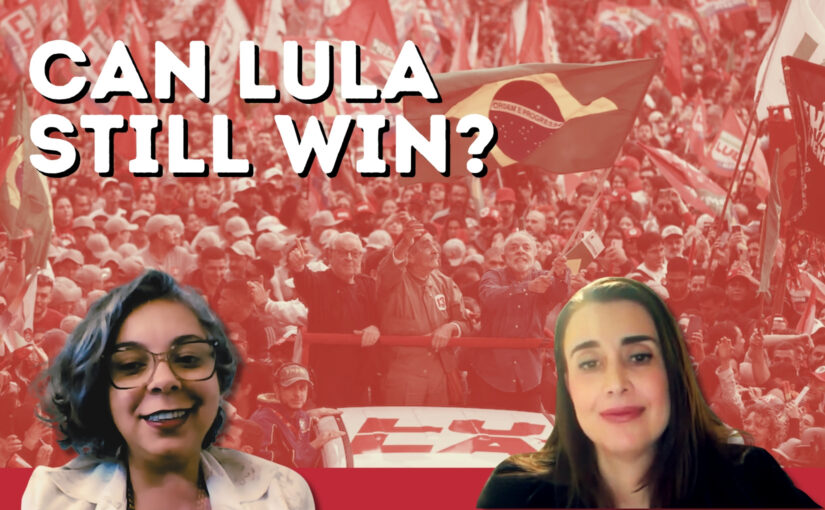
With just a few days to go before Brazil’s presidential runoff on 25 October, Invent the Future reporter Sara Vivacqua speaks to Isabel dos Anjos Leandro – Brazilian political scientist, long-standing Workers’ Party (PT) activist and political educator from Minas Gerais – about what’s at stake.
They discuss the open campaign of US pressure on Brazil’s election and its links to the Bolsonaro family; the surprise first-round result, in which Flávio Bolsonaro edged ahead of Lula; where Lula can find the votes to win, from the undecided to the millions who abstained; the grassroots campaign spreading beyond the party and onto social media; what is really driving the Bolsonaro vote; and why a Flávio Bolsonaro victory, alongside a far-right Congress, would threaten the 1988 Constitution and the independence of the Supreme Court.
The interview is in Portuguese with English subtitles; an English translation of the transcript is below.
Further reading:
Carlos Martinez and Sara Vivacqua, “Brazil hangs in the balance” (Morning Star)
Carlos Martinez and Sara Vivacqua, “What is at stake in Brazil’s election” (Morning Star)
Transcript
Translated from Portuguese.
Sara Vivacqua: Today I’m here with Isabel dos Anjos Leandro, a Brazilian political scientist with a doctorate and post-doctorate, and a long-standing activist in the Workers’ Party, with a background in political education, party strategy and programme development.
Isabel is currently coordinator of Lula’s presidential campaign in Minas Gerais, and also works as a parliamentary adviser in Minas Gerais.
Isabel, thank you for joining us today here on Invent the Future.
Isabel dos Anjos Leandro: It’s a pleasure, Sara, to be able to talk with you about this moment – a very important moment for Brazilian democracy above all, and also for democracy in Latin America and especially in the countries of the Global South, given the challenges we’ve faced recently.
Just one correction: this time I’m not part of the presidential campaign’s coordination here. I’m carrying out my work in other spaces, but we have a coordinating team here in Minas that has been taking care of those tasks.
Sara: Isabel, when we talk about Brazil’s 2026 elections, we’re not talking about an election taking place in normal political conditions, nor a purely domestic contest between two projects for the country.
Brazil is voting under an open, coordinated and hostile campaign of external pressure, led by Washington and coordinated with the Bolsonaro family.
Over the last two years, we’ve seen how the Trump administration has used economic, diplomatic and legal instruments against Brazil: the tariffs, the sanctions against Brazilian officials, the pressure linked to Jair Bolsonaro’s political fate, and now, in the elections.
At the same time, we’ve seen members of the Bolsonaro family travelling to Washington and lobbying for tariffs to be imposed on their own country, with no mandate for any kind of negotiation, and linking US economic pressure to the outcome of Brazil’s election.
So the question posed in Brazil’s presidential election today is much bigger than who occupies the presidency.
We’re looking at two possible futures: a Latin America subjugated to US hegemonic power, with Brazil as the last piece on the board and Trump’s big prize – or a stronger multipolar order, more closely aligned with BRICS.
Brazil is a strategic point today. As we know, Lula has deepened relations with BRICS, with China, with the Global South; he defends a more independent foreign policy and has reduced the traditional instruments of dependence on the United States.
In the first round, we had a surprise. The polls had Lula ahead, but the result was the opposite: Flávio Bolsonaro finished with 47 percent of the vote and Lula with 45 percent. There was also a high abstention rate, which has now become a central factor for the second round.
My question is: can this still be turned around? Where can Lula find the votes he needs to win the election?
Isabel: Sara, we need to understand some features of the international situation you describe. The first is that today, when we think about the global geopolitical chessboard, we have to recognise that the United States has an ongoing project of colonisation. That project of colonising the world isn’t over. Although it has suffered serious setbacks, it’s still an ongoing and very vigorous process.
As a country, we’re contending for a position that sets us apart and pulls the pendulum the other way. Brazil is a country of continental size, with an active economy – an economy that offers alternatives different from those presented by the United States.
So the international relations that President Lula establishes are, in the terms Celso Amorim has always used, relations of sovereignty – a foreign policy that is both active and assertive.
So that’s the first point: in this international situation, Brazil is without doubt caught up in the struggle on the global chessboard.
The United States, with all its power and all its weaknesses, is also contending over what kind of domination will be exercised over Brazil. And President Lula makes it very clear that it will be a relationship of sovereignty.
The United States can only survive its current crises by establishing external domination. And Brazil is a threat to that domination, to its consolidation. That’s the first point.
The second point is that Trump’s agenda is tied to one of the projects in Brazil – the project championed by the Bolsonaro family.
So here we have these illegitimate representatives of that way of governing, of acting. The ones who look to the coloniser, who look to the United States as the great father figure who will come and impose order, are the Bolsonaro family.
So there’s a two-way interest between these two political actors in the domination of Brazil.
This colonising project isn’t only external. Bolsonaro, together with his family, has a project for Brazil to be a colony of the United States – a Brazil subjugated to the whole system of external domination that Donald Trump is imposing today.
That’s a very important point, because we need to discuss the elections not only in terms of what happens at the ballot box, but also in terms of the competing projects.
In the first round, the idea that we would win outright gave us a mistaken view of the real danger to democracy that Flávio Bolsonaro represents.
It’s not about whether or not we’re in a second round, but above all about the risk Brazilian democracy runs when elections are so closely fought, and with such unequal weapons.
Some things are very curious. The people who have always spread fake news, who have never had any commitment to the truth, are now using the term ‘fake news’ to attack their opponent.
Flávio Bolsonaro has been trying at all costs, through every form of communication – and more and more reports of this are coming in – to criminalise leaders, to criminalise any communication that isn’t from his side, that isn’t under his control.
So these elections in Brazil aren’t settled. Going to a second round means that Brazilian society hasn’t decided, by a majority and within the rules of the game, on any one candidate.
In the first round we had a range of candidates – above all the two with the most votes, Flávio Bolsonaro and Luiz Inácio Lula da Silva – and other candidates in the running. Who went through to the second round? Flávio Bolsonaro and Lula. Very close together.
So we also need, Sara, to take a realistic view at this moment. Flávio hasn’t won the election, and Lula hasn’t won it either. What we have is a new contest.
The second-round picture has to be viewed with one eye on the rear-view mirror of the first round, but thinking about the actual result it will produce.
On 25 October, second-round polling day in Brazil, both candidates start from scratch. They go in with the first-round result behind them, but when the polls open that morning, both of them will be on zero votes.
So where does Lula intend to find the votes he needs to win?
The first thing to consider in this analysis is that there’s a very important figure in the polls for thinking about Lula’s position in this contest: the level of rejection of Flávio Bolsonaro.
This second round has brought something new for the left: social media have shown that they play a very important role.
I’m in Minas Gerais right now – I’m from Minas, as you can probably tell – and here in Minas Gerais this was very clear.
Here we have a far-right figure who won a big vote with a campaign built on social media, but we also have new developments, such as the election of federal deputy Annelise – a young Black woman from the city of Divinópolis, who speaks from her position as a young Black woman, a voice that isn’t usually heard, but who is coming to occupy a space.
So there’s a message there: social media are part of this, and they play an active role, capable of influencing voters in these elections. That’s a lesson to take away.
What’s the challenge, Sara? For left-wing voters, and the left in general, this was still an area we were wary of. I’m not saying the left wasn’t there, but it was an area of hesitancy. That battle hadn’t been fought as decisively as it has been in the last few days.
And a lot of effort has gone into making sure the left occupies that space too.
One example since the first round is the work of Janones, a federal deputy who is also from Minas Gerais.
I’m not just favouring my own patch, you know! It’s not that I’m only talking about Minas – it’s just that these cases illustrate the situation very well.
Today in Brazil, there’s a Lula army of four million people on the WhatsApp channel.
So where will Lula find those voters? He’ll find them among people who didn’t vote for Flávio, among people who are getting to know Flávio and might change their minds – because not every Flávio Bolsonaro voter is a Bolsonarista. We can’t see it in such linear terms.
We also need to understand that the third candidate in the first round of the 2026 elections is called abstinence… sorry, abstention! It was actually a pun we made here and it stuck with me. It’s called abstention.
The people who didn’t vote are the ones who, together with the majority who understand the two projects at stake, can make the difference.
So there are three big groups in this country in terms of voting: there’s Flávio, there’s Lula, and there are those who chose neither, who didn’t go to the polls.
And that’s where the work being done in the second-round campaign becomes so important.
Why don’t people go to the polls? It isn’t simply a legal question. The cost of not voting is very low. In Brazil, if you don’t vote, you can go to the electoral court afterwards to regularise your situation. It costs four reais.
So it’s not about a financial cost or a penalty; above all, it’s about building trust – a sense that institutions matter and that turning out to vote can make a difference.
Today you can see how much the polls and the elections are being debated, discussed and talked about in Brazil.
That’s why I believe, I think and I assess that Lula is looking for these voters among the undecided, among those who might switch their vote, and also among those who abstained. The third-placed candidate in this year’s election is abstention.
Sara: Isabel, what is the campaign doing in terms of PT organisation? What’s changed for the second round? Is the campaign doing anything differently in these three weeks? Which voters have you been trying to reach?
Isabel: There’s a change that goes beyond the party. There’s been a change in this second round, and here I want to focus my analysis on something that goes beyond party organisation.
Lula’s campaign today is a campaign that people have embraced. You see a lot of people who were complacent, sitting on the fence, or distant, or only half-heartedly involved in the first round.
Now you see a demand for the campaign. You see people campaigning. The election has become part of the fabric of many people’s lives.
And when I say many people, I mean people with no party affiliation. The party has its own organisation and its own way of campaigning, but it isn’t only the party.
Today Lula’s campaign is one that ordinary people – to use the legal term, the average man and woman – are taking on as their own.
And the best, most precious thing the left party – the PT – has is the strength of its activist base.
What made it possible for a factory worker – for Lula – to get there was work – Deputy Marquinho Lemos always insists on this – that was sown long before. It’s the organising, the building of a critical consciousness back when the PT was founded, in an earlier period, which then spread.
So when you ask me about this today, I think we also need to look at this other side of the campaign: a campaign that becomes popular, that takes on a life of its own, that sets its own agenda.
It’s common to be somewhere and have people ask you for campaign material. The campaign has its strategies – perhaps someone from the campaign coordination or leadership could give better examples – but the second-round organisation has been geared towards this.
But I think the different perspective we need – the one that has shown results and possibilities – is to look at what happens when people get involved in this campaign, when people get involved in defending it.
Today you can see that it’s one of the dominant topics on social media. As Janones puts it, we’ve occupied that territory. Everyone’s inevitably talking about the election; the memes are out there having fun with it, bringing a bit of humour, which is essential.
But the election isn’t decided, and with ten days to go there’s still work to do. Brazil is a continental country, so it takes effort to get material out and to keep social media buzzing. Until 5pm on the 25th, this campaign is still under way.
It’s a second-round campaign. The first round has to be a learning experience, but it can’t be a harbour where we settle down, rest or lament. It needs to be a foundation for thinking about the near future – which is being back at the polls on the 25th.
Sara: Isabel, we’ve seen millions and millions of people taking to the streets, especially students. You’re talking about exactly these people: an initiative that isn’t necessarily centred on the party, but is Lula’s real base – the popular base of ‘Lulismo’, which is a very important phenomenon in Brazilian society.
And I wanted to ask you: what are you hearing on the campaign trail, on the streets, in the neighbourhoods? What’s really leading people to vote for Flávio Bolsonaro? The economy, crime, religion, anti-PT sentiment, disinformation? Or is fascism a real phenomenon?
Isabel: People vote for many reasons. We need to understand the complexity of Brazilian society so as not to fall into the fallacy of attributing it to a single cause.
Thinking in terms of political science theory, you have the so-called Bolsonaristas – people who identify with the movement, who believe the US model is the best one for Brazil, who think too many rights are an obstacle to development, and who do indeed have a colonialist inheritance.
So there’s one profile – Bolsonaro’s core electorate, the so-called Bolsonaristas – but there are also people who buy into some of the fantasies that Bolsonarismo has sold.
There’s the idea of security, and a class hatred that people experience as an improvement in their own lives. It’s not about what I don’t have under the Lula government – it’s about what someone else has that I don’t think they deserve.
So yes, there are these motives of class hatred, and there’s an attitude closely tied to an idea of moral order.
Flávio often tries to project this – which is why I call it a fantasy, because it doesn’t hold up as a political project. But we have to understand that in a democracy there’s also room for difference – and in Flávio Bolsonaro’s case, it’s an anti-democratic difference, one that doesn’t stand on democratic foundations.
And one thing that has come out of this second round, Sara, is that Flávio Bolsonaro is becoming better known for what he actually puts forward in his project than for the image he tries to sell. That’s a big difference, and people on the street are noticing it.
There’s something I often say: this is a party that was built by selling little star badges, with people travelling eight or ten hours in rickety cars to build the party – and that’s what’s being done on social media today.
So the strength of the Brazilian people is showing itself at this moment too. It’s been a very important moment.
Young people on the streets, the diversity of the campaigns, the decentralised protests, the way people have organised – as individuals, in their collectives and in groups – also shows the importance of the political consciousness and education built up over many years. There’s still reason for hope, and still reason to factor that into future scenarios.
We mustn’t forget that there are many challenges, whether Lula is elected or not. Without Lula, those challenges are even greater, with more risks and more serious consequences. But Lula’s election doesn’t mean all our problems are solved.
Sara: I wanted to ask you: in a scenario – which I hope doesn’t happen – where Flávio Bolsonaro wins, could you explain to a non-Brazilian audience what that would mean? That it isn’t just a change of president, but what it would really mean: the question of the Supreme Court, and a possible change in Brazil’s constitutional order – perhaps the end of the 1988 Constitution, the hallmark of Brazilian democracy.
Isabel: Yes. In Brazil we have – fairly recently, in historical terms – the 1988 Constitution, regarded as a milestone in building democracy, in the process of redemocratisation. This is the ‘Citizens’ Constitution’, which opened the period of democracy we live in today, with all its challenges.
For those watching from outside Brazil: we have a rather curious system. The president is elected by direct vote across the whole country, and we have a two-chamber – bicameral – legislature. There’s the Chamber of Deputies, made up of deputies elected in their states, and there’s also the Senate, which represents each state.
The federal Chamber plays an important role, and there’s been a shift there: the far right has been taking over those spaces at the expense of the centre, not necessarily of the left. Those who’ve been losing ground to the far right are the centre, or the traditional right.
On top of that, there’s the Senate, which is also a guardian. Through a system of checks and balances, the whole thing is kept in equilibrium: the president as head of the national executive, and two chambers in what’s called a bicameral system.
If Flávio Bolsonaro were to win, he’d go into the presidency already in a favourable position in the Chamber of Deputies, and he has also managed to expand his presence in the Senate.
So what we’d have is a far-right hegemony able to alter the Constitution’s so-called entrenched clauses and completely change our political and legal order. Flávio Bolsonaro’s election would mean the consolidation of that change.
There was an interesting example yesterday. There was a vote on the six-by-one work schedule. It passed the Senate yesterday. It was a vote…
Sara: Just to explain for our international audience: in Brazil, people can work six days a week with one day off. Yesterday a measure was approved making it illegal for people to have only one day off. Now, by law, people will have two days off. A big victory for workers.
Isabel: More than ‘can’, Sara: the system is a compulsory six-day working contract, with one day off a week depending on the sector. That day off is set by the employer. So you don’t even have a guaranteed right to choose which day you get off – it’s whichever day suits whoever employs you, which makes even a minimally healthy life impossible for working people.
So with Flávio Bolsonaro’s rise, you have a shift that could roll back all those constitutional gains – and the Constitution itself, as the charter that protects the rights of the Brazilian people. And what’s being promised are significant changes.
Besides having a far-right executive with the far right dominant in both houses of the national legislature, there’s also a direct consequence – beyond the constitutional changes – for the Supreme Federal Court. The Supreme Court is the highest court in Brazil, and its justices are nominated by the president of the Republic.
So with the nomination of new justices to fill the existing vacancies – and the Senate in fact blocked one, so President Lula wasn’t able to appoint another justice of his choosing – a possible Flávio victory, or even the numbers already in the Chamber and the Senate, would make these changes possible.
That’s why, beyond the whole debate about political projects, a Flávio victory would also, institutionally, consolidate far-right hegemony in the legislature, the executive and, as a consequence, the judiciary.
So we’d have a reversal of the checks and balances we’ve had since 1988. The far right would dominate all three of the great decision-making branches of national politics.
Sara: Isabel, thank you so much for this interview. I know you’re campaigning along with everyone else in Brazil, that the campaign isn’t leaving anyone time to breathe, and that you’ve taken time out to talk to us. Thank you very much – I hope to see you again soon, with Lula in the presidency.
Isabel: We hope so too. And this is a moment when the international press has a very important role – in Lula’s relations with other countries, but above all in making clear what’s happening here, Sara.
So I return the thanks. It’s very important that people can look at and understand the Brazilian situation. We’re a continental country with some very particular characteristics, but above all we need to discuss democracy in global terms, and Brazil has a fundamental role to play, as a member of the Global South, in the changes, the possibilities, the advances – and also the obstacles – that this candidacy presents for Brazil.
Thank you very much, Sara. See you soon. All the best.