
China is planning to spend 25 trillion yuan ($3.7 trillion) over the next five years on what it calls “the six networks”: water, electricity, computing, communications, logistics and urban pipelines. In the following article, Carlos Martinez looks at what the programme involves – and at the millions of jobs it is designed to create – and asks why China can organise its economy along such rational lines while Western capitalist countries cannot.
Drawing on Michał Kalecki’s “Political Aspects of Full Employment” and Marx’s observations on the “general conditions of production”, Carlos argues that the answer lies not in Keynesian technique but in political economy: in China, capital lacks the power to veto public investment. Meanwhile in Britain, privatised water companies haven’t built a major reservoir in over three decades.
This article was first published in the Morning Star.
In a recent briefing, the Economist reports that China is planning to spend 25 trillion yuan ($3.7 trillion) over the next five years on what it calls “the six networks”: water, electricity, computing, communications, logistics and urban pipelines. That corresponds to roughly 3 percent of China’s cumulative GDP between now and 2030.
Six networks
The proposal was set out in the outline of the 15th Five-Year Plan (2026–30), and is already being implemented. The National Development and Reform Commission expects investment to exceed 7 trillion yuan this year alone.
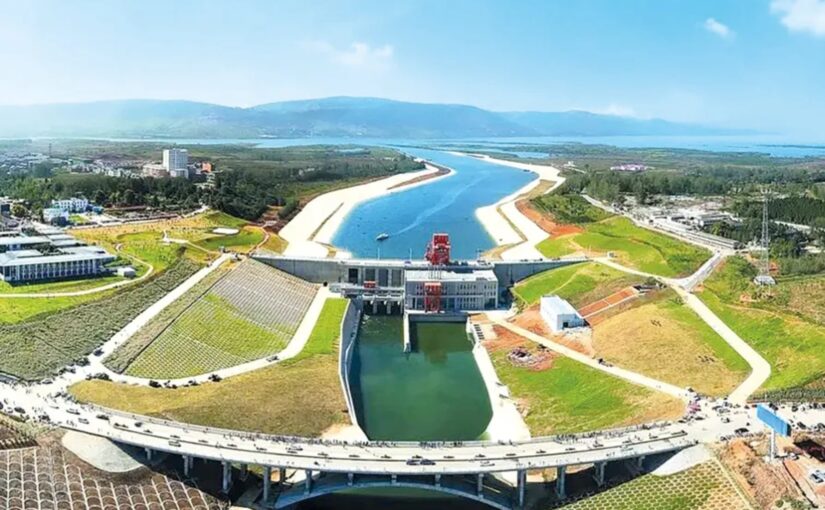
The water network will receive more than 6 trillion yuan for reservoirs, canals, flood defences and ecological restoration. China’s water network already covers 80 percent of the country’s land area, and the first phase of the South-to-North Water Diversion Project has delivered 88 billion cubic metres of water, benefiting 195 million people.
The power grid will receive more than 5 trillion yuan, much of it spent by China’s two state-owned grid companies. The aim is to carry solar and wind power from the deserts of the north-west to the cities of the east through a network of ultra-high-voltage lines – already over 50,000km long – backed by battery storage and smart distribution.
The computing network will link the country’s data centres into a single system. Under the East Data, West Computing project, six of China’s ten national data-centre clusters will be built in western provinces such as Ningxia and Gansu, where land is cheap and renewable energy plentiful. China’s intelligent computing capacity reached 1.88 million petaflops in the spring, two and a half times the level a year earlier.
The communications network builds on more than 5 million 5G base stations, with an upgraded 5G-Advanced network now covering 330 cities, thousands of low-orbit satellites planned, and 6G scheduled for commercial launch around 2030.
The urban pipeline network will receive around 5 trillion yuan to build or renovate 770,000km of gas, water, heating and sewage pipes – enough to reach the moon and back.
And the logistics network aims to cut costs further; they have already fallen from 14.9 percent of GDP a decade ago to 13.9 percent in 2025.
The networks are designed to work together. The grid and the water system power and cool the data centres. The data centres train the AI models that forecast demand and balance intermittent renewable supply, and that manage the drones, robots and autonomous vehicles increasingly moving China’s freight. The Economist briefing cites Helen Qiao of Bank of America describing it as “less cement and more circuits”: much of the money goes on upgrading existing infrastructure – fitting sensors to pipes, for example – rather than simply building more.
Jobs first
One aspect of the plan that has received little attention in the West is employment.
Improvements to the water network are expected to create more than 3 million new jobs over the plan period, grid investment more than a million direct jobs, and pipeline renovation around 2.8 million jobs a year. These are not merely projections. In the first half of this year, water projects alone employed 1.34 million people, 1.11 million of them rural labourers.
That is a deliberate choice. Employment is an explicit target in Chinese economic planning, and the six networks are a means of meeting it at a time when the property sector, for two decades a major source of construction jobs, is in decline.
What Keynes couldn’t explain
Clearly impressed with the scale and ambition of this programme of investment, the Economist scours the annals of bourgeois economic thought for an explanation, finding that, in a 1942 radio address, John Maynard Keynes urged the British government to prepare a library of public works that could be accelerated whenever private demand weakened – blueprints “as ambitious and glorious as the minds of our engineers and architects and social planners can conceive”. The six networks, says the Economist, are China’s answer to the challenge of weak private demand.
This analysis is not without merit, but it is incomplete. Keynes described what a rational economy would do, but his theory does not explain why China can organise its economy along rational lines while Western capitalist countries cannot.
In 1943, a year after Keynes’s radio address, the Polish Marxist economist Michał Kalecki published a short essay, “Political Aspects of Full Employment”, explaining why governments in capitalist countries would resist using public spending to sustain full employment, even though they knew how to do it.
Kalecki’s answer was that capitalists oppose it on political grounds. Public investment encroaches on the domain of private profit, and permanent full employment strengthens the hand of workers: under such a regime, he wrote, “the ‘sack’ would cease to play its role as a disciplinary measure” (extending Marx’s observations in Capital, Volume I about the “industrial reserve army”). Business leaders prefer unemployment and a docile workforce to the risks of a state that guarantees jobs.
Marx also observed that capital will build roads, canals and other “general conditions of production” only when these promise a profit; otherwise it leaves them to the state, or leaves them unbuilt. In the era of neoliberalism, very little is left to the state, and a great deal remains unbuilt.
China’s six networks rest on a different foundation. The banks that finance the investment are state-owned. The grid, the telecoms networks and the major construction firms are state-owned. Land is publicly owned. And all of it is embedded in a planning system that works on a horizon of years and decades rather than quarterly returns. The central government can borrow for ten years at less than 1.7 percent interest, and it can direct that money to where it is needed rather than where it earns the highest return.
This is the decisive point. While there are, of course, capitalists in China – and indeed they are invited to participate in the six networks – they do not have the political power to veto public investment in the way Kalecki described.
Meanwhile in Britain
Britain’s privatised water companies have not built a major new reservoir since the early 1990s. They have paid out billions in dividends while pumping sewage into rivers and loading themselves with debt; Thames Water is now drowning in some £20 billion of it. Renewable energy projects have faced waits of 10 to 15 years to connect to the electricity network. HS2 has been cut back to a fraction of its original ambition.
None of this is for lack of engineers or ideas. It is because the decisive levers of the economy are in private hands, and private capital will not build the general conditions of production unless it can extract a profit from them.
As the Economist puts it, the return on some of China’s investments may prove disappointing, “but as Keynes would no doubt point out: the return on unemployment is even worse”. China can act on that insight. Britain, under the rule of capital, cannot.
Socialism is allowing China to build the economy of the future.