
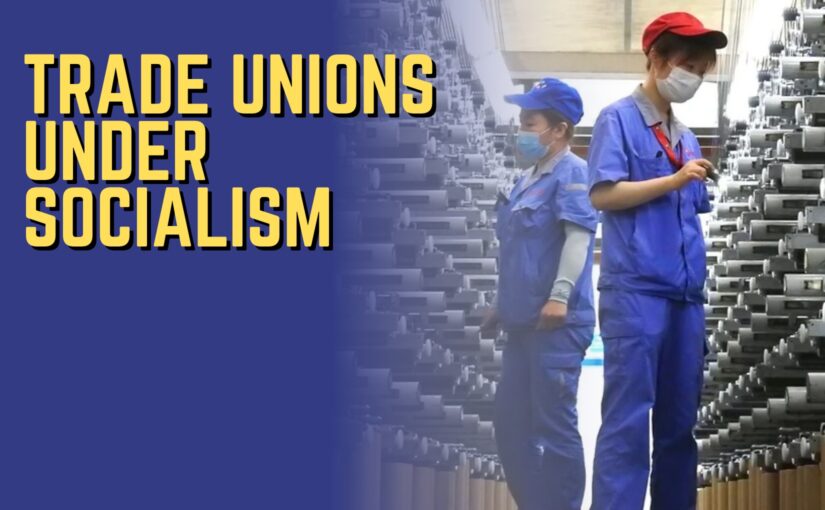
China’s trade union federation has grown faster than any union federation in history – from 134 million to around 300 million members in two decades, with union density of around 75 percent, compared with around 20 percent in Britain and 10 percent in the US. Yet in the West, including on much of the left, Chinese unions are routinely dismissed as fake or as tools of an authoritarian state.
In this contribution to a Critical Theory Workshop panel on Immanuel Ness’s new book on the dialectics of Chinese labour, Carlos Martinez explains why. Trade unions work differently under socialism: workers are not struggling against the state as an agent of capital, but with the state against capital. And China is still a developing country, where modernisation is essential to escaping dependence on the imperialist core. Seeing only the “sweatshop” snapshot, Carlos argues, is a fundamentally undialectical way of looking at Chinese labour, and it misses the whole trajectory.
Watch the full panel discussion.
Transcript
Thanks so much, Gabriel, for that extremely generous introduction and to Critical Theory Workshop for inviting me to speak here, in spite of the fact that I know substantially less about this topic than the other panellists.
But mainly, thanks go to Manny for writing a very useful, a very important, and I think a very brave, courageous book. And you yourself note in the book that challenging the consensus in the West on Chinese unions is a taboo, right? You’re right that we risk being excluded from the field of Western labour studies.
What I want to talk about is the anti-China consensus in relation to trade unions seems a little bit bizarre if you look at the numbers as the book explains, and as Manny has talked about in his introduction, for the last half century, trade unionism has been in decline, practically everywhere in the world. Meanwhile, in China, the All-China Federation of Trade Unions has grown faster than any union federation in history. In the last two decades, it’s gone from 134 million members to around 300 million today, representing union density of around 75 percent. Now, here in Britain, union density is around 20 percent. In the United States, it’s around 10 percent. So 75 percent seems pretty fantastic, right?
But in the West, all of this, including, sadly, among much of the left, is dismissed as kind of state propaganda or manifestation of authoritarianism or fake unions, et cetera. So what I want to talk about in the few minutes that I’ve got is, why don’t people get it? What’s so difficult about understanding trade unions in China?
I think the first reason, and the most important reason, and something that’s explored a fair amount in the book is trade unions simply work differently under socialism. And that should be fairly obvious, right? Trade unions under socialism work differently to how they work under capitalism. And, of course, the labour studies field is concentrated primarily in the West, and it’s based on the experience of unions in the West, i.e. in capitalist countries.
What does it mean to be a capitalist country? It means a society in which the capitalist class, the people who own and deploy capital, constitute the ruling class, and the state primarily serves their interests, right? So in that context, the trade union, which is a vehicle for the working class to organise against capital, should have an essentially antagonistic relationship with capital, with the state, right? That’s what you expect: independence from the state is indispensable for trade unions in capitalist countries and Western countries. And that’s one of our demands as leftists, as Marxists, as communists, right? We rightly demand that, while noting that trade unions being organised as part of the capitalist state and controlled by the interests of capital has traditionally been one of the features of fascism. That’s what you have with the German labour front in Nazi Germany. That’s what you have with the so-called syndicates in Mussolini’s Italy.
But in a socialist state, the working class and its allies, by definition, are organised as the ruling class. In China, the trade unions, the All-China Federation of Trade Unions, was part of the coalition that took power in 1949. The Communist Party of China and the People’s Republic of China, the Chinese state, didn’t set up the Chinese Trade Union Federation. The ACFTU predates the formation of the People’s Republic of China by around 25 years. Upon the capture of power and upon liberation, upon the incorporation of the People’s Republic, the trade unions were immediately brought into the state structure. And as Manny’s mentioned, what was established in 1949 was defined as a people’s democratic dictatorship led by the working class and based on an alliance of workers and peasants.
So, a people’s democratic dictatorship, which is probably a pretty obscure expression for non-Marxists, but Marxists will be familiar with it. It creates democracy for the working class and peasantry and imposes dictatorship on the forces of feudalism, imperialism and comprador capitalism. There’s no need for trade unions to be independent of that sort of arrangement. So we’re talking about working class organisations in a workers’ state. And Manny writes in the book, under socialism, workers are not struggling against the state as an agent of capital, but with the state against capital.
And that’s been the case in every socialist country. This isn’t actually something that’s unique to China. You find a very similar arrangement in Cuba. You find a very similar arrangement in Vietnam. You found a very similar arrangement in the Soviet Union, in the German Democratic Republic, et cetera. In each case, the union federation was linked to the governing Communist Party. And that’s actually a little reminder that the modern Western critique of trade unions in China is, in many ways, just a revival of the old critique of the Soviet trade unions. And that’s a reminder that you’ve got a pretty clear, continuous line from Cold War propaganda through to new Cold War propaganda.
I think there’s additionally, in the case of China, perhaps a racial element that means the critique is a bit more extreme when it comes to China than it was for the USSR. Somehow it’s easier for us to think of China’s rulers as uniquely sinister. We’ve got this Fu Manchu stereotype of cynical, inscrutable Chinese, hell-bent on world domination. And that sort of stereotype and that sort of image is only just beneath the surface of mass consciousness in the West, generally speaking.
So none of which is to say that there’s no problems or contradictions in terms of Chinese labour and Yan Pan has enunciated some of those very ably. The fact is that building socialism has never been a simple process, largely because the world remains dominated by imperialist powers. Socialism with Chinese characteristics has many contradictions. It’s a very complex and a very new process that hasn’t yet, something that hasn’t been done before.
The most obvious contradiction is that while capital is subordinated to the state, the dictatorship that’s imposed on the capitalist class is basically pretty benign these days. People who own and deploy capital may not be able to form their own political party. They may not be able to organise in their specific class interest. They may not be able to organise to restore capitalism, but they can make a lot of money. They can exploit human labour. They can live very well.
And furthermore, alongside that, China’s whole framework of development relies partly on capital to help develop the productive forces in order to create a material basis for a more advanced socialism. As such, you’ve got this sort of fragile class alliance which creates a complex dual role for an organisation like the All-China Federation of Trade Unions, which is both defending workers against capital and helping the country to develop, to develop its productive forces, to modernise, to move towards a more advanced socialism.
And actually, I think the ACFTU these days, at least, does a great job in defending the interests of the working class. It takes up the demands for higher wages, for better conditions, for social insurance, for pensions and so on. And one example of that is that no company in China is allowed to ban union activity, which is a situation which we in the West can only be envious of. And with ACFTU help, workers win around 95 percent of labour cases in court.
And Manny pointed out in his opening remarks about this sort of Catch-22 analysis from the West about Chinese trade unions, but that if workers go on strike, it shows that they reject the state, they reject authoritarianism. But if there’s peace, if there’s labour peace, if they don’t go on strike, that supposedly shows repression and that the critic always wins. And it reminded me of a classic quote from Michael Parenti’s book, Blackshirts and Reds, where he said: “If the churches in the USSR were empty, this demonstrated that religion was suppressed. But if the churches were full, this meant the people were rejecting the regime’s ideology. If the workers went on strike, this was evidence of their alienation from the collectivist system. If they didn’t go on strike, this was because they were intimidated and they lacked freedom.”
So the second reason, a second very important reason, I think people in the West and including on the left struggle to understand Chinese trade unionism and its differences with Western trade unionism is that China is a developing country. It’s still in the process of modernisation, yes, over the last few years, it’s emerged as a science and technology powerhouse, but its productivity is still a fair way behind that of the imperial core. Its per capita income is perhaps 20 percent of the US’s. It still has literally hundreds of millions of people who live in relative poverty, albeit they enjoy a standard of living far above what their counterparts enjoy in the other countries of the Global South.
Modernisation probably doesn’t feel that important to a lot of people in the West. It doesn’t feel that important to a lot of people in the US or in Canada or in Britain or in Europe because we’ve been reaping its fruits for a long time now. But for a country in the Global South, it means becoming more prosperous, it means creating a better life. And it also, very importantly, at a political and a geopolitical level, means escaping from the position that the West would like to hold China in as a peripheral country dependent on the imperial core, vulnerable to imperialist pressure, vulnerable to intervention.
So modernising and developing the productive forces is an entirely necessary process, and it involves a lot of hard work. There’s no way around that.
And, yeah, I was on a delegation in China three or four years ago, and it was a delegation of communist parties. And someone from Northern Europe asked the vice chair of the ACFTU, well, what do you think of fighting for a six-hour working day? That’s what we’re fighting for in the union movement in our country. And this vice chair, this official, waited for the question to be translated, allowed himself the briefest of chuckles and said, listen, we’re a developing country, and if our working class, if our 400 million workers went down to a six-hour working day, we wouldn’t develop. That would slow down China’s development. What we do instead is we fight to ensure that the 40-hour week is respected, that workers are properly compensated when they do do overtime, they only do overtime if they want to do overtime, they have social insurance, they have pensions, they’re not abused and exploited, that they have a voice in the workplace.
And sorry, Gabriel, I’m aware I’ve gone overtime, so I’ll just finish up by saying that much of the Western left looks at Chinese labour conditions, and they just see this. It’s a caricature or a snapshot, which is the sweatshop, right? And that misses the whole trajectory. It’s a fundamentally, actually, undialectical way of seeing it. Yes, there is a history of brutal exploitation of labour in China, particularly by the likes of Apple and by the likes of Nike, by basically Western multinationals.
And the All-China Federation of Trade Unions, working with the state, has been in the lead of the fight against that exploitation and has had remarkable successes, successes that are basically without parallel elsewhere in the world. So, yeah, thank you. I’ll leave it at that.