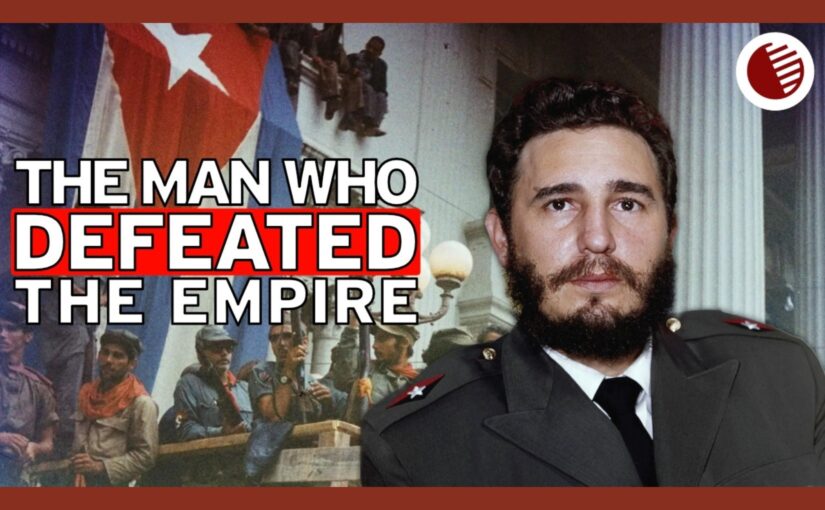
On what would have been Fidel Castro’s hundredth birthday, and with Cuba under its most severe siege since 1959, Carlos Martinez joined Radhika Desai on the Geopolitical Economy Hour alongside Francisco Domínguez, a founding member of the Cuba Solidarity Campaign and a specialist on Latin America’s political economy.
The discussion traced Fidel’s revolutionary audacity from Moncada and the Granma landing through his personal command at Playa Girón, the internationalism that sent hundreds of thousands of Cuban troops to help defeat apartheid South Africa at Cuito Cuanavale, and his refusal to follow Gorbachev when 85 percent of Cuba’s trade vanished overnight – and asked what all of this tells us about whether the revolution can survive Washington once again.
The full auto-generated transcript is reproduced below, lightly edited for readability.
Transcript
Radhika Desai: Hello and welcome to another Geopolitical Economy Hour, the socialist and anti-imperialist conversation that illuminates the fast-changing political economy and geopolitical economy of our times. You’re watching Radhika Desai, Geopolitical Economist, and I’m Radhika Desai.
The topic today is extremely socialist and anti-imperialist. It’s Fidel Castro. Last week, along with our two guests here today, I had the privilege of attending the celebration of the life of Fidel on his 100th birthday. That was on the 13th of August. It was organised by the Cuban embassy and it was a deeply, deeply moving affair. Two magnificent speeches were given by former Labour Party leader Jeremy Corbyn and the Cuban ambassador, Ismara Vargas Walter. And there was also a beautiful short film on the life of Fidel.
Between them, these three contributions really brought to life the awe-inspiring political feats of the great Fidel, who was known, as you all know, among Cubans simply by his first name. He made Latin America’s first socialist revolution. He defeated imperialism militarily at the height of its power. He took the revolution to great heights of human development. He practised a legendary internationalism, both militarily and, as many people will know, medically. The revolution he led survived the loss of support of the other great superpower, namely the Union of Soviet Socialist Republics. And Fidel also kept up an analysis of the world situation with a diamond-like clarity — and of course also of the situation, often quite dire, of Cuba itself — and shared it on a regular basis with the Cuban people in his legendary speeches, which were listened to with rapt attention even though they often went on for hours.
Appreciating all this when a new assault from the United States is endangering Cuba’s mighty revolution once again was especially poignant. So with me to discuss Fidel’s legacy, and what it means for Cuba today and for Latin America, are two intellectuals with decades of engagement with and commitment to Cuba, Latin America and revolution: Francisco Domínguez and Carlos Martinez. Welcome both.
Francisco Domínguez: Thank you for having us.
Radhika Desai: Let me introduce both of you before going on. Francisco Domínguez is a specialist on Latin America’s contemporary political economy, and I know from having listened to his excellent speeches that he has vast historical knowledge of Latin America and its revolutionary history. He has studied and written extensively about Cuba, particularly after the Special Period that followed the collapse of the Soviet Union in 1991. This has included the permanent aggression of the US against Cuba, historically and of course in its stepped-up form after 1991, and the various measures taken by the Cuban government to address the problems raised by the collapse and loss of support of the USSR — the expansion of tourism, for example. Francisco has visited the island on numerous occasions and has had the chance to learn from leading Cuban intellectuals. He’s a founding member of the Cuba Solidarity Campaign and has been on its executive since its foundation.
Carlos Martinez is an independent scholar and author — and I should say author of two really excellent books, again with a really sharp analysis of both China and the Soviet Union. This is in line with the particular interest he takes in the history and politics of socialist countries, of which of course Cuba is such a shining example. He’s been a long-standing friend of Cuba and a member of the Cuba Solidarity Campaign. And last but not least, he co-edits the excellent Friends of Socialist China website, which involves him taking the temperature of the state of socialist revolution worldwide on a regular basis.
So it’s really great to have both of you. Francisco, perhaps you can start us off by reflecting on the current moment. We were celebrating Fidel’s life just recently, but at the same time the 100th anniversary of his birth coincided with a moment of great peril for the revolution he led. So perhaps we can start with you reflecting on what Fidel would have said and done.
Francisco Domínguez: I think it would be a very similar response to the one Díaz-Canel has given, which is in line with the spirit and the ethics and nature of the Cuban revolution: we will resist for as long as it takes, no matter what the consequences might be.
The situation in Cuba is quite dire. For the first time since 1959, the United States has been able to organise a naval military blockade of the island, preventing Cuba from getting one drop of oil for nearly six months. The Cuban economy is quite poor in terms of energy resources, so it depends very heavily on oil for running electricity. And after the attack on Venezuela on the 3rd of January this year, the oil that Venezuela was sending to Cuba regularly dried up completely. I mean, zero. So the situation is extremely bad.
But in my understanding of what the situation is like — which is extremely bad, and I don’t want to minimise it at all — I think they have reached a level which is sort of stationary. It cannot get worse. That’s number one.
Number two, some important steps have been taken to resolve the structural energy problem that Cuba has, particularly with China setting up 55 solar farms on the island, which has contributed significantly, though not completely, to resolving the problem. The plan is to have 92 by 2027 — that is to say, next year. China has donated to Cuba 60,000 tons of rice, which is 10 percent of the annual consumption of the island.
There is much more than that, but I want to point out something which is quite important and which is being ignored, obviously, by the corporate media. Brazil, Mexico, Russia and China are coordinating their efforts to help Cuba. Mexico continues to send food and all sorts of other inputs, medicine and so on to Cuba, and so is Brazil — and these are two very large economies. If you add to that Russia and China, then clearly there is a determination by these countries.
Radhika Desai: Carlos, any reflections?
Carlos Martinez: I completely agree with Francisco’s analysis. If we think about what Fidel would have done in this moment, some of the things you associate with Fidel are audacity, boldness, courage, leadership, and this incredible commitment to socialism, to anti-imperialism, to protecting Cuba’s sovereignty.
Funnily enough, I was just thinking about the meaning of the name Fidel, which means faithful — and it manifests in the English word fidelity. Fidel was always faithful to those principles of Marxism, to the ideas of socialism, to the ideas of national sovereignty, to the ideas of internationalism, revolutionary internationalism and anti-imperialism. And I think the Cuban people and the Cuban leadership carry that same mantle.
If you look at the whole history of the Cuban revolution from 1953 until today, it’s a history of succeeding against the odds: the Moncada barracks attack in ’53, the Granma landing a couple of years later, taking power in 1959, the Bay of Pigs — Playa Girón — in 1961, beating off the attempted US invasion. That’s one of very few examples in the 20th century of a successful counter-attack and rebuff of a US invasion. Then 1991: the collapse of the Soviet Union, the end of Comecon, the collapse of 85 percent of Cuba’s trade, the Special Period, the introduction of tourism, the introduction of austerity measures, the conversion to urban gardening and all the rest of it.
If you look at the numbers and make a cold-hearted assessment of any of those situations, you would say there’s no way Cuba is going to come through, no way Cuba is going to survive. And yet they did — with the unity of the people, with this profound commitment to the revolution and to Cuba’s sovereignty.
So Cuba’s answer to the current situation has been very much moulded in Fidel’s spirit: solar power generation tripling within a year, 92 Chinese-financed solar parks being constructed to end the fuel dependency, Chinese aid, Chinese rice coming in. There’s been Russian oil shipment — hopefully there’ll be more of those — and Russian aid. There’s been aid from Vietnam. There’s been coordinated support, as Francisco has said, from Mexico, from Brazil and from other countries. And there’s been the introduction of new economic reforms under siege as a way of getting the economy moving, enhancing Cuba’s sovereignty and rebuilding its capacity to defend itself and maintain its independence.
Radhika Desai: Maybe we can go through his life in some ways. It seems to me that he was born — not really poor, but not among the privileged classes — and that from very early on he was somebody about whom you can say quite truly that he had fire in his belly, that he yearned for establishing justice for the people among whom he grew up. He brought Cuba from an extremely poor, oppressed, illiterate population to, as I said earlier, very high human development indicators. So what do you take most from thinking about his early life? Francisco, perhaps?
Francisco Domínguez: He was part of a generation that was radicalised massively because of excessive US intervention. Cuba was a very peculiar country — always was. The Cuban Creole oligarchy decided not to become independent when all the Latin American countries were, and the reason was that it was very worried after the revolution in Haiti, because it had become the supplier of sugar to the world and began to import slaves. There were several attempts at insurrection between 1812 and 1843. So they decided to remain a colony.
And when Spain lost its power in Latin America because of the generalised independence of the Latin American nations, Cuba decided to become a colony of the United States. Had it not been for the division between free states and pro-slavery states in the United States, Cuba would have been made a colony of the United States. Together with sections of US imperialism, they funded military expeditions to expel the Spanish militarily and annex Cuba to the United States. It was known as the annexationist movement.
So Cuba was never independent, and the independence it gained in 1903 was quite restricted. Cuba was a protectorate. Between 1903 and 1959 the most influential person in the country was the US ambassador. US ambassadors in Cuba decided who the next president was going to be in the next election, whenever there was an election.
By 1952 Batista, who was going to go for elections as well, knew he was going to lose and decided to go for a coup — and that was the trigger. By then Fidel had already demonstrated he was an extraordinary individual. He looked the part. He was tall, he was handsome, he had extraordinary oratorical capacity from the age of 15, 16, 17, and by 19 he was number one at Havana University.
The thing that triggered the whole thing, that led to armed insurrection, was that between 1952 and 1959 the Batista paramilitaries and secret police assassinated 20,000 people, and they did it in the most horrendous ways. They left the corpses, nearly destroyed, in the street to make sure that people saw them. That was the trigger, and then Fidel decided to go for it.
Just in terms of audacity: not only did he organise the Moncada barracks assault, which, when you look at it from the military point of view, you think, Jesus Christ. They survived that. Even more extraordinary, when it came to the trial he decided to defend himself. He did it successfully, although he was sent to prison, convicted — but his famous History Will Absolve Me is incredibly excellent, absolutely no question about it. What is interesting is that this is Martí. If you read the whole thing — which I must have read I don’t know how many times — it is basically Martí. The word socialism is not mentioned, but it is socialism.
Then he organised the Granma landing, which was another terrible way of doing it. And all the way through he showed this incredible audacity. He was always extremely bold, and he came to the conclusion that you need a fighting, disciplined organisation that is so effective that it will actually ensure the country will be defended. And he came to the conclusion — I’ll leave this part of my conversation here — that the best way to defend the nation’s sovereignty and independence from imperialism was a socialist society. Nothing else would do.
He more or less drew the same conclusion that Martí did not live long enough to draw, because he would have drawn the same conclusion. Martí said what we are doing by winning our independence in 1895: we’re preventing the rise of an empire, which was the United States, and we’re helping to destroy an old one, which was Spain. He didn’t succeed — Spain disappeared because of the United States. So it’s pretty much the same framework.
And when you go through the whole thing, just as a footnote: I had the privilege of listening to him live five times.
Radhika Desai: Wow.
Francisco Domínguez: Which is quite an experience.
Radhika Desai: I can imagine. How long did those speeches last?
Francisco Domínguez: One was an hour and a half, which was quite short, and then the others lasted from three hours onwards.
Radhika Desai: Carlos, please.
Carlos Martinez: What’s so special about Fidel, I suppose, is that he had these extraordinary personal qualities that he then combined with Marxism-Leninism. It’s clear he was a very daring, courageous human being. He also had remarkable leadership skills, and those were probably demonstrated from early on in life, as a child.
He’s well known for leading by example. He always wore the same worn military uniforms. He never carried decorations, for 45 years in the leadership. He went to every hurricane, every natural disaster — he was there on the spot himself. He was capable of the most unbelievable oratory. Che Guevara famously talked about Fidel’s oratory and described it as being like the dialogue of two tuning forks, and that Fidel and the mass vibrate together in this dialogue of growing intensity.
Radhika Desai: That’s an astonishing metaphor.
Carlos Martinez: He was an astonishing speaker, probably without parallel in the 20th century. He was an insatiable reader and learner. He really consumed knowledge like an unstoppable force. And then at university he came across and embraced Marxism. He talks about how he came to university with this rebellious spirit, but then, as a result of reading and of engaging with other political student groups, he became a Marxist-Leninist.
He’s got a famous quote that I’ll read out: “If you don’t eventually come to truly understand the history of class struggle, or at least have a clear idea that society is divided between the rich and the poor, and that some people subjugate and exploit other people, you’re lost in a forest, not knowing anything.” And then famously, of course, in 1961 he said: “I’m a Marxist-Leninist, and I shall be a Marxist-Leninist to the end of my life.”
But it was a very non-dogmatic and creative application of Marxism-Leninism. He applied Marxism to Cuba’s specific situation, recognising that what Cuba needed first and foremost in 1959 was a road to national independence, actual national liberation, as Francisco has talked about. Recognising also the pervasive racism — the fact that Cuba at that time was essentially an apartheid society, where people of African origin weren’t able to go into certain parks, weren’t able to go into certain restaurants, very similar to the situation that prevailed in the southern states of the US at that time, or indeed in apartheid South Africa. He recognised the semi-feudal nature of the rural economy. So it was a very specific application of Marxism, adapted to the actually existing reality that prevailed in Cuba at the time.
Just as a side note, it’s interesting to observe that of all the countries in which socialism has survived and made its way past the 1989 to 1991 so-called end of history moment, it’s been those countries that have made these unbelievable efforts to adapt Marxism to their unique circumstances. It’s Cuba, it’s the DPRK, it’s China, it’s Vietnam, it’s Laos.
And remember, Fidel didn’t even declare the Cuban revolution to be socialist until April 1961, literally a day or two before the Bay of Pigs invasion, when they knew it was coming — for the very reason that there had been decades of anti-communist propaganda. You recall that the 1950s was the height of anti-communist hysteria in the US, which spread to the US’s semi-colonies like Cuba. So decades of propaganda meant that Cubans agreed with socialist policy but they recoiled at the actual word. So the Cuban leadership’s view was: let people learn through their direct experience what socialism means, because they’re not going to accept it as abstract theory.
And as Francisco has mentioned, the History Will Absolve Me speech provides, remarkably, in 1953, the intellectual foundation for the whole Cuban revolution and its whole experience in the ensuing seven decades. It covers the problem of land, the problem of industrialisation, of housing, of unemployment, of education, of health. So this programme of Moncada actually became the programme of government, the programme of the Cuban revolution, over the course of seven decades.
Radhika Desai: You mentioned audacity, Francisco, and I remember the first time that I really took note of somebody called Fidel Castro was back in the early ’80s, when in the context of the Third World debt crisis — the Mexican, Argentine and so on debt crisis — he said: repudiate the debts, just don’t pay them. If that had happened, the whole history of the next two decades would have been so different. He had that capacity to see that.
And I suppose that was really necessary, because the early years of the Cuban revolution were so tumultuous. They made a revolution, again as you say, in such compromised circumstances, with a small band of fighters, and then you had within a couple of years the Bay of Pigs invasion, and then the Cuban missile crisis. What are your reflections on how the revolution was made, how it survived those very critical years? Maybe Francisco, if you can.
Francisco Domínguez: I think he had the ability to inspire the masses — not just the direct supporters, the guerrilla fighters, but the masses as a whole. He had this ability to be so persuasive. Some people say it was because he was good at talking, but I don’t think so. He went through analysing a particular issue in such detail, from every imaginable angle, drawing all the ramifications and all the conclusions, so that at the end, even if internally you had some doubts, he would dismantle them before you expressed them. He was so good at that.
Somebody who was a revolutionary, dead now — we’re talking about the 1960s — said Fidel’s capacity to persuade was such that he would be able to sell a refrigerator to somebody living in the North Pole. So that gives you an idea of the way he was.
Now, in terms of audacity: not only declaring the revolution socialist ninety miles away from the most powerful military force, which had already tried to invade the country in ’61. That was extremely bold. That’s number one. But number two, every time there was the possibility of Cuba participating in helping the liberation of the Third World — that today we call the Global South — Cuba would not hesitate. And the reason they were able to do this is that he began from something very small, sometimes with a speech, and then he would draw all the imaginable geopolitical conclusions at the maximum level — not because he was exaggerating, but because he knew what the ramifications were and what all the consequences were of what you wanted to do.
So when he realised that the Angolans required support from Cuba, there he went: sent 30,000 on the first occasion in ’75, then in 1987 sent 50,000, which is extraordinarily brave. Imagine — when you read the details, he did it by himself. That is to say, Cuba sent ships by themselves, without any international support of any kind, including from the Soviet Union, who were extremely worried and were not very keen.
And even better — better is the word — when Cuba was in real trouble in 1992, 1993, I remember the perception that the Cubans had. An academic intellectual told me: I said, what’s the economic situation of Cuba? And he said this: Francisco, imagine you are a labourer painting a wall, and then somebody abruptly takes the ladder away. We’re hanging from the brush. That’s the situation.
To move from that position, where they lost so much, to being able to reinsert themselves in the world economy through tourism particularly — not exclusively, but mainly through tourism — within five years, is simply extraordinary. And when the United States realised that they were not going to succeed, by the collapse of the USSR, in destroying the Cuban revolution, he had the boldness to invite the Pope.
Radhika Desai: Yes.
Francisco Domínguez: In 1998 — the most reactionary Pope imaginable. And then there he was. I remember the anecdotes the Cubans told me about it. The stewards were in the demonstrations where the Pope spoke. I was told, not confidentially — everybody knew — the instruction was: make sure you don’t complicate things, don’t say anything. And there was a moment when the Pope said, this is very important, the Church has this principle that people should not have premarital sex — and they began to boo him. And then I was told the stewards were running around saying, shut up, shut up, don’t complicate things. So this tells you the level of discipline, and the level of boldness to invite the Pope, who had actually managed to destroy the socialist system in Poland just by his own intervention.
And then he did it, but what he won with that was actually to get the Catholic Church in the United States to campaign against the blockade. So that gives you an idea of the level of the strategy that he was thinking of all the time — absolutely every single time. He would draw all the conclusions, as the best Marxist imaginable, of whatever situation arose in the world where Cuba was part of it.
Radhika Desai: You’re so right. Every time I read a speech by Castro I’m reminded of this thing that Marx says in The Eighteenth Brumaire about how socialist revolutions constantly criticise themselves, constantly interrupt themselves. Presumably he’s talking about this learning process where socialist revolutions are constantly learning. And it’s as though — going back to the tuning forks metaphor, Carlos — it’s as though what Castro was doing, because he gave these long speeches about all sorts of things, from foreign affairs to how sugar is manufactured and what have you, is that he is engaging in this dialogue in which he, along with the Cuban people, is learning how to absorb what has just happened, whatever it may have been. So he’s conducting that dialogue with the people, wouldn’t you say?
Carlos Martinez: Yes, absolutely. And just again on the audacity of the revolution: Cuba had no business making a socialist revolution in the 1950s — ninety miles from the United States, economically dominated by the United States, politically supervised by the United States, at the height, as we’ve said, of McCarthyism, at the height of anti-communist hysteria. It’s very much not an obvious place for socialism to blossom.
There are two quotes that I think sum the whole situation up, one from Fidel and one from Raúl Castro. The one from Fidel is: the duty of every revolutionary is to make the revolution; it’s not for revolutionaries to sit in the doorways of their houses waiting for the corpse of imperialism to pass by. That very much sums up Fidel — yes, as a theoretician, yes, as a Marxist, yes, as a profound thinker, but also as a man of action, and as a revolutionary to his very core. And then Raúl Castro said at Fidel’s funeral: extraordinary things become possible when the people are united and determined to defeat injustice.
That’s the whole story of the Cuban revolution — achieving extraordinary things against all odds. Fidel was someone who saw a revolutionary situation and who then did the practical work of preparing people to fight. The Cubans had no business defeating the US invasion in 1961. You had 1,500 CIA-trained mercenaries. You had US air support, US naval support. Fidel armed the population. He personally directed the defence from the field, and the invasion was crushed within 72 hours. This is one of very few decisive defeats of a US-sponsored invasion in the 20th century.
And something that’s not often mentioned in connection with Fidel is that he was a military genius — an extraordinary military strategist. The revolutionary strategy of taking power in the first place in 1959 in Cuba was an extraordinary military feat. The Bay of Pigs in 1961 was an extraordinary military feat. The victory in Angola from 1975 was an extraordinary military feat, and Fidel directed that personally. It seems incredible that literally a head of state from a small island country thousands of miles away would be deeply involved in a military battle against the forces of apartheid, against the forces of white supremacy and colonialism in southern Africa. But Fidel took several hours of his day, every day during that period, to engage in military planning.
Cuba had no business surviving 1991. It had no business surviving the collapse of the Soviet Union and the collapse of the Eastern European people’s democracies. Cuba, as I said earlier, was deeply integrated with the socialist world. Over 85 percent of its foreign trade was conducted through Comecon. And of the Comecon member states, only two socialist countries have survived that counter-revolutionary period: Cuba and Vietnam. Very few people predicted that Cuban socialism would endure. All the major politicians, all the major analysts in the United States predicted that Cuba would fall along with the Soviet Union.
But Fidel was very clear. He said: what we are today, everything that we’ve got, all the massive steps forward that we’ve taken in terms of education, in terms of healthcare, in terms of tackling racism, the dignified life that we’ve built for our people — we owe all of that to the revolution. We owe all of that to socialism. And he said very clearly: if Cuba were to return to capitalism, if Cuba were to return to being a dependency of the United States, we’d lose our independence, we’d lose our sovereignty forever, we’d become an extension of Miami, an appendage of this monstrous North American imperialism.
He made this extremely powerful speech commemorating the martyrs in Angola — I think it was 1989. He never made an overt criticism of what was happening in the Soviet Union; he would have considered that a violation of the principles of international relations between socialist states. But he saw what was happening in the Soviet Union. He saw the political reforms that were being made, which were essentially handing political power to this nascent capitalist class. He saw how the Communist Party of the Soviet Union was giving up on power and was attacking its own history. And all he said was: communists are duty bound to struggle under all circumstances, and the banners of the revolution — for us, and for socialism — are not going to be surrendered without a fight. Only cowards and the demoralised surrender, but never communists.
And then, kind of predicting essentially the fall of the Soviet Union, he says — and sorry to give another Fidel quote, but frankly his words were —
Radhika Desai: No, no, please. This is exactly where I wanted to take the conversation. How did he assess it?
Carlos Martinez: His words are a lot better than mine.
Radhika Desai: Go on.
Carlos Martinez: “We’ve never aspired to having custody of the banners and principles which the revolutionary movement has defended throughout its heroic and inspiring history. However, if fate were to decree that one day we’d be among the last defenders of socialism, in a world in which US imperialism had realised Hitler’s dreams of world domination, we will defend this bulwark to the last drop of our blood.”
Radhika Desai: That’s amazing. In fact, that’s exactly where I wanted to take the conversation. So maybe I’ll keep it with you, Carlos. How did he assess the fall of the Soviet Union? What did he think of it — quite independently of the implications it had for Cuba? How did he judge the event?
Carlos Martinez: As I say, he didn’t say a great deal about it as it was happening. All he did say is: yes, we need to improve our socialism; yes, we need to make reforms; yes, we need to provide a better life to people — but we’re not going to do any of that by dismantling socialism. We’re not going to do any of that by negating our glorious history. We’re not going to do any of that by handing power over to our enemies. The one thing he did say about perestroika, in 1988, 1989, was that if this is so good for the working class, then how can it be that the imperialists are all so happy with it? Why are they applauding it? Why is our international class enemy applauding this, if it’s so good for us?
Radhika Desai: Quite right.
Carlos Martinez: And this was at a time when the Communist Party of the Soviet Union had given up its privileged position in the Soviet system. It was at a time when the Communist Party of the Soviet Union had essentially handed control of the media over to a small band of privateers, who set about dismantling and disparaging Soviet history. The Soviet press was full of stories about how the Soviets didn’t really win the war, or that the Soviets were equally culpable in the Second World War — a war in which the Soviet Union had lost an estimated 27 million people, but ultimately had been the single country that defeated Nazism, that liberated the concentration camps, and that liberated Europe when essentially every country in Europe, with the exception of Britain, which was protected by the Channel, was occupied by the Nazis or by Nazi-aligned forces. It took the Soviet Union to come to Europe’s rescue, and God knows what would have happened if the Soviet Union had been defeated. We might still be living under a Nazi regime to this day.
So Fidel’s position was very simple: we’re not going to improve socialism by dismantling it, by disparaging it, and by negating our own history. And as I said, in 1989, 1991, people thought Cuba would go in that same direction, and capitulation was a real option. It was what Washington expected. It was the whole end-of-history chorus. Gorbachev’s path was available to the Cubans, and Fidel refused it. What the Cuban people wanted was not the destruction of socialism, it was the improvement of socialism.
Radhika Desai: But it just so happened that it was possible to refuse that in Cuba, where perhaps elsewhere it turned out not to be possible.
Carlos Martinez: And this is something Fidel says as well: Cuba is not a country in which socialism arrived in the wake of the victorious divisions of the Red Army. In Cuba, our people created our socialist society in the course of a legitimate, heroic struggle. And that comes back to something I was saying earlier — that this was a situation where Fidel and the Cuban leaders had taken the principles of Marxism, the principles of Leninism, but applied them to Cuba’s specific circumstances. So it was very much a homegrown enterprise.
And you would still have had lots of people alive in 1989 who remembered what life was like in 1959, who remembered what it was like to be a semi-colony of the United States, who remembered what it was like to be in a situation where 1 percent of the population were landowners and they owned more than 50 percent of the land, who remembered what it was like to live in essentially an apartheid society. They recognised the dignity that Cuban socialism had given them and they weren’t willing to give it up. So at the end of the day they did whatever they possibly could to sustain their revolution — and 35 years later it’s still there.
Radhika Desai: Absolutely. Francisco, any reflections on that?
Francisco Domínguez: Gorbachev visited the island — I think it was in 1989 — and he went there with a programme of capitulation. Basically: you accommodate, as we have done, you apply your own strategy — I’m paraphrasing obviously — and then we can continue the business; otherwise, if you don’t, we’ll start withdrawing the support. And the farewell meeting between the two, which is captured in videos as well as in pictures, is so stiff. You can tell that Fidel told him what he thought about it. The answer was absolutely clear: no. From there on, I think Fidel knew what was going to happen, what was going to unravel, and what their position would be as Cuba.
Just to give some figures: Cuba used to get supplies of oil from the Soviet Union — 12 million tons of oil a year. Cuba needed nine to run its economy, and it got the whole thing at 20 percent of the market price. Then Cuba refined the extra three and sold them on the world market at world market prices. So it’s a double benefit, in a positive sense.
Radhika Desai: Correct.
Francisco Domínguez: In 1985 the pound of sugar was seven cents on the world market and the Soviet Union paid 40 — and Cuba was exporting seven million tons of it. And rather than use it for an elite that would live a privileged life, what they did was build one of the most comprehensive welfare states in the world. There’s no question about it, if you look at what people were actually entitled to from 1959; and it lasted about 35 years.
I mention this in conversations and public meetings as a subsidy, and the Cubans do not like the word. But when you think about it, the important thing is how it was used. So when everything went and they were hanging from the brush, their situation was serious.
There is another dimension to this question of surviving, which is not only going back to 1959. I agree with Carlos, obviously — the memory was fresh, nobody wanted to go back to 1959, where the proportion of women who were prostituted was so high and the level of poverty in the country was so great, the inequalities so disgusting, the brutality and abuse incredible. But the strategy of US imperialism, all the way from 1923 and so on, all the way to George W. Bush and even now, was to destroy the Cuban revolution — by economic collapse if they could, but if they couldn’t, by military means.
Colin Powell issued a report of 452 pages. It’s so clear — we read it. It makes it totally clear that that’s what they want to do. And then Condoleezza Rice later on produced a supplement to that which is even worse, even more clear. There is a chapter in the document, which is 168 pages, where it says: this is secret, we cannot tell you what it is. The message is totally clear.
So the point I’m making is this. It is in the Helms-Burton Act, it is in these reports by Colin Powell and by Condoleezza Rice: their intention is to dismantle everything communist in Cuba. Which means generals will be in prison — many of them will be executed, if not all of them. Anybody connected to the Communist Party will be removed, imprisoned, tried. And then if the Miami Cubans take control, which they will do because the United States always prefers proxies, you can imagine the level of assassination that that will entail. So it’s not just going back to 1959; it will be much, much worse. The idea will be to eradicate Fidelism completely, so that it never ever raises its head again on the island.
And the important thing for me is that it will set back the progressive agenda for Latin America and the rest of the world for 30, if not 50 years, because we would have a domino effect in the negative sense. So it’s extremely important to understand this dimension. Some people think regime change is okay — we have a very revolutionary government, we’re going to have a right-wing government, which is going to have terrible economic consequences. This is much, much worse. It applies to Venezuela in exactly the same way. Therefore we need to intensify our solidarity with Cuba, because it makes a difference. It helps. We’re not decisive, but it’s quite important to ensure that that is the case.
And I finish with a sentence which I remember verbatim from Fidel, when he said in his speech: it has been bestowed on our shoulders, the terrible honour of being the bearers of socialist revolution, because everything else is gone. He said the price we’re going to pay is going to be absolutely terrible, but we’re very proud. That gives you an idea of the calibre of the individual and of the revolution.
And now, just to finish my point on this: the revolution can be judged only by what was done from the point of view of welfare to the masses. I remember an MP at one of the Cuba Solidarity Campaign meetings said the following, which struck me so hard because it was wonderful. He said: Cuba is the only country where the daughter of a sugar cane cutter can become a doctor.
Radhika Desai: Yes.
Francisco Domínguez: So that gives you an idea of what it is. It’s not just in terms of welfare — it’s the projection of this generous internationalism, which applies not only to struggle and weapons, which it has done, but also to helping Italy with the COVID crisis, helping Africa, helping Pakistan during the earthquake. The rescue teams are always ready. This is a candle that is lit and it will never go out. That is the revolution.
Radhika Desai: Internationalism is a theme I wanted to cover, and you’re going close to that. But I also wanted to ask: from what I’ve read, I understand that when the Cuban economy had to be shifted to earning foreign exchange through tourism, and US dollar stores had to be opened in Cuba, Castro always regretted that — but it was always for him a holding mechanism, a way of surviving. What did he see as possible beyond that, after this holding mechanism? Did he have any vision of what might happen in the future?
Francisco Domínguez: I think his understanding was this: unless we maintain the standard of living of the population by making adjustments which are absolutely inevitable and necessary, then we’re not going to be able to hold out. So they went for it, and they created what is known by a new word in Spanish, cuentapropista, which is self-employed, but in Cuban parlance. And they created a huge number — I think at one point 150,000 people registered licences to repair door locks and telephones and electrical appliances. They had to register and they paid a flat rate a year which was pretty nominal. What was interesting is that it resolved to some degree the problem of employment, because in many respects there were inefficiencies in the economy as a result of perhaps too-heavy centralisation. That was one dimension.
Then, if you think about the amount of nationalisation they conducted in ’59, perhaps it was too much. We say that with hindsight, of course. Just to give you an example: the production and distribution of ice cream was a state monopoly. So you could not find ice cream, and the number of flavours was usually two, chocolate and strawberry. And whenever they emerged, they had this chain of distribution — the ice cream parlour was Coppelia. As soon as people learned in any neighbourhood that ice cream had arrived, there was a huge queue immediately, and it disappeared in seconds, and they had to wait two months, three months.
So tourism resolved that, and they allowed more entrepreneurs. I remember I went to Cuba at the time after these reforms and I saw a parlour in the window of a house — they made the window of the house the entrance, to sell the ice cream. I said, have you got ice cream? He said yes I do. Have you got chocolate? Of course. Strawberry? Yes we do. Have you got mango? He said yes. Have you got all flavours? They had everything.
People in Nottingham produced a collective book on the economic reforms and I contributed an article there. The total amount that arrangement represented in GDP terms actually made the economy grow up to five, six percent a year. They recovered. It was 27 percent — and I remember discussing with socialists who were quite scandalised: 27 percent! And then somebody said, 73 percent is on the other side, what are you worried about? And all these people who are in this private sector depend on the state for many of their benefits. In terms of the paladares, the family restaurants, they were entitled to have only 12 chairs, no more. They couldn’t have chains of restaurants, and if you were discovered having 13 chairs the penalty would be $1,000, payable immediately.
So obviously this is not perfect, but it worked in such a way that it resolved the problem, incorporated Cuba into the tourism industry, restored Cuba to the world economy quite substantially, and created no major social, economic or political problems at all — and the Communist Party remained dominant. We know that the market can be dominated completely by a strong communist party; we have the example of China. So the Cubans did the right thing, and this is the way he perceived it: for as long as that works, let’s do it.
Radhika Desai: Interesting. Carlos, did you want to add anything?
Carlos Martinez: Again, I think Francisco is absolutely right. What the Cubans have discovered is that building socialism is a matter of a great deal of creativity, a great deal of improvisation, a great deal of pragmatism. There’s no checklist, unfortunately, no runbook where you just check items off and then you’ve got socialism. Deng Xiaoping made this Chinese idiom very famous, talking about building socialism with Chinese characteristics as being a matter of crossing the river by feeling the stones. And the Cubans really discovered that for themselves.
Fidel, very late in his life — I think it was maybe 2010, 2011 — famously said: among all the errors we may have committed, the greatest of them all was that we believed that someone really knew something about socialism, or that someone actually knew how to build socialism. They came to this understanding that socialism is, after all, what José Carlos Mariátegui described as a heroic creation. And Ricardo Alarcón, another very senior Cuban leader, said that there has been a fundamental error in the global socialist movement in believing that there exists just one socialist model. Actually we have to speak of socialisms in the plural. There are numerous paths to taking power and conducting a socialist revolution, and numerous paths, infinite paths, towards building socialism.
And I think that recognition of plurality is also manifested in Cuba’s very non-dogmatic and very magnanimous foreign policy. They supported all the different roads to socialism, especially those that emerged in Latin America. Fidel wholeheartedly backed Allende’s electoral road in Chile between 1970 and 1973. Extraordinarily, Fidel as a head of state did a 25-day tour of Chile in 1971 with Allende, speaking at stadiums up and down the country and really getting a feel for the place. And they offered Cuba’s wholehearted support to that revolutionary project in Chile. When it was brought down by a CIA-sponsored coup, many of the fighters, the defenders of that process in Chile, found refuge in Cuba.
The Cubans later embraced Chavismo. They later embraced Lula and the Workers’ Party, progressive governance in Brazil, Evo Morales in Bolivia, Rafael Correa in Ecuador. And they considered them not as a betrayal of some kind of deeply held revolutionary principles — that you have to come to socialism by following a particular path — but as a continuation of a global path towards socialism, which will have many different tributaries running alongside it, but which all run ultimately in the same direction.
Radhika Desai: That’s so important to recall. I think this is part of the internationalism, but also part of Fidel’s very deep understanding of the worldwide progress, shall we say, of socialism.
Maybe a final set of reflections from both of you. It seems to me that one quality of the leadership of any revolution appears only after that leader is gone, which is the ability of that revolution to survive. In both the case of Chávez and the case of Fidel, the revolutions did survive, more or less in line with what they would have done. So, bringing the conversation back to today — I also remember reading somewhere, and I don’t know this for myself, that there are no statues to Fidel in Cuba, there are no portraits and what have you, but nevertheless Fidel is still very much there, in a certain sense, in the spirit of Cuba. Some final reflections on that from both of you perhaps — Francisco, with you starting.
Francisco Domínguez: When Carlos mentioned creative effort or endeavour, it reminded me of something, before I make the reflection. We met Ricardo Alarcón in 1993, some 400 Europeans including me. He said: you’ve seen we have problems, because tourism brings problems of every kind and you have to manage them, which is not easy, and you cannot just take a bland administrative attitude, you have to understand the social and economic processes. He said, you have seen the problems, you have seen the prostitutes in the streets.
And then he said, let me make it very clear — he’s so good, because it’s typical Fidel style — he said: what two people do with their bodies in the privacy of a room is entirely their affair. However, if as a result of this corporeal encounter there is a financial transaction, that’s illegal and these people will be arrested. But in order for us to know that this happened, we have to have a soldier inside every hotel room. And then everybody laughed, like you did just now. And he said no, no — we have the capacity to do it, don’t get me wrong. However, can you imagine were we to do it? The international human rights organisations, women’s organisations… And we wouldn’t do it anyway, because it doesn’t help. You arrest them, charge them a fine, and they will go and do more of it because they need to pay the fine and recover the money. So the conception was that we need to persuade them this is no good, and that this is going to be part and parcel of recovering the economy.
Now, coming back to the question of the quality of the political leadership: very peculiarly, the Cuban revolution did not have a communist party before it made the revolution. The Communist Party came later. The strength of the leadership of the revolution, up to the setting up of the Communist Party, was actually in Fidel and the guerrilla force. That was the core of it, and it was that which provided the leadership all the way through, including the splits and fusions that took place until the Communist Party was established.
Nevertheless, the level of discipline and the political quality of the leadership of the 26th of July Movement already, under the leadership of Fidel, and then later on of the Communist Party — from what I know in terms of communist parties in Latin America and perhaps elsewhere, I think it is one of the most disciplined political parties imaginable. You organise a meeting here, and the Cubans are first on the door before anybody else. When it comes to deploying the stalls and the material, the Cubans help you out. Then they help you distribute the chairs, put the flags and the banners on the walls. And when the meeting finishes they never leave right away — they help you dismantle everything, take the boxes to the cars. I’ve seen them so many times. Not only having intense discussions internally, but having an eye on discipline when it comes to implementation, is absolutely exemplary.
And if you have a fighting, disciplined political party like that one, you can undertake any challenge much more successfully than any other kind of party. It seems to me that that is the key to the revolution. Without that leadership, and without Fidel of course, it would have been much more difficult for the revolution to survive all these years. And it’s still there. There’s no question about it. It’s still very strongly there. And it reflects itself in terms of the ethos and in terms of the discipline particularly.
When it comes to it, if the party says you’ve got to make sacrifices, the party does. Let me give you one example. I got to know several deans of faculties on my visits there, and one of them said: we are allowed now, as academics, to visit abroad by invitation three times, because the government was regulating it. He said, except — and I thought he was going to tell me, if you’re a member of the Communist Party you’re entitled to four. He said no, we’re entitled only to two. Everybody else is entitled to three.
And he said, damn — of course I’ll obey, but this is exactly the moment when we’re opening up to the world and we’re getting in contact with everybody else. So that gives you an idea of the kind of party it is. The party members are elected by their constituents. The constituents present themselves at the hustings. They have to convince their constituency, which is a neighbourhood, and only they make the decision who is the best person to go to the party. The party doesn’t choose them, the masses do, which is incredible. So it seems to me that is an indication of how much the politicisation of the masses has taken place, but also how much they trust the masses. And he produced this wonderful, extraordinary, efficient instrument which is going to be there for as long as possible, in my view.
Radhika Desai: That’s so interesting, because what that tells you is that being a party member, being perhaps a party officer or leader, is a duty, it’s not a privilege. That’s the key, and there’s an emphasis on that. If they can keep that up, that’s astonishing. Because what undermined the Soviet Union at some level, or contributed to it — and Carlos will say more about this, because he’s written a great book about it — is the privileged character of the party and leadership. But Carlos, final words, before we wrap up.
Carlos Martinez: I want to leverage your question a bit cynically, just to briefly talk about Cuba’s foreign policy and internationalism, and Fidel’s vision of socialism as a global project — partly because I think we should mention it in this podcast, but also because I think it’s actually a huge part of Cuba’s national identity. One of the reasons, and probably a very important reason, for Cuba’s survival is this pride and confidence that comes from being a country that’s consistently stood up for the oppressed and the exploited, and that’s consistently refused to be intimidated by the powerful.
Ultimately you can have great leadership, you can have incredibly intelligent and charismatic people like Fidel Castro, but to survive a moment like 1991, or indeed to survive a moment like now, with the energy siege and the threat of regime change coming from Washington and from Miami, you need the people. You need the population behind you. You have to have very deep roots in the masses. And I think in Cuba’s case, that pride in Cuba’s role in the world — being a small Caribbean country that comes to the aid of the oppressed worldwide — is a huge part of the glue that keeps the people united and determined to defend their revolution.
Fidel talks about the importance of internationalism, of revolutionary internationalism, for Cuba. It’s not just about Cuba’s foreign policy, it’s about projecting the essence of its revolution outwards. His formulation was that being internationalist is paying our own debt to humanity, and whoever is not capable of fighting for others will never be sufficiently capable of fighting for himself. So you’ve got this idea of solidarity as something that’s constitutive of the whole revolution.
We talked briefly about Angola, but between 1975 and 1991 Cuba sent nearly 400,000 troops to Angola against apartheid South Africa’s invasions. More than 2,000 Cubans died on African soil. Cuba didn’t take any payments for that. It didn’t take any oil. It didn’t take any minerals. It didn’t establish any military bases. It didn’t ask for any territory. And the result of those efforts, culminating in the battle of Cuito Cuanavale in 1987 to ’88, was that the South African forces were halted. That laid the basis for Namibian independence. That laid the basis for the unbanning of the African National Congress. That laid the basis for the fall of apartheid.
And Mandela actually said, when he came to Cuba — he came to Matanzas in July 1991, and Cuba was the first country outside Africa that Mandela visited upon being released from prison — that the Cuban internationalists have made a contribution to African independence, freedom and justice that is unparalleled for its principled and selfless character; that without the defeat of Cuito Cuanavale their organisations wouldn’t have been unbanned, and the defeat of the racist army at Cuito Cuanavale made it possible for him to be there that day. What other country, he asked, can point to a record of greater selflessness than Cuba?
And it’s not only Angola. Cuba also provided material and military support to Algeria, to Guinea-Bissau, to Congo, to Ethiopia, to Mozambique, to Zimbabwe, to Namibia. They provided tank crews in the Golan Heights in 1973. Fidel Castro was the only foreign head of state to visit the liberated zones of South Vietnam during the Vietnam War. Cuba famously provided refuge for Robert F. Williams and for Assata Shakur. I think it’s fair to say that no country has contributed more, in proportion to its size and its resources, to the liberation of other peoples.
And I think that’s a very important part of Cuba’s identity. As you mentioned Palestine, I’ll read one more quote that I came across a couple of days ago, which is Fidel at the UN General Assembly in 1982. Remarkably, he says that the revolutionary movement has always learned to hate racial discrimination and pogroms of any kind; that from the bottom of their hearts they repudiated the merciless persecution and genocide that the Nazis visited on the Jews; but that there is nothing in recent history that parallels it more closely than the dispossession, persecution and genocide that imperialism and Zionism are currently practising against the Palestinian people. Evicted from their land, expelled from their own country, scattered throughout the world, persecuted and slaughtered, the heroic Palestinians are, he said, a vivid example of sacrifice and patriotism, and the living symbol of the most terrible crime of our era. That was 44 years ago, almost to the day, and incredibly apt.
Radhika Desai: Incredible. So we’ve been remembering a man who took his country from under the jackboot of American imperialism and put it really in the firmament of the major socialist achievements of the world, up to today. What a journey. Carlos, Francisco, thank you so much for these wonderful remarks and reminiscences about Fidel Castro. I hope our audience learns from this. What I take from it is really that one should have something of his commitment to understand the world and to change it. Thank you so much, and folks, until next time. This is goodbye from us.
Carlos Martinez: Thank you.